What Birth Time to Use for a BaZi Chart: A Checklist
Use the time written on your birth certificate, exactly as the clock showed it, and choose the time zone of the place where you were born. That is the right input for almost everyone. The chart on Mingli Atlas then converts it to the standard time of your birthplace, removing summer time if it was in force. A few cases deserve a second look: summer time, being born far from your zone’s centre line, births in southern Vietnam before 1975, a birth time close to the edge of a double hour, a birth between 23:00 and midnight, and an unknown birth time. This checklist walks through each one, with a table of the 12 double hours and a table of true solar time gaps by city.
The checklist
- Which time to enter: the time on the birth certificate or hospital record, as the clock showed it. Do not add or subtract anything.
- Summer time: if you were born while daylight saving time was in force, still enter the time as written; the chart removes the extra hour.
- Born abroad: choose the time zone of your birthplace, not the zone you live in now.
- Born in southern Vietnam before 1975: keep the Vietnam time zone and enter the clock time of the day. Born in the North in those years? Choose Vietnam: the North before 1975 (UTC+7).
- Close to a double-hour edge: if your birth time is less than about 35 minutes from an odd hour (01:00, 03:00, 05:00 and so on), also cast a chart with true solar time switched on and compare.
- Born between 23:00 and midnight: find out whether the school or teacher you follow changes the day at 23:00 or at midnight.
- Unknown birth time: BaZi still gives three of the four pillars; Zi Wei Dou Shu needs the hour.
Why the time on the certificate is usually enough
BaZi reads its day and hour pillars on the standard time of the place of birth, and the year and month pillars on the solar terms, the 24 points of the sun’s yearly path. The BaZi year, for example, starts at the Start of Spring term in early February, not at the lunar New Year. The chart converts your local clock time to that absolute moment for you, so the clock time you were born at is all it needs.
The one thing the chart does not do unless you ask is adjust for where the sun actually stood over your birthplace. That is true solar time and how it differs from clock time, an option you can switch on in the chart form.
Case by case
Summer time (daylight saving time)
Enter the time exactly as written and let the chart remove summer time. Clocks in the United States, Europe and Australia move one hour ahead in summer, and China did the same from 1986 to 1991, so a summer birth record in those places shows summer time. For a birth in New York at 12:00 on 1 July 1990, the chart notes that 12:00 on the clock was 11:00 standard time and casts the chart for 11:00. If you subtract the hour yourself first, it is removed twice.
Born abroad, or far from your time zone’s centre line
Choose the time zone of your birthplace from the list, which covers Asia, Europe, the Americas, Oceania and Africa. Every zone is set for one line of longitude, and the further your birthplace sits from that line, the further true solar time drifts from the clock. In London or New York the gap stays within about 20 minutes over the year, but Madrid keeps Central European Time while lying west of London, and its sun runs about an hour to an hour and a half behind the clock all year. If you were born in a place like that and your birth time is anywhere near the edge of a double hour, true solar time is worth a look.
For Zi Wei Dou Shu, a birth outside Vietnam also uses the standard time of the birthplace, both for the hour and for the lunar date. New moons fall on different dates in different zones, so the lunar date can be one day apart from a birth at the same clock time in Vietnam; the chart states which zone it used.
Born in southern Vietnam before 1975
Time zone records show clocks in southern Vietnam on UTC+8 in about 1947 to 1955 and 1960 to 1975, one hour ahead of UTC+7. By default the chart reads your time as that clock time and does not take the hour off. Some teachers subtract it and some do not, so the chart adds a note telling you which reading you are looking at. With true solar time switched on, the calculation starts from the absolute moment of birth, so the hour is accounted for automatically: 10:00 on 15 June 1970 in Ho Chi Minh City (106.7 degrees east) becomes 09:06 true solar time. Anyone born in the North in those years should choose Vietnam: the North before 1975 (UTC+7).
A birth time close to the edge of a double hour
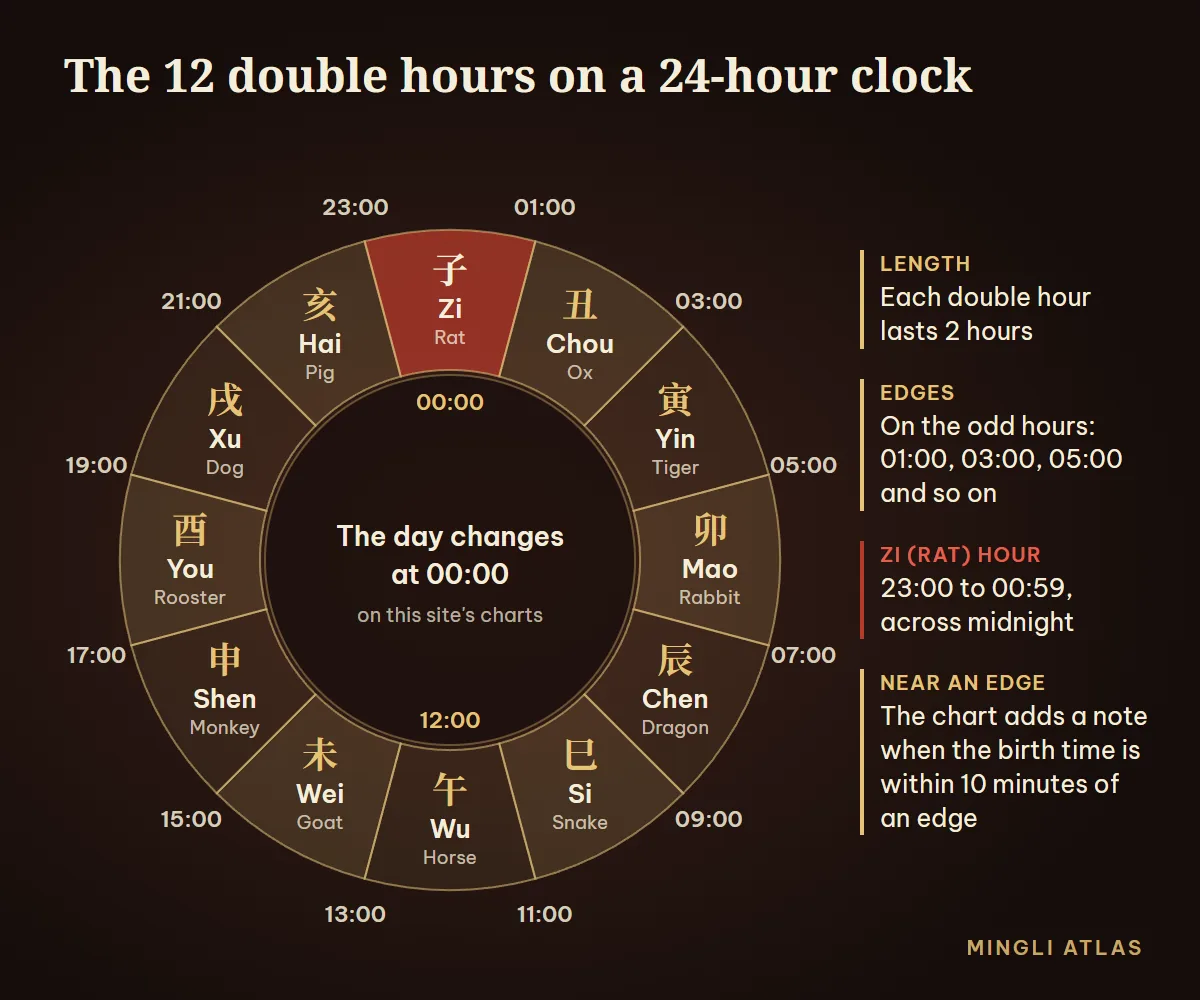
Each double hour lasts two hours and changes on an odd hour. When the time used for the chart is less than 10 minutes from an edge, the chart adds a note suggesting you also look at the neighbouring hour, because a record that is a few minutes off can change the hour pillar and, in Zi Wei, the Life palace. For example, a birth in Hanoi at 13:05 on 14 February 2026 falls in the Wei 未 (Goat) hour by the clock, but true solar time is 12:54, the Wu 午 (Horse) hour.
An unknown birth time
On the BaZi chart, tick I don’t know my birth time (three pillars only). You get the year, month and day pillars, and anything that depends on the hour pillar is left out rather than guessed. Your Day Master, the stem of the day pillar, is still there, so most of the character picture can be read. Zi Wei Dou Shu needs the birth hour to place the Life and Body palaces, so the Zi Wei chart asks for an exact time. Before you leave the hour out, ask whether the time was written down anywhere else, such as a hospital record or a family note; a time someone remembers only roughly, like early morning, can still tell you which charts to compare.
The 12 double hours on a 24-hour clock
The day is split into 12 double hours of two hours each, named after the 12 earthly branches. The Zi (Rat) hour starts at 23:00 and runs past midnight to 00:59; each of the others starts on an odd hour.
| Double hour | Branch | Clock time |
|---|---|---|
| Zi (Rat) | 子 | 23:00 to 00:59 |
| Chou (Ox) | 丑 | 01:00 to 02:59 |
| Yin (Tiger) | 寅 | 03:00 to 04:59 |
| Mao (Rabbit) | 卯 | 05:00 to 06:59 |
| Chen (Dragon) | 辰 | 07:00 to 08:59 |
| Si (Snake) | 巳 | 09:00 to 10:59 |
| Wu (Horse) | 午 | 11:00 to 12:59 |
| Wei (Goat) | 未 | 13:00 to 14:59 |
| Shen (Monkey) | 申 | 15:00 to 16:59 |
| You (Rooster) | 酉 | 17:00 to 18:59 |
| Xu (Dog) | 戌 | 19:00 to 20:59 |
| Hai (Pig) | 亥 | 21:00 to 22:59 |
How far true solar time drifts from the clock
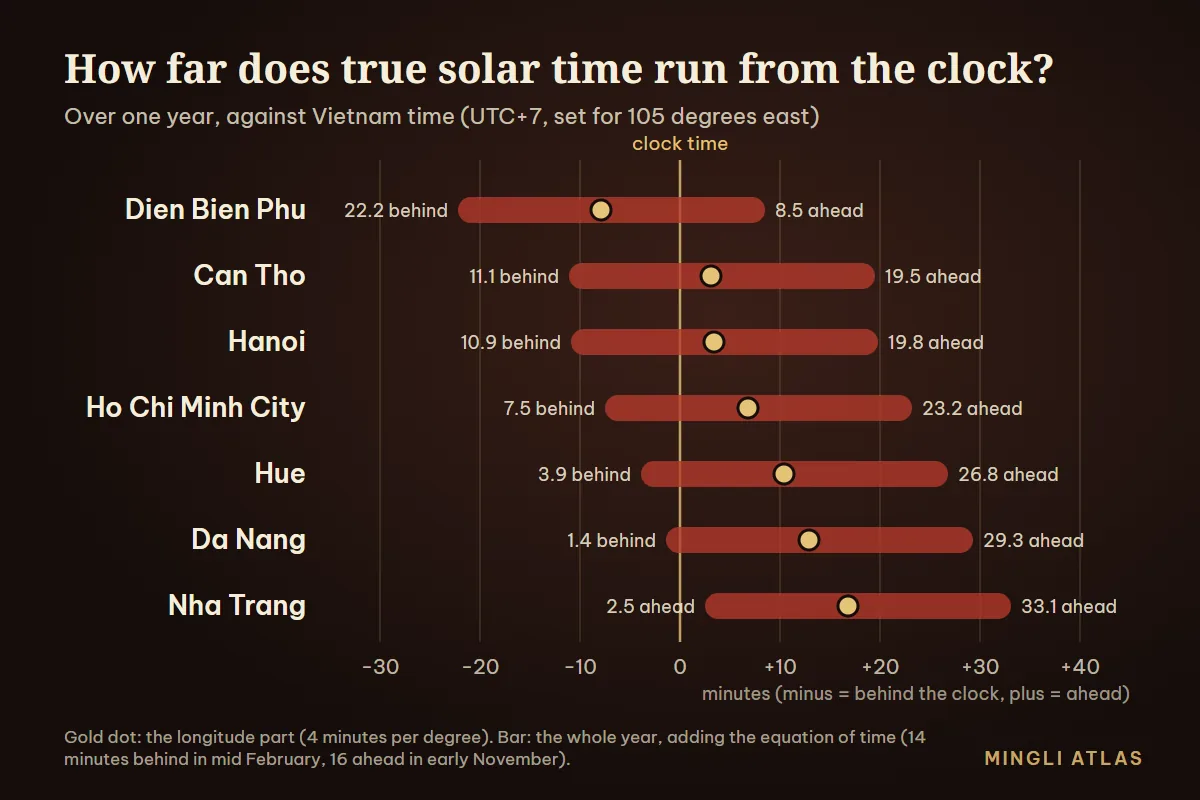
From a few minutes to over an hour, depending on where and when you were born. The gap has two parts. The first is longitude: the Earth turns one degree every 4 minutes, and each time zone is set for one meridian. Vietnam’s UTC+7 is set for 105 degrees east; Hanoi lies at about 105.85 degrees east, so (105.85 minus 105) x 4 = 3.4 minutes, and when the clock shows 12:00 the sun in Hanoi already reads about 12:03. The second part is the equation of time, caused by the Earth’s elliptical orbit and tilted axis: sun time runs up to about 14 minutes behind in mid February and up to about 16 minutes ahead in early November.
| City | Longitude | From longitude | Over a year |
|---|---|---|---|
| Dien Bien Phu | 103.02 E | 7.9 min behind | 22.2 min behind to 8.5 min ahead |
| Hanoi | 105.85 E | 3.4 min ahead | 10.9 min behind to 19.8 min ahead |
| Ho Chi Minh City | 106.7 E | 6.8 min ahead | 7.5 min behind to 23.2 min ahead |
| Hue | 107.6 E | 10.4 min ahead | 3.9 min behind to 26.8 min ahead |
| Nha Trang | 109.19 E | 16.8 min ahead | 2.5 to 33.1 min ahead |
| London | 0.13 W | 0.5 min behind | 14.8 min behind to 15.9 min ahead |
| New York | 74.0 W | 4.0 min ahead | 10.3 min behind to 20.4 min ahead |
| Beijing | 116.4 E | 14.4 min behind | 28.7 min behind to 2.0 min ahead |
| Madrid | 3.7 W | 74.8 min behind | 89.1 to 58.4 min behind |
These figures use the same formula the chart applies when true solar time is on (an approximation of the equation of time, accurate to about half a minute), measured against standard time. Hanoi, Hue and Ho Chi Minh City use the longitudes the chart form suggests, the other Vietnamese cities use approximate city-centre longitudes, and the cities abroad use the longitudes the form prefills for their time zones. The longitude box is prefilled with the main city of the zone you choose, so correct it if you were born elsewhere.
True solar time is optional and off by default. Some teachers use clock time and some use true solar time; the chart lets you choose and always says which one it used.
Born between 23:00 and midnight
The chart on this site changes the day at midnight. Some schools treat the start of the Zi hour at 23:00 as the start of the next day, so a birth at 23:30 takes the next day’s pillar. Here, from 23:00 to 24:00 the day pillar stays on the calendar day, while the hour pillar is the Zi hour with the stem of the following day. A birth at 23:30 on 10 January 2000 gets a Ding Mao (丁卯) day and a Ren Zi (壬子) hour, the same hour pillar as 00:30 the next morning. Under the 23:00 rule the day pillar would be Wu Chen (戊辰), which means a different Day Master, so this is the first thing to check when two charts for the same birth disagree.
Cast the chart and compare
Once you are sure of the time, calculate your BaZi chart from your birth time or calculate your Zi Wei chart with its 12 palaces. Each chart lists the notes about the time it used: summer time removed, true solar time if you switched it on, and a warning when the birth time sits near an edge. The full set of rules, including the solar terms, the Zi hour and time zones, is on the page how Mingli Atlas calculates and reads your chart.
A chart is a frame for reflecting on yourself, not a certain prediction. If the charts for two neighbouring hours read differently, read both and keep what rings true for you.
Keep reading
From reading to your chart
See your own chart
Free BaZi and Zi Wei charts, read against the classical texts, with no email needed.