How to Find Your Zi Wei Five Element Bureau
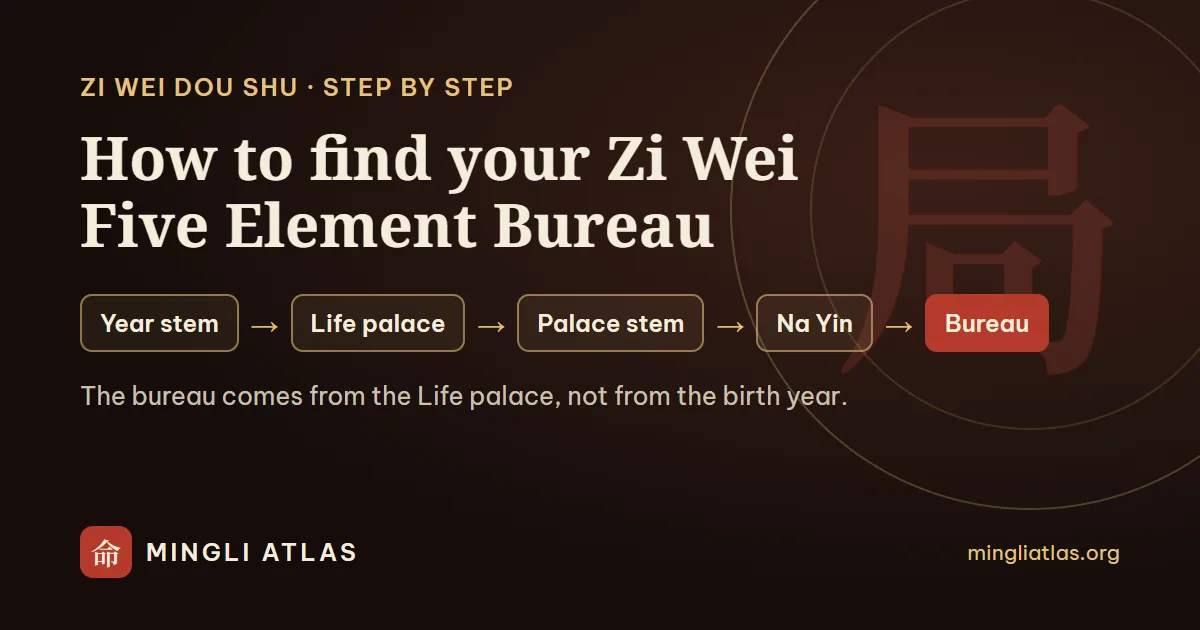
Your Zi Wei Five Element Bureau (五行局) comes from the stem and branch of your Life palace (命宮), not from your birth year. There are five steps: find the stem of your lunar birth year, place the Life palace, give the Life palace its stem, read the Na Yin (納音) element of that stem and branch, and turn that element into a bureau. The answer is always one of five: Water 2, Wood 3, Metal 4, Earth 5 or Fire 6.
This guide walks through each step by hand, gives a lookup table for all 60 cases and works one full example. If you first want to know what the bureau is and why the chart needs it, read what the Five Element Bureau is and what it does.
What you need before you start
You need three facts: your lunar birth year, your lunar birth month and your birth hour as one of the twelve double hours. The lunar birth day is not needed for the bureau itself, but you will need it straight after, to place the Zi Wei star. The birth hour matters most: one double hour off can move the Life palace, and a different Life palace can mean a different bureau.
| Double hour | Clock time | Double hour | Clock time |
|---|---|---|---|
| Zi 子 | 23:00 to 01:00 | Wu 午 | 11:00 to 13:00 |
| Chou 丑 | 01:00 to 03:00 | Wei 未 | 13:00 to 15:00 |
| Yin 寅 | 03:00 to 05:00 | Shen 申 | 15:00 to 17:00 |
| Mao 卯 | 05:00 to 07:00 | You 酉 | 17:00 to 19:00 |
| Chen 辰 | 07:00 to 09:00 | Xu 戌 | 19:00 to 21:00 |
| Si 巳 | 09:00 to 11:00 | Hai 亥 | 21:00 to 23:00 |
Step 1: Find the stem of your lunar birth year
The year stem follows the last digit of the lunar year: 4 is Jia 甲, 5 is Yi 乙, 6 is Bing 丙, 7 is Ding 丁, 8 is Wu 戊, 9 is Ji 己, 0 is Geng 庚, 1 is Xin 辛, 2 is Ren 壬 and 3 is Gui 癸. So 1995 ends in 5 and is a Yi year (Yi Hai 乙亥).
The Zi Wei year turns at the Lunar New Year, not at the solar term Lichun used in BaZi. Someone born on 20 January 1996 still belongs to the Yi Hai year, because the Lunar New Year fell on 19 February 1996 that year.
Step 2: Place the Life palace from your birth month and hour
On the board of twelve palaces, treat the Yin 寅 palace as the first lunar month and count forwards to your birth month. From the palace where you stop, call it the Zi hour and count backwards to your birth hour; the palace where you land is the Life palace. The full rule, with the line from the Quanshu, is on the page about how the Life palace is placed.
For example, the 7th month and the Si hour: counting from Yin to the 7th month reaches Shen 申. Calling Shen the Zi hour, count backwards Shen (Zi), Wei (Chou), Wu (Yin), Si (Mao), Chen (Chen), Mao (Si). The Life palace is at Mao 卯.
Leap months are handled differently by different chart makers. The charts on Mingli Atlas count the first half of a leap month (up to day 15) as the previous month and day 16 onwards as the next month. If you were born in a leap month, check this before comparing charts from two places.
Step 3: Give the Life palace its stem
Every palace carries a heavenly stem, and the stem of the Yin palace sets the whole ring. The Quanshu gives the rule in its section on starting the Five Elements at Yin:
甲己之歲起丙寅,乙庚之歲起戊寅,丙辛之歲起庚寅,丁壬之歲起壬寅,戊癸之歲起甲寅。
Ziwei Doushu Quanshu (紫微斗數全書), vol. 2, Starting the Five Elements at Yin
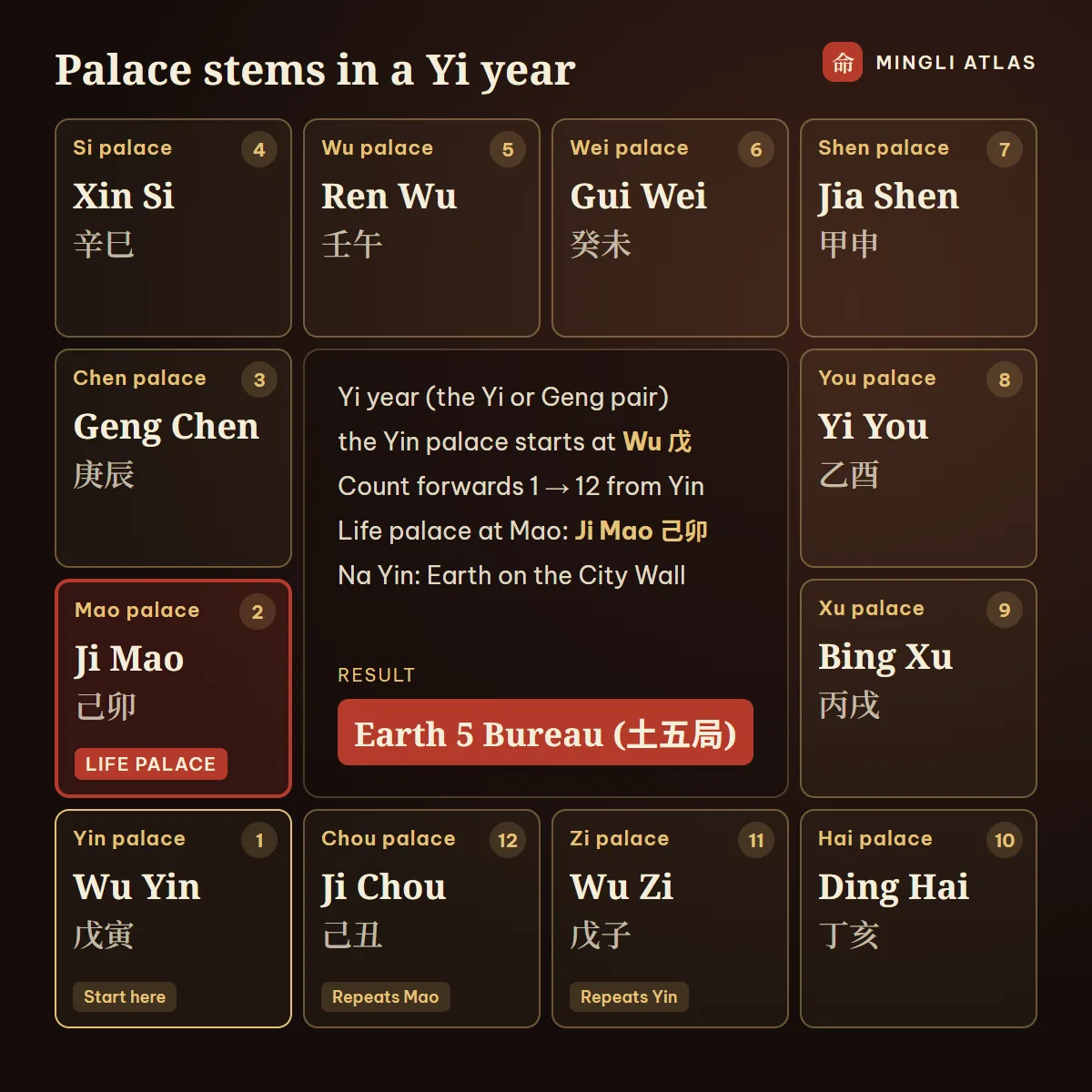
In plain words: in Jia or Ji years the Yin palace takes Bing; in Yi or Geng years, Wu; in Bing or Xin years, Geng; in Ding or Ren years, Ren; in Wu or Gui years, Jia. From the Yin palace, count the ten stems forwards (Jia, Yi, Bing, Ding, Wu, Ji, Geng, Xin, Ren, Gui) through Mao, Chen, Si and on until you reach the Life palace.
There are twelve palaces but only ten stems, so the last two palaces of the ring, Zi and Chou, repeat the stems of Yin and Mao. In a Yi year, for instance, Yin is Wu Yin 戊寅, Mao is Ji Mao 己卯, Zi is Wu Zi 戊子 and Chou is Ji Chou 己丑.
Step 4: Read the Na Yin of the Life palace stem and branch
Each stem and branch pair has a Na Yin name, and two neighbouring pairs share one name: Bing Yin and Ding Mao are both Fire in the Furnace (爐中火). The last character of the name is the element: Fire in the Furnace is Fire, Earth on the City Wall (城頭土) is Earth. You can look up all sixty pairs in the Na Yin table of the sixty stem and branch pairs.
This is the Na Yin of the Life palace. The Na Yin of your birth year, the one people mean when they say “I was born a Fire year”, is a different thing and is not used for the bureau.
Step 5: Turn the Na Yin element into a bureau
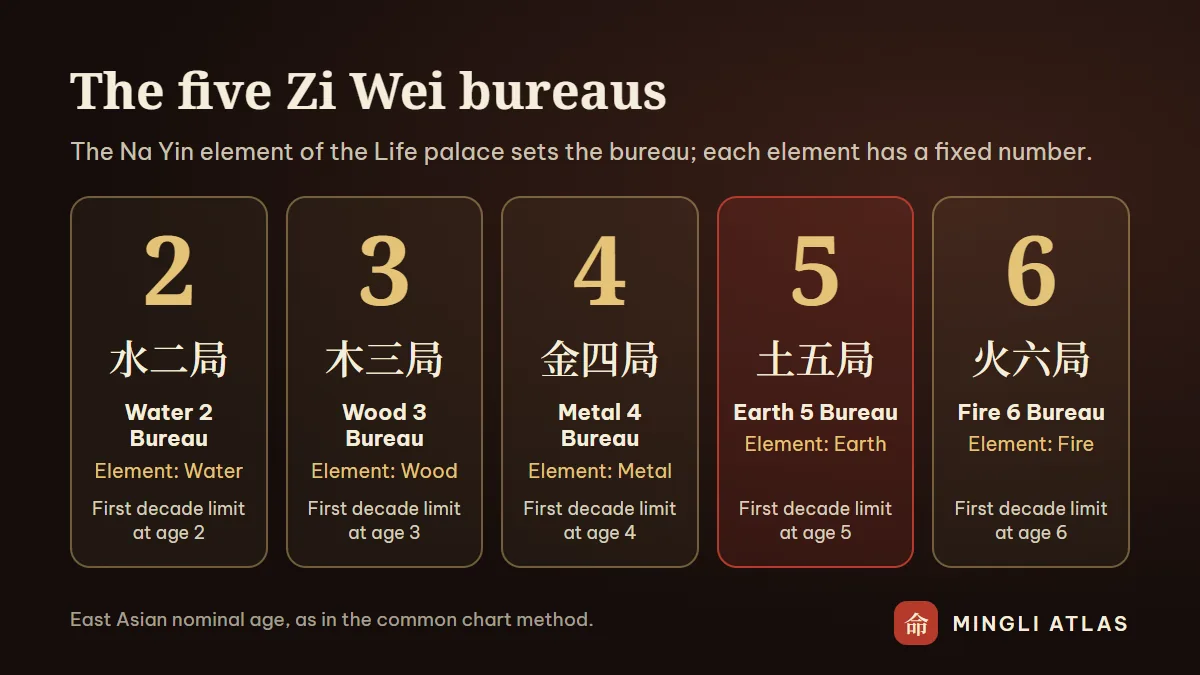
The Na Yin element of the Life palace is the element of the bureau, and each element has a fixed number that does not follow the producing cycle.
| Na Yin element of the Life palace | Five Element Bureau | Number | First decade limit starts |
|---|---|---|---|
| Water | Water 2 Bureau (水二局) | 2 | Age 2 |
| Wood | Wood 3 Bureau (木三局) | 3 | Age 3 |
| Metal | Metal 4 Bureau (金四局) | 4 | Age 4 |
| Earth | Earth 5 Bureau (土五局) | 5 | Age 5 |
| Fire | Fire 6 Bureau (火六局) | 6 | Age 6 |
Ages in the last column are East Asian nominal ages (虛歲), where you count 1 at birth and add a year at each Lunar New Year. Starting the first decade limit at the bureau number is the convention of the common chart method and of the charts on Mingli Atlas.
Lookup table: bureau by year stem and Life palace
If you already know which branch your Life palace sits in, you can skip steps 3 to 5 and read the answer below. Each cell gives the bureau and, in brackets, the stem and branch of the Life palace. All 60 cells were checked against the Zi Wei charts calculated on Mingli Atlas.
| Life palace in | Jia 甲 or Ji 己 year | Yi 乙 or Geng 庚 year | Bing 丙 or Xin 辛 year | Ding 丁 or Ren 壬 year | Wu 戊 or Gui 癸 year |
|---|---|---|---|---|---|
| Yin 寅 | Fire 6 (丙寅) | Earth 5 (戊寅) | Wood 3 (庚寅) | Metal 4 (壬寅) | Water 2 (甲寅) |
| Mao 卯 | Fire 6 (丁卯) | Earth 5 (己卯) | Wood 3 (辛卯) | Metal 4 (癸卯) | Water 2 (乙卯) |
| Chen 辰 | Wood 3 (戊辰) | Metal 4 (庚辰) | Water 2 (壬辰) | Fire 6 (甲辰) | Earth 5 (丙辰) |
| Si 巳 | Wood 3 (己巳) | Metal 4 (辛巳) | Water 2 (癸巳) | Fire 6 (乙巳) | Earth 5 (丁巳) |
| Wu 午 | Earth 5 (庚午) | Wood 3 (壬午) | Metal 4 (甲午) | Water 2 (丙午) | Fire 6 (戊午) |
| Wei 未 | Earth 5 (辛未) | Wood 3 (癸未) | Metal 4 (乙未) | Water 2 (丁未) | Fire 6 (己未) |
| Shen 申 | Metal 4 (壬申) | Water 2 (甲申) | Fire 6 (丙申) | Earth 5 (戊申) | Wood 3 (庚申) |
| You 酉 | Metal 4 (癸酉) | Water 2 (乙酉) | Fire 6 (丁酉) | Earth 5 (己酉) | Wood 3 (辛酉) |
| Xu 戌 | Fire 6 (甲戌) | Earth 5 (丙戌) | Wood 3 (戊戌) | Metal 4 (庚戌) | Water 2 (壬戌) |
| Hai 亥 | Fire 6 (乙亥) | Earth 5 (丁亥) | Wood 3 (己亥) | Metal 4 (辛亥) | Water 2 (癸亥) |
| Zi 子 | Water 2 (丙子) | Fire 6 (戊子) | Earth 5 (庚子) | Wood 3 (壬子) | Metal 4 (甲子) |
| Chou 丑 | Water 2 (丁丑) | Fire 6 (己丑) | Earth 5 (辛丑) | Wood 3 (癸丑) | Metal 4 (乙丑) |
One thing the table makes plain: every column contains all five bureaus. Your birth year alone cannot tell you your bureau; you need to know where your Life palace is.
Worked example: a made-up chart
The person in this example is made up and belongs to no real person: a man born at 9:30 in the morning on 14 August 1995 in Hanoi.
- Convert to the lunar calendar: the 19th day of the 7th month of the Yi Hai year, in the Si double hour (9:30 falls between 09:00 and 11:00).
- Year stem: Yi, in the Yi or Geng pair, so the Yin palace takes the stem Wu 戊.
- Life palace: the 7th month lands on Shen; counting backwards from Shen to the Si hour reaches Mao.
- Life palace stem: Wu Yin, then Ji Mao. The Life palace is Ji Mao 己卯.
- Na Yin: Ji Mao is Earth on the City Wall (城頭土), element Earth.
- Bureau: Earth 5 Bureau (土五局), number 5.
The Zi Wei chart on Mingli Atlas, calculated for this exact birth, gives the same Ji Mao Life palace and the Earth 5 Bureau. For the same person, the birth-year Na Yin is Fire on the Mountain Top (山頭火), from the Yi Hai year, and the BaZi Day Master is Ding 丁 Fire; neither of them is the bureau.
What the bureau number is used for
Placing the Zi Wei star
The bureau number and the lunar birth day decide which palace holds the Zi Wei star. Find the smallest number that, added to the birth day, makes the total divisible by the bureau number; the quotient counts palaces from Yin, with Yin as 1; if the added number is even, move forwards by that much, and if it is odd, move back. In the example, day 19 and bureau 5: add 1 to make 20, divide by 5 to get 4, count Yin, Mao, Chen, Si; the added 1 is odd, so move back to Chen. This chart’s Zi Wei star sits in the Chen palace.
Timing the first decade limit
The first decade limit sits in the Life palace and begins at the nominal age equal to the bureau number. The man in the example has his first decade limit from age 5 to 14; as a yin man (a Yi year), his second limit moves backwards to the Siblings palace, ages 15 to 24. Direction and the classical variants are explained on the page about how decade limits work in Zi Wei.
Common mistakes when finding the bureau
- Using the birth-year Na Yin instead of the Life palace. A Yi Hai year has the Na Yin Fire on the Mountain Top, but the bureau depends on the Life palace and can be any of the five.
- Changing the year at Lichun. Zi Wei changes year at the Lunar New Year. Births between Lichun and the Lunar New Year are easy to give the wrong year stem, which then gives the Yin palace the wrong stem.
- Forgetting that Zi and Chou repeat. Counting stems straight round all twelve palaces, without repeating the Yin and Mao stems at Zi and Chou, gives the wrong stem in those two palaces.
- Mixing up the numbers. Water is 2, not 1, and Fire is 6. The numbers do not follow the order Metal, Water, Wood, Fire, Earth.
- A wrong birth hour. A rounded birth time, or confusion between summer time and standard time, can push you into the next double hour and move the Life palace.
Check your answer with the chart tool
The quickest check is to calculate your free Zi Wei chart with the same birth details and compare its Life palace stem and branch and its bureau with your hand calculation. If they differ, look again at the birth hour and the lunar year first, because those are the two most common slips. The bureau is a technical step for building the chart; a reading should look at the whole chart rather than stop at the name of the bureau.
Keep reading
From reading to your chart
See your own chart
Free BaZi and Zi Wei charts, read against the classical texts, with no email needed.