Autumn Equinox 2027 (Qiufen): Date, Pentads, Habits
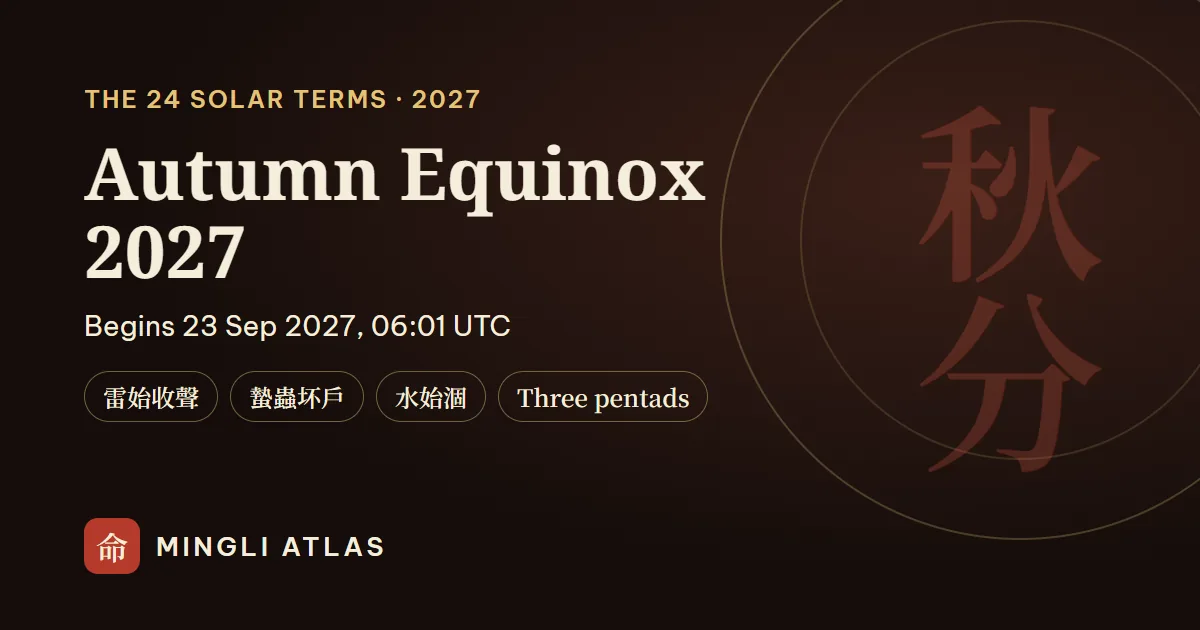
The Autumn Equinox (秋分, Qiufen) begins on Thursday 23 September 2027 at 06:01 UTC (14:01 in Beijing, 13:01 in Vietnam, 07:01 in London, 02:01 in New York) and lasts until Cold Dew on 8 October. In the Chinese calendar it is the fourth solar term of autumn and the midpoint of the season; astronomically it is the September equinox, when the sun crosses the celestial equator. It is a midpoint term (中氣), so the BaZi month does not change: the whole term sits inside the Ji You month. This guide gives the 2027 pentad dates, the classical lines on day and night dividing, and three habits for the balance point of the year.
When is the Autumn Equinox 2027?
The Autumn Equinox 2027 begins on 23 September at 06:01 UTC, when the sun reaches 180° of ecliptic longitude. The moment falls on a Yi Si (乙巳) day, in a Ji You (己酉) month of a Ding Wei (丁未) year. The term lasts fifteen days, until Cold Dew (寒露) begins on 8 October at 12:17 UTC.
| Milestone | UTC | Beijing (UTC+8) |
|---|---|---|
| White Dew (previous term) | 7 Sep 2027, 20:28 | 8 Sep, 04:28 |
| Autumn Equinox | 23 Sep 2027, 06:01 | 23 Sep, 14:01 |
| Cold Dew (next term) | 8 Oct 2027, 12:17 | 8 Oct, 20:17 |
The time comes from the same calendar function that drives the Mingli Atlas chart tools, and it is the astronomical equinox itself. On the US West Coast (UTC-7) the moment is still 23:01 on 22 September, so American calendars for the Pacific time zone list the equinox on the 22nd.
The three pentads of the Autumn Equinox 2027
Each solar term splits into three pentads (候) of about five days. In 2027, counted by Vietnam calendar days, they fall as follows.
| Pentad | Dates (2027) | Chinese | Meaning |
|---|---|---|---|
| First | 23 to 27 September | 雷始收聲 | Thunder falls silent |
| Second | 28 September to 2 October | 蟄蟲坏戶 | Insects seal their burrows |
| Third | 3 to 7 October | 水始涸 | Waters begin to dry up |
The pentads describe yang withdrawing: thunder stops, insects bank up the entrances of their burrows, rivers and ponds start to drop. The 坏 of the second pentad is read as 培 (“bank up”) according to the Jijie, and the Yi Zhou Shu writes it that way (蟄蟲培户).
What do the classical texts say about the Autumn Equinox?
「秋分,八月中。解見春分。」
Yueling Qishier Hou Jijie (月令七十二候集解), section 秋分
In plain words: the Autumn Equinox is the midpoint of the eighth month; for the explanation, see the Spring Equinox. There, “fen” (分) means to divide in half: the term falls at the middle of the season, and day and night are divided equally. The “eighth month” is the You (酉) month of the solar calendar.
The Book of Rites describes the month in more detail:
「是月也,日夜分,雷始收聲,蟄蟲坏户……陽氣日衰,水始涸。」
Book of Rites, Monthly Ordinances (禮記·月令), 仲秋之月
This month day and night are equal, thunder falls silent and insects seal their burrows; yang qi weakens day by day and the waters begin to dry up. “Yang weakens day by day” is the key phrase: from the equinox, nights in the northern hemisphere are longer than days until the winter solstice.
What should you do during the Autumn Equinox?
The Huangdi Neijing gives its advice for the whole of autumn:
「早臥早起,與雞俱興,使志安寧,以緩秋刑,收斂神氣,使秋氣平,無外其志,使肺氣清」
Huangdi Neijing, Suwen (素問), chapter 四氣調神大論
Go to bed early and rise early, with the rooster; keep the mind calm to soften autumn’s harshness; gather your spirit in rather than letting it scatter; keep the breath of the lungs clear. The equinox is the balance point of the season, so all three habits are about balance:
- Set a fixed time to stop working. “Keep the autumn qi level” (使秋氣平) suggests an even rhythm. Choose one hour as your daily cut off and hold it for the fifteen days, so the evening is really yours.
- Turn off notifications you do not need. The first pentad is thunder falling silent (雷始收聲). Go through your apps and mute everything that does not need an answer within the hour.
- Watch one sunrise or sunset. The texts say “day and night divide” (日夜分). Around 23 September the sun rises almost due east and sets almost due west everywhere on Earth; note where it meets your horizon and compare it at the winter solstice.
These are lifestyle readings of a classical text, not medical advice. Never look straight at the sun; if you have an eye condition, a sleep disorder or a chronic illness, follow your doctor.
Are day and night really equal at the equinox?
Almost, but not quite. On the equinox itself the day is still a few minutes longer than the night, because the atmosphere bends sunlight over the horizon and because sunrise is counted from the first edge of the sun, not its centre. The day of truly equal light and dark comes a few days later, depending on latitude; near the equator it barely happens at all.
The hemisphere matters too. In the Southern Hemisphere this is the spring equinox, and the Chinese name “autumn divides” describes only the north. The instant is the same everywhere on Earth.
Does the Autumn Equinox change the month pillar in BaZi?
No. The Autumn Equinox is a midpoint term (中氣), so it sits inside the You month. Everyone born from White Dew (7 September 2027, 20:28 UTC) up to Cold Dew (8 October 2027, 12:17 UTC) has the month pillar Ji You (己酉).
The boundary to watch is Cold Dew: from 12:17 UTC on 8 October 2027 the month pillar becomes Geng Xu (庚戌). If a birth falls near that moment, enter the exact hour and minute in the BaZi chart calculator, which converts your local time zone for you.
Follow the Autumn Equinox day by day
The Today page shows the solar term, pentad and day pillar of each day, and sets the day beside your own chart if you have made one. For the term itself, read what the Autumn Equinox is in the solar terms section. The previous term is White Dew 2027; the next is Cold Dew 2027.
Keep reading
From reading to your chart
See your own chart
Free BaZi and Zi Wei charts, read against the classical texts, with no email needed.