Start of Autumn 2027 (Liqiu): Date, Pentads, BaZi Month
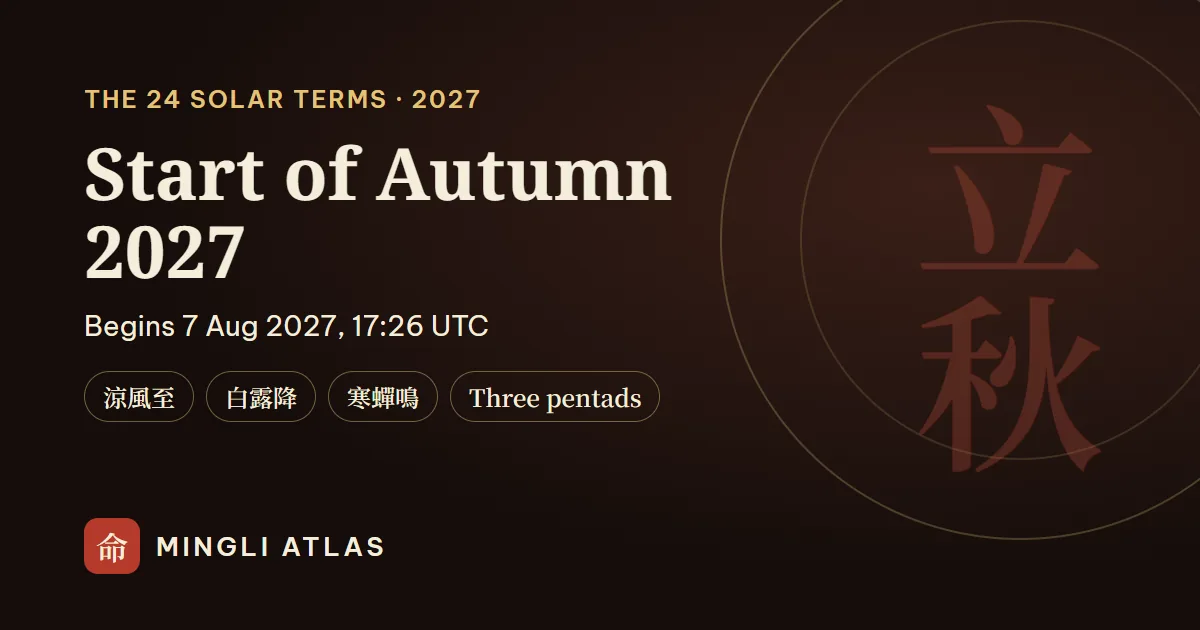
Start of Autumn (立秋, Liqiu), the first solar term of autumn in the Chinese calendar, begins on Saturday 7 August 2027 at 17:26 UTC (01:26 on Sunday 8 August in Beijing, 00:26 in Vietnam) and lasts until End of Heat on 23 August. Because the moment falls just after midnight in East Asia, Chinese calendars list it on 8 August while calendars in Europe and the Americas list 7 August; both are right. It is a sectional term (節), so at that minute the BaZi month pillar changes from Ding Wei to Wu Shen. This guide gives the pentad dates for 2027, what the classical texts say, and three habits for the hot end of the northern summer.
When is Start of Autumn 2027?
Start of Autumn 2027 begins on 7 August at 17:26 UTC, when the sun reaches 135° of ecliptic longitude. In London that is 18:26 and in New York 13:26, both still on Saturday 7 August. The moment falls on a Ji Wei (己未) day, in a Wu Shen (戊申) month of a Ding Wei (丁未) year. The term lasts fifteen days, until End of Heat (處暑) begins on 23 August at 08:14 UTC.
| Milestone | UTC | Beijing (UTC+8) |
|---|---|---|
| Major Heat (previous term) | 23 Jul 2027, 01:04 | 23 Jul, 09:04 |
| Start of Autumn | 7 Aug 2027, 17:26 | 8 Aug, 01:26 |
| End of Heat (next term) | 23 Aug 2027, 08:14 | 23 Aug, 16:14 |
The time comes from the same calendar function that drives the Mingli Atlas chart tools. Many calendars give only a date, which is why you will see both 7 and 8 August quoted for 2027: the date depends on the time zone, the instant does not.
The three pentads of Start of Autumn 2027
Each solar term splits into three pentads (候) of about five days. In 2027, counted by Vietnam calendar days, they fall as follows.
| Pentad | Dates (2027) | Chinese | Meaning |
|---|---|---|---|
| First | 8 to 12 August | 涼風至 | Cool winds arrive |
| Second | 13 to 17 August | 白露降 | White dew descends |
| Third | 18 to 22 August | 寒蟬鳴 | Autumn cicadas sing |
The pentads record the first signs of the turn in the Yellow River basin: a cooler wind, dew at night, a different cicada song. In most of the world mid August is still hot, so read them as seasonal markers rather than a forecast.
What do the classical texts say about Start of Autumn?
The classical calendar explains the word “autumn” itself as gathering in: from this term on, living things begin to draw together after the growth of summer.
「立秋,七月節。……秋,揫也。物于此而揫斂也。」
Yueling Qishier Hou Jijie (月令七十二候集解), section 立秋
In plain words: Start of Autumn is the sectional term of the seventh month. “Qiu” (autumn) is glossed as “gather in”: here all things begin to draw together. The “seventh month” is the Shen (申) month of the solar calendar, not the seventh lunar month; the ellipsis marks a passage left out.
The Book of Rites shows that the term was once a court ceremony:
「是月也,以立秋。先立秋三日,大史謁之天子曰:「某日立秋,盛德在金。」天子乃齊。」
Book of Rites, Monthly Ordinances (禮記·月令), 孟秋之月
This month holds Start of Autumn. Three days before it the Grand Historian tells the Son of Heaven, “On such a day autumn begins; the flourishing virtue is in Metal.” The Son of Heaven then fasts. Autumn belongs to the Metal phase, and the season was prepared for in advance rather than met on the day.
What should you do during Start of Autumn?
The Huangdi Neijing gives one passage for all three months of autumn:
「早臥早起,與雞俱興,使志安寧,以緩秋刑,收斂神氣,使秋氣平,無外其志,使肺氣清」
Huangdi Neijing, Suwen (素問), chapter 四氣調神大論
Go to bed early and rise early, with the rooster; keep the mind calm to soften autumn’s harshness; gather your spirit in rather than letting it scatter; keep the breath of the lungs clear. Since early August is still hot in the northern hemisphere, three habits pick the parts you can use now:
- Move your exercise to the early morning. “Rise with the rooster” (與雞俱興) fits the hottest weeks well: the hour after sunrise is usually the coolest of the day, so walk or train then and skip the midday heat.
- Cross three things off your list before October. The classical gloss says that here “all things draw together” (物于此而揫斂也). Go through what you have committed to for the rest of the quarter and drop or postpone three items that are not essential.
- Sleep on any reply that annoys you. “Keep the mind calm” (使志安寧) is hardest in sticky late summer weather. Draft the message, read it again the next morning, and only then send it.
These are lifestyle readings of a classical text, not medical advice. If you have a heart or blood pressure condition or are being treated for a chronic illness, ask your doctor before changing when or how hard you exercise.
Why is it still summer at Start of Autumn?
Because the solar terms mark positions of the sun, not temperatures. In the traditional reckoning each season begins about six weeks before its astronomical midpoint, so Start of Autumn opens the season halfway between the June solstice and the September equinox, while the heat is still at its peak in much of the northern hemisphere.
In the Southern Hemisphere early August is late winter. The term still begins at the same instant everywhere on Earth; only its seasonal name fits the north.
Start of Autumn changes the BaZi month from Ding Wei to Wu Shen
At 17:26 UTC on 7 August 2027 the month pillar changes from Ding Wei (丁未) to Wu Shen (戊申). Someone born in London on the evening of 7 August after 18:26 already has the Wu Shen month; someone born in Vietnam in the first 26 minutes of 8 August still has Ding Wei.
There is a quirk this year: 2027 is a Ding Wei year, and the month before Start of Autumn is also a Ding Wei month, so charts for births just before the boundary show the same year and month pillar. From 17:26 UTC they no longer match. Enter the exact hour and minute in the BaZi chart calculator, which converts your local time zone for you.
Follow Start of Autumn day by day
The Today page shows the solar term, pentad and day pillar of each day, and sets the day beside your own chart if you have made one. For the term itself, read what Start of Autumn is in the solar terms section. The previous term is Major Heat 2027; the next is End of Heat 2027.
Keep reading
From reading to your chart
See your own chart
Free BaZi and Zi Wei charts, read against the classical texts, with no email needed.