Frost’s Descent 2026: Date, Pentads and What to Do
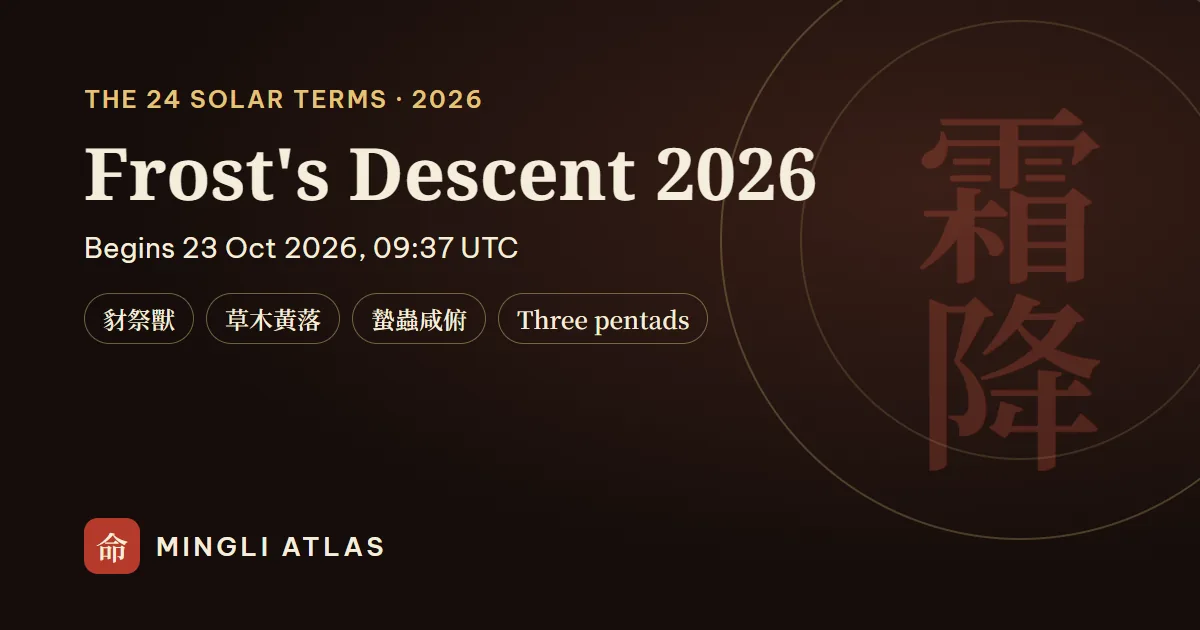
Frost’s Descent (霜降, Shuangjiang), the last solar term of autumn in the Chinese calendar, begins on Friday 23 October 2026 at 09:37 UTC (17:37 in Beijing, 16:37 in Vietnam) and lasts until Start of Winter on 7 November. This guide gives the exact dates of its three pentads in 2026, what the classical texts say about the season, and three small things you can do during these fifteen days.
When does Frost’s Descent 2026 begin and end?
Frost’s Descent 2026 begins on 23 October at 09:37 UTC, when the sun reaches 210° of ecliptic longitude. It ends fifteen days later, on 7 November at 09:52 UTC, when Start of Winter (立冬) begins.
Calendars disagree by a day or an hour because they report the moment in different time zones. In New York (UTC-4 on that date) the term starts at 05:37 on 23 October; in London at 10:37. The time here comes from the same calendar function that drives the Mingli Atlas chart tools.
| Milestone | UTC | Beijing (UTC+8) |
|---|---|---|
| Cold Dew (previous term) | 8 Oct 2026, 06:29 | 8 Oct, 14:29 |
| Frost’s Descent | 23 Oct 2026, 09:37 | 23 Oct, 17:37 |
| Start of Winter (next term) | 7 Nov 2026, 09:52 | 7 Nov, 17:52 |
What are the three pentads of Frost’s Descent in 2026?
Each solar term is split into three pentads (候) of about five days, each named after a sign of the season observed in the Yellow River basin. In 2026, counted by Vietnam calendar days, they fall as follows.
| Pentad | Dates (2026) | Chinese | Meaning |
|---|---|---|---|
| First | 23 to 27 October | 豺祭獸 | Jackals lay out their prey |
| Second | 28 October to 1 November | 草木黃落 | Leaves yellow and fall |
| Third | 2 to 6 November | 蟄蟲咸俯 | Insects lie still in hibernation |
The pentads are seasonal markers, not weather forecasts for where you live: animals store food, leaves drop, insects go to ground.
What do the classical texts say about Frost’s Descent?
The classical calendar describes Frost’s Descent as the point where autumn’s contraction is complete: moisture no longer settles as dew but freezes into frost.
「霜降,九月中。氣肅而凝露結為霜矣。」
Yueling Qishier Hou Jijie (月令七十二候集解), section 霜降
In plain words: Frost’s Descent is the midpoint of the ninth month; the air turns austere and the dew congeals into frost. The “ninth month” is the Xu (戌) month of the solar calendar, not the ninth lunar month.
The Book of Rites adds how people worked in this month:
「是月也,霜始降,則百工休。」
Book of Rites, Monthly Ordinances (禮記·月令), 季秋之月
This month frost first descends, and the hundred crafts rest from their work. Outdoor work for the year was being wrapped up.
What should you do during Frost’s Descent?
No classical text gives a to-do list for this one term. The closest guidance is the autumn passage of the Huangdi Neijing, read together with the Book of Rites line above.
「早臥早起,與雞俱興,使志安寧,以緩秋刑,收斂神氣,使秋氣平,無外其志,使肺氣清」
Huangdi Neijing, Suwen (素問), chapter 四氣調神大論
In plain words: go to bed early and rise early, with the rooster; keep the mind calm to soften autumn’s harshness; gather your spirit in rather than letting it scatter; keep the breath of the lungs clear. Three small practices follow from it:
- Go to bed thirty minutes earlier. “Early to bed, early to rise” is the clearest instruction in the passage. Switch screens off half an hour sooner for these fifteen days and notice how your sleep responds.
- Finish one open task before Start of Winter. Both “gather the spirit in” (收斂神氣) and “the crafts rest” (百工休) point to closing rather than opening. Pick one unfinished task and complete it before 7 November instead of starting something new.
- Take five slow minutes of breathing in the morning. The Neijing links autumn with the lungs (使肺氣清). Five minutes of slow, deep breathing in fresh air after you wake keeps that habit without any equipment.
These are lifestyle readings of a classical text, not medical advice. If you are being treated for a breathing or sleep condition, follow your doctor.
Does Frost’s Descent mean frost where you live?
Only if you live at a similar latitude and climate to northern China. The solar terms were named after the climate of the Yellow River basin, where the first frosts come around this time of year. In the lowland tropics there is no frost at all, and in the Southern Hemisphere late October is spring.
Read Frost’s Descent as a position of the sun rather than a weather event: the term starts at the same instant everywhere on Earth, and only its local name for the season fits northern China.
Does Frost’s Descent change the month pillar in BaZi?
No. Frost’s Descent is a midpoint term (中氣), so it sits inside the Xu month. Everyone born from Cold Dew (8 October 2026, 06:29 UTC) up to Start of Winter (7 November 2026, 09:52 UTC) has the month pillar Wu Xu (戊戌); the term begins on a Geng Wu (庚午) day in a Bing Wu (丙午) year.
The boundary to watch is Start of Winter: from 09:52 UTC on 7 November 2026 the month pillar becomes Ji Hai (己亥). If a birth falls near that moment, enter the exact hour and minute in the BaZi chart calculator, which converts your local time zone for you.
Follow Frost’s Descent day by day
The Today page shows the solar term, pentad and day pillar of each day, and sets the day beside your own chart if you have made one. For the term itself, read what Frost’s Descent is in the solar terms section. The previous term is Cold Dew; the next is Start of Winter 2026.
Keep reading
From reading to your chart
See your own chart
Free BaZi and Zi Wei charts, read against the classical texts, with no email needed.