Start of Winter 2026 (Lidong): Date, Pentads, What to Do
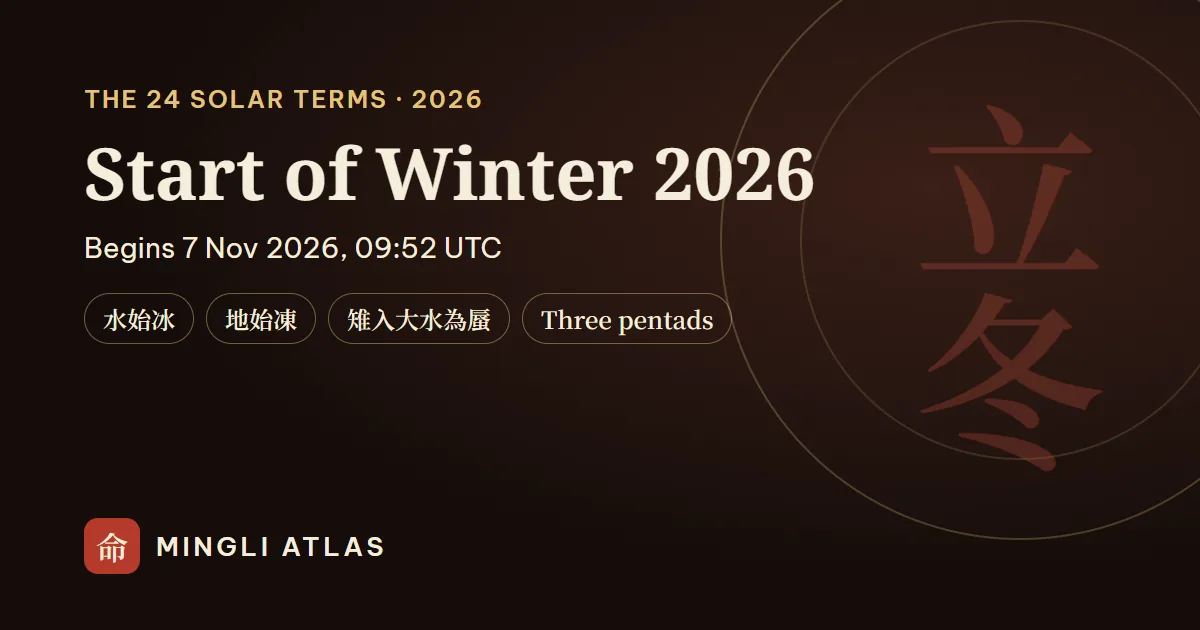
Start of Winter (立冬, Lidong), the first solar term of winter in the Chinese calendar, begins on Saturday 7 November 2026 at 09:52 UTC (17:52 in Beijing, 16:52 in Vietnam) and lasts until Minor Snow on 22 November. Unlike Frost’s Descent before it, Start of Winter is a sectional term (節), so it changes the month pillar of a BaZi chart. This guide gives the 2026 dates of its three pentads, explains why the term belongs to Water, and turns the classical winter advice into three practical habits.
When is Start of Winter 2026?
Start of Winter 2026 begins on 7 November at 09:52 UTC, when the sun reaches 225° of ecliptic longitude. In New York that is 04:52 on 7 November; in London 09:52. The moment falls on a Yi You (乙酉) day, in a Ji Hai (己亥) month of a Bing Wu (丙午) year. The term lasts fifteen days, until Minor Snow (小雪) begins on 22 November at 07:23 UTC.
| Milestone | UTC | Beijing (UTC+8) |
|---|---|---|
| Frost’s Descent (previous term) | 23 Oct 2026, 09:37 | 23 Oct, 17:37 |
| Start of Winter | 7 Nov 2026, 09:52 | 7 Nov, 17:52 |
| Minor Snow (next term) | 22 Nov 2026, 07:23 | 22 Nov, 15:23 |
Is 7 November really the first day of winter?
In the Chinese calendar, yes. Its seasons begin at the four “starts” (立春, 立夏, 立秋, 立冬), halfway between a solstice and an equinox, so winter begins in early November. Western astronomical winter begins at the December solstice instead, which the Chinese calendar treats as midwinter (冬至).
Neither is wrong: they divide the same solar year at different points. The Chinese reckoning follows the shortening of daylight, which is already steep by early November in the Northern Hemisphere.
The three pentads of Start of Winter 2026
Each solar term splits into three pentads (候) of about five days, each named after a sign of the season in the Yellow River basin. In 2026, counted by Vietnam calendar days, they fall as follows.
| Pentad | Dates (2026) | Chinese | Meaning |
|---|---|---|---|
| First | 7 to 11 November | 水始冰 | Water begins to freeze |
| Second | 12 to 16 November | 地始凍 | The ground begins to freeze |
| Third | 17 to 21 November | 雉入大水為蜃 | Pheasants enter the water and become giant clams |
The third pentad records an old belief: pheasants were scarce in early winter, and people said they had gone into the water and turned into giant clams (蜃). It is a seasonal marker, not biology.
Which element is Start of Winter?
Water. Winter belongs to Water, and the month that Start of Winter opens, the Hai (亥) month, is a Water branch. The Book of Rites records the court astronomer announcing the day to the ruler:
「是月也,以立冬。……「某日立冬,盛德在水。」天子乃齊。」
Book of Rites, Monthly Ordinances (禮記·月令), 孟冬之月
In plain words: this month holds Start of Winter. The Grand Historian announces, “On such a day winter begins; the flourishing virtue is in Water.” The Son of Heaven then fasts.
The classical commentary on the solar terms glosses the word for winter itself:
「立冬,十月節。……冬,終也,萬物收藏也。」
Yueling Qishier Hou Jijie (月令七十二候集解), section 立冬
Start of Winter is the sectional term of the tenth month; “winter” means “end”, when all things are gathered in and stored. The “tenth month” is the Hai month of the solar calendar, not the tenth lunar month.
What should you do at Start of Winter?
Classical winter advice turns on one idea: storing. The Huangdi Neijing opens its winter passage like this:
「冬三月,此謂閉藏。水冰地坼,無擾乎陽。」
Huangdi Neijing, Suwen (素問), chapter 四氣調神大論
The three months of winter are called “closing and storing”: water freezes and the ground cracks; do not disturb the yang. The concrete advice follows:
「早臥晚起,必待日光,使志若伏若匿,若有私意,若已有得,去寒就溫,無泄皮膚,使氣亟奪」
Huangdi Neijing, Suwen (素問), chapter 四氣調神大論
In plain words: go to bed early and rise late, waiting for the sunlight; keep your intentions as if hidden, as if private, as if already fulfilled; leave the cold for warmth; do not let sweat drain the body’s qi. Three habits follow from it:
- Wake with the daylight when you can. “Early to bed, late to rise, wait for the sun” reverses the autumn advice. On days off, let yourself wake after sunrise instead of setting an alarm in the dark.
- Write next year’s plans in a private notebook. “As if private, as if already fulfilled” (若有私意,若已有得) suggests keeping intentions inside for now. Use these weeks to think a plan through and write it down for yourself, then act on it in spring.
- Exercise to warmth, not to exhaustion. “Leave the cold for warmth, do not let the skin leak” (去寒就溫,無泄皮膚) means staying warm and not sweating heavily. Dress properly for early mornings and late evenings, and prefer movement that warms you over sessions that leave you drenched.
These are lifestyle readings of a classical text, not medical advice. If you have a heart, blood pressure or other chronic condition, ask your doctor how to exercise and keep warm safely.
Start of Winter changes the BaZi month pillar
Start of Winter is a sectional term (節), so at 09:52 UTC on 7 November 2026 the month pillar changes from Wu Xu (戊戌) to Ji Hai (己亥). A person born earlier that day still has the Wu Xu month; from that moment on, the month is Ji Hai.
This is one of the boundaries most often entered wrongly, because many people know their birth date but not the exact time. If you were born around 7 November in any year, enter the hour and minute in the BaZi chart calculator; it uses that year’s exact term time and converts your local time zone.
Follow Start of Winter day by day
The Today page shows the solar term, pentad and day pillar of each day, and sets the day beside your own chart if you have made one. For the term itself, read what Start of Winter is in the solar terms section. The previous term is Frost’s Descent 2026; the next is Minor Snow 2026.
Keep reading
From reading to your chart
See your own chart
Free BaZi and Zi Wei charts, read against the classical texts, with no email needed.