Grain Rain 2028 (Guyu): Start Time, Pentads, vs 2027
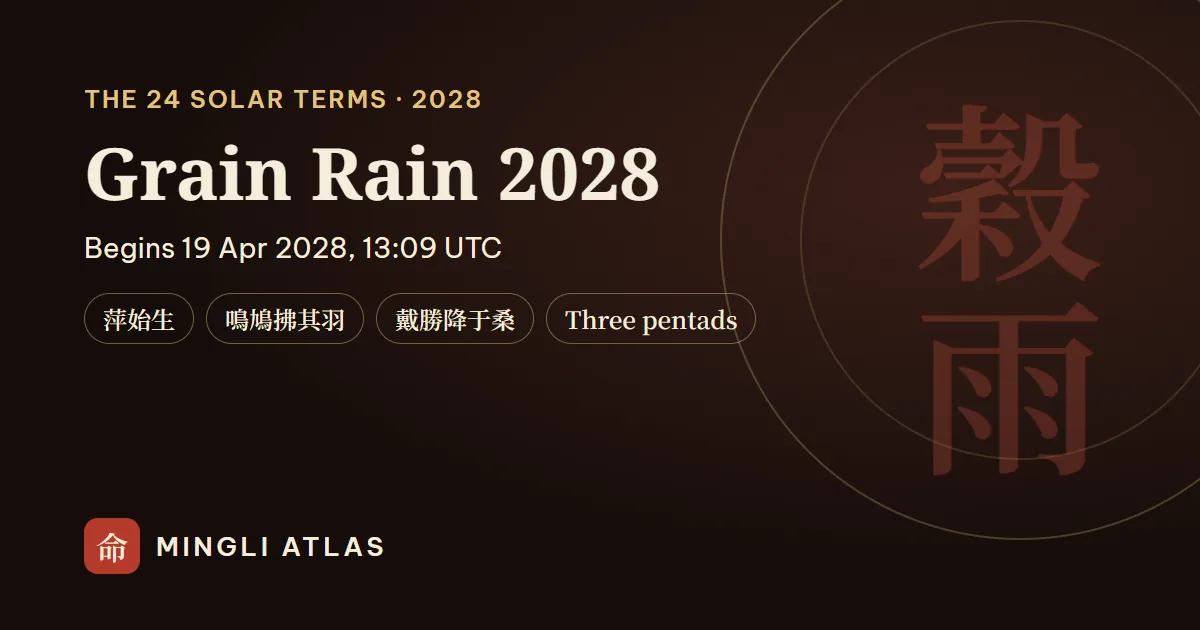
Grain Rain (穀雨, Guyu) begins on Wednesday 19 April 2028 at 13:09 UTC, which is 21:09 in Beijing and 20:09 in Vietnam, and runs until the Start of Summer late on 4 May in UTC. It is the last solar term of spring and a midpoint term (中氣), so the BaZi month stays Bing Chen for the whole fortnight. This guide gives the 2028 pentad dates, shows how this year’s timing compares with 2027, explains the name from the classical commentary, and suggests three small habits for the end of spring.
What time does Grain Rain 2028 begin?
Grain Rain 2028 begins on 19 April at 13:09 UTC, when the sun reaches 30° of ecliptic longitude. In London that is 14:09 (British Summer Time) and in New York 09:09 the same morning, so every major time zone shares the date this year. The moment falls on a Jia Xu (甲戌) day, in a Bing Chen (丙辰) month of a Wu Shen (戊申) year. The term lasts about fifteen and a half days, until the Start of Summer (立夏) begins on 4 May 2028 at 23:12 UTC.
| Milestone | UTC | Beijing (UTC+8) |
|---|---|---|
| Clear and Bright (previous term) | 4 Apr 2028, 06:03 | 4 Apr, 14:03 |
| Grain Rain | 19 Apr 2028, 13:09 | 19 Apr, 21:09 |
| Start of Summer (next term) | 4 May 2028, 23:12 | 5 May, 07:12 |
The times come from the same calendar function that drives the Mingli Atlas chart tools. Tables that print 21:09 are using Beijing time.
Grain Rain 2028 pentad dates
Each solar term splits into three pentads (候). The dates below are Vietnam calendar days; in 2028 the third pentad runs six days, because the Start of Summer only arrives on the morning of 5 May in Vietnam.
| Pentad | Dates (2028) | Chinese | Meaning |
|---|---|---|---|
| First | 19 to 23 April | 萍始生 | Duckweed begins to grow |
| Second | 24 to 28 April | 鳴鳩拂其羽 | Turtledoves preen their feathers |
| Third | 29 April to 4 May | 戴勝降于桑 | Hoopoes alight on mulberry trees |
Duckweed spreading over ponds, doves preening, hoopoes with their fan-shaped crests settling in the mulberries: all three are small signs of a wet, green late spring. The Book of Rites writes the duckweed as 蓱, a variant of 萍.
How 2028 differs from 2027
In 2027 Grain Rain began on 20 April at 07:17 UTC; in 2028 it begins on 19 April at 13:09 UTC. Two things explain the shift. The sun needs nearly six hours more than 365 days to come back to the same point, so adding exactly 365 days to last year’s moment takes you to 19 April 2028 at 07:17 UTC, and this year’s start comes 352 minutes after that, about 5 hours 52 minutes. The calendar date also moves back a day, because 2028 is a leap year: with 29 February in the calendar, every term after February lands one date earlier than it otherwise would.
The pillars at the start change completely. Last year the moment fell on a Ji Si (己巳) day in a Jia Chen (甲辰) month of a Ding Wei (丁未) year; this year it is a Jia Xu day in a Bing Chen month of a Wu Shen year. The month branch is still Chen; its stem follows the new year stem. Last year’s guide is Grain Rain 2027.
What does the name Grain Rain mean?
「穀雨,三月中。自雨水後,土膏脉動,今又雨其穀于水也。」
Yueling Qishier Hou Jijie (月令七十二候集解), section 穀雨
In plain words: Grain Rain is the midpoint of the third month. Since Rain Water the soil has been moist and stirring; now rain falls again on the sown grain. Here “rain” works as a verb: it rains onto the seed. The phrase “the rich soil stirs” (土膏脉動) pictures topsoil that has soaked up moisture since Rain Water and is coming alive. The “third month” is the Chen (辰) month of the solar calendar, not the third lunar month.
What to do at the end of spring 2028
Grain Rain is the last stretch of the three spring months that the Huangdi Neijing describes:
「春三月,此謂發陳。天地俱生,萬物以榮。」
Huangdi Neijing, Suwen (素問), chapter 四氣調神大論
The three months of spring are called “issuing forth and spreading out”: heaven and earth give life together, and all things flourish. The chapter continues:
「夜臥早起,廣步於庭,被髮緩形,以使志生,生而勿殺,予而勿奪,賞而勿罰」
Huangdi Neijing, Suwen (素問), chapter 四氣調神大論
In plain words: go to bed a little later and rise early, stroll with easy steps in the courtyard, loosen the body so the will can grow; nurture rather than kill, give rather than take, praise rather than punish. This year, three small habits suit the last fortnight of spring:
- Take an easy walk after dinner. “Stroll with broad steps in the courtyard” (廣步於庭). In Vietnam the term begins at 20:09, just after dinner; start that evening with twenty unhurried minutes around your street, and repeat it a few evenings a week until the Start of Summer.
- Give one specific word of praise a day. “Praise rather than punish” (賞而勿罰). For these fifteen days, tell a colleague or family member exactly what they did well, once a day, instead of speaking up only when something goes wrong.
- Refresh one pot of soil. “The rich soil stirs” (土膏脉動). Repot or feed one plant, or sow a tray of herbs on a balcony; it is a small task that keeps you in touch with the season.
These are lifestyle readings of a classical text, not medical advice. People with asthma, hay fever or a joint condition often feel worse on damp late spring days; check with your doctor before changing your exercise routine.
Does Grain Rain change the BaZi month?
No. Grain Rain is a midpoint term (中氣) inside the Chen month, so everyone born from Clear and Bright (4 April 2028, 06:03 UTC) up to the Start of Summer (4 May 2028, 23:12 UTC) has the month pillar Bing Chen (丙辰). The year pillar is Wu Shen (戊申), in force since the Start of Spring.
The next boundary sits close to midnight in Europe: 23:12 UTC on 4 May is 00:12 on 5 May in London, while it is 19:12 on 4 May in New York and 06:12 on 5 May in Vietnam. A birth around that night can fall on either side, so enter the hour and minute in the BaZi chart calculator, which converts your local time zone for you.
Is late April really rainy?
It depends where you are. The name describes the Yellow River plain, where late spring rain falls on newly sown fields. In northern Vietnam late April usually brings the first showers and thunderstorms after the damp spells of early spring, while the south is typically still finishing its dry season, with the rains often arriving in May. In the Southern Hemisphere the same instant falls in mid autumn. Treat the name as a cue to tend what you have sown, not as a forecast.
Follow Grain Rain day by day
The Today page shows the solar term, pentad and day pillar of each day, and sets the day beside your own chart if you have made one. For the term itself, read what Grain Rain is in the solar terms section. The previous term is Clear and Bright 2028; the next is Start of Summer 2028.
Keep reading
From reading to your chart
See your own chart
Free BaZi and Zi Wei charts, read against the classical texts, with no email needed.