White Dew 2028: Exact Time and the Xin You Month
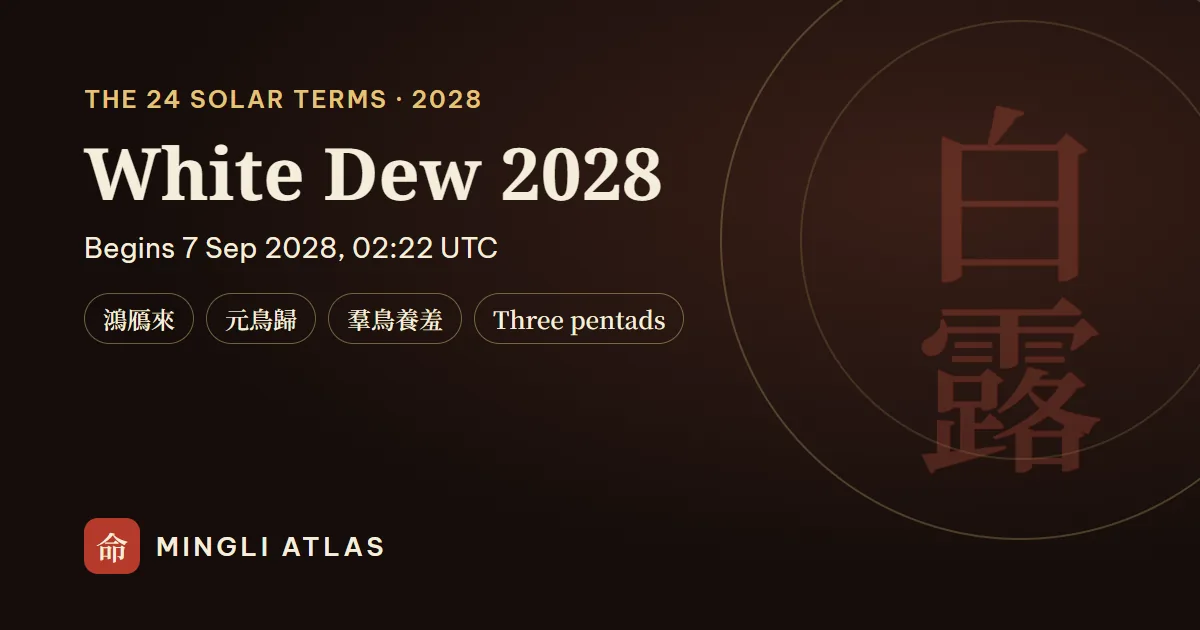
White Dew (白露, Bailu) begins on Thursday 7 September 2028 at 02:22 UTC: 10:22 in Beijing, 09:22 in Vietnam and 03:22 in London, but still 22:22 on Wednesday 6 September in New York. It lasts until the Autumn Equinox on 22 September. It is a sectional term (節), so at that minute the BaZi month pillar changes from Geng Shen to Xin You. This guide gives the 2028 pentad dates, what has shifted since last year, and three habits for the back to school weeks of mid autumn.
When is White Dew 2028?
White Dew 2028 begins on 7 September 2028 at 02:22 UTC, when the sun reaches 165° of ecliptic longitude. The moment falls on a Yi Wei (乙未) day, in a Xin You (辛酉) month of a Wu Shen (戊申) year. The term lasts a little over fifteen days, until the Autumn Equinox (秋分) on 22 September at 11:45 UTC.
| Milestone | UTC | Beijing (UTC+8) |
|---|---|---|
| End of Heat (previous term) | 22 Aug 2028, 14:00 | 22 Aug, 22:00 |
| White Dew | 7 Sep 2028, 02:22 | 7 Sep, 10:22 |
| Autumn Equinox (next term) | 22 Sep 2028, 11:45 | 22 Sep, 19:45 |
The times come from the same calendar function that drives the Mingli Atlas chart tools. Asia, Europe and UTC all list 7 September this year; calendars set to American time zones list 6 September.
White Dew 2028 pentad dates
Each solar term splits into three pentads (候) of about five days. The dates below are Vietnam calendar days.
| Pentad | Dates (2028) | Chinese | Meaning |
|---|---|---|---|
| First | 7 to 11 September | 鴻鴈來 | Wild geese arrive |
| Second | 12 to 16 September | 元鳥歸 | Swallows depart |
| Third | 17 to 21 September | 羣鳥養羞 | Birds store up food |
The pentads show three ways birds answer autumn: northern species arrive, summer visitors leave, and residents lay in food. The Jijie writes 元 in the second pentad where the Book of Rites and the Yi Zhou Shu write 玄 (玄鳥歸), the dark bird, meaning the swallow.
How the classical source explains the name
「白露,八月節。秋屬金,金色白,陰氣漸重,露凝而白也。」
Yueling Qishier Hou Jijie (月令七十二候集解), section 白露
In plain words: White Dew is the sectional term of the eighth month. Autumn belongs to Metal, and Metal’s colour is white; yin qi grows heavier and the dew gathers white. The gloss works on two levels at once, Five Phases symbolism and plain observation of colder nights. The “eighth month” is the You (酉) month of the solar calendar.
「秋三月,此謂容平。天氣以急,地氣以明。」
Huangdi Neijing, Suwen (素問), chapter 四氣調神大論
The three months of autumn are called “form settled and level”: things have taken their shape, heaven’s qi turns brisk and earth’s qi turns clear.
What to do during White Dew 2028
The Neijing’s advice for autumn:
「早臥早起,與雞俱興,使志安寧,以緩秋刑,收斂神氣,使秋氣平,無外其志,使肺氣清」
Huangdi Neijing, Suwen (素問), chapter 四氣調神大論
Go to bed early and rise early, with the rooster; keep the mind calm; gather your spirit in; keep the breath of the lungs clear. This year the term lands in the first week of the school year in many countries, so the three habits follow that rhythm:
- Bring the household routine back home. The second pentad is the swallow going home (玄鳥歸). If you have children at school, settle bedtimes, wake up times and packing the bag the night before in the first week; routines set early tend to last the term.
- Empty standing water around the house. The Neijing says “earth’s qi turns clear” (地氣以明). After the rains, tip out pots, saucers, tyres and buckets on balconies and in yards; it is a small job that leaves mosquitoes fewer places to breed.
- Do one thing at a time in your main working hours. “Gather your spirit in” (收斂神氣). Keep one forty five minute block a day for a single task, with notifications off and the phone in another room; after two weeks you will know which hour suits you best.
These are lifestyle readings of a classical text, not medical advice. In tropical regions September is often a season for mosquito borne fevers such as dengue; if you or a family member has a persistent high fever, see a doctor early. If you have a breathing or joint condition or another chronic illness, follow your doctor as the weather changes.
How White Dew 2028 differs from 2027
In 2027, White Dew began on Tuesday 7 September at 20:28 UTC. In 2028 it begins on Thursday 7 September at 02:22 UTC: the same UTC date, but East Asian calendars move from 8 to 7 September. Because 2028 is a leap year, 365 days after last year’s moment only reaches 20:28 UTC on 6 September 2028, and the term arrives 5 hours 54 minutes after that, which carries it past midnight UTC.
Last year the moment fell on a Ding Wei year, Ji You month and Geng Yin day; this year it is a Wu Shen year, Xin You month and Yi Wei day. The new month is a You month both times, with the stem moving from Ji to Xin.
White Dew changes the BaZi month from Geng Shen to Xin You
At 02:22 UTC on 7 September 2028 the month pillar changes from Geng Shen (庚申) to Xin You (辛酉). Someone born in New York on the evening of 6 September after 22:22 already has the Xin You month; someone born in Vietnam on the morning of 7 September before 09:22 still has Geng Shen.
The year pillar stays Wu Shen (戊申) throughout. Because the change falls on different dates in different time zones, enter the exact date, hour and minute in the BaZi chart calculator, which converts your local time zone for you.
Will you see white dew where you live?
It depends on latitude. The name describes northern China, where early September nights are cool enough for heavy dew. In the tropics the term usually passes in the rainy season with little dew to see, and in the Southern Hemisphere early September is the start of spring. The term begins at the same instant everywhere; only the dew is local.
Follow White Dew day by day
The Today page shows the solar term, pentad and day pillar of each day, and sets the day beside your own chart if you have made one. For the term itself, read what White Dew is in the solar terms section. The previous term is End of Heat 2028; the next is Autumn Equinox 2028.
Keep reading
From reading to your chart
See your own chart
Free BaZi and Zi Wei charts, read against the classical texts, with no email needed.