Rain Water 2027 (Yushui): Date, Pentads and BaZi Month
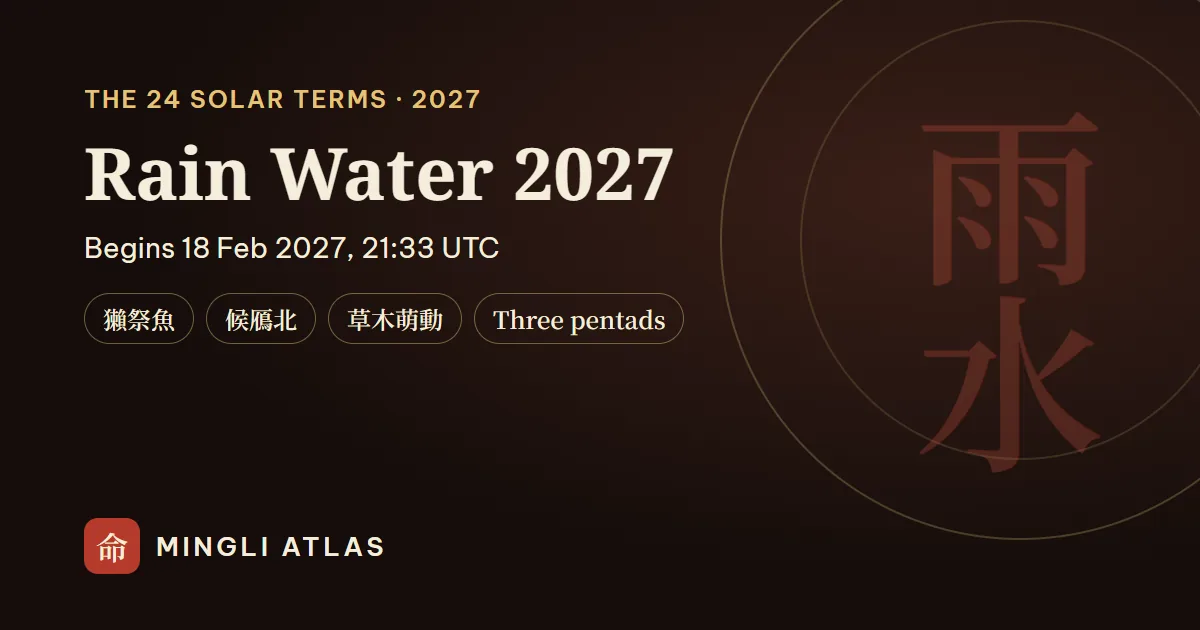
Rain Water (雨水, Yushui) begins on Thursday 18 February 2027 at 21:33 UTC, which is already 05:33 on Friday 19 February in Beijing and 04:33 in Vietnam, and lasts until the Awakening of Insects on 5 March. It is a midpoint term (中氣), so the BaZi month pillar does not change: it stays Ren Yin, in a Ding Wei year. This guide gives the 2027 pentad dates, explains why the classical calendar puts “rain” straight after the Start of Spring, and suggests three habits for the weeks when work resumes after the Lunar New Year.
When is Rain Water 2027?
Rain Water 2027 begins on 18 February at 21:33 UTC, when the sun reaches 330° of ecliptic longitude. In London that is 21:33 on 18 February; in New York 16:33 the same afternoon. In China and Vietnam the date is 19 February. The moment falls on a Ji Si (己巳) day, in a Ren Yin (壬寅) month of a Ding Wei (丁未) year. The term lasts fifteen days, until the Awakening of Insects (驚蟄) begins on 5 March 2027 at 19:39 UTC.
| Milestone | UTC | Beijing (UTC+8) |
|---|---|---|
| Start of Spring (previous term) | 4 Feb 2027, 01:46 | 4 Feb, 09:46 |
| Rain Water | 18 Feb 2027, 21:33 | 19 Feb, 05:33 |
| Awakening of Insects (next term) | 5 Mar 2027, 19:39 | 6 Mar, 03:39 |
This is why Chinese sources say 19 February and Western almanacs say 18 February: it is the same instant seen from different time zones. The time comes from the same calendar function that drives the Mingli Atlas chart tools.
The three pentads of Rain Water 2027
Rain Water splits into three pentads (候) of about five days. In 2027, counted by Vietnam calendar days, they fall as follows.
| Pentad | Dates (2027) | Chinese | Meaning |
|---|---|---|---|
| First | 19 to 23 February | 獺祭魚 | Otters lay out their fish |
| Second | 24 to 28 February | 候鴈北 | Wild geese fly north |
| Third | 1 to 5 March | 草木萌動 | Plants begin to sprout |
The first pentad is a striking picture: otters catch so many fish that they lay them out along the bank, as if making an offering, which is what the character 祭 means. The second has two wordings: the Jijie writes 候鴈北 (geese turn north), while the Book of Rites and the Yi Zhou Shu write 鴻鴈來 (wild geese arrive). Only in the third pentad do the plants truly sprout.
Why does “rain” come right after the Start of Spring?
「雨水,正月中。天一生水,春始屬木,然生木者,必水也,故立春後繼之雨水,且東風既解凍,則散而為雨水矣。」
Yueling Qishier Hou Jijie (月令七十二候集解), section 雨水
In plain words: Rain Water is the midpoint of the first month. Heaven first gives rise to water; spring belongs to Wood, and what makes Wood grow is water, so Rain Water follows the Start of Spring. The east wind has thawed the ice (the first pentad of the Start of Spring), and the ice now disperses as rain. This is a Five Phases argument: Water generates Wood, so water must arrive as soon as the Wood season opens.
Not every text agrees on the order. The Monthly Ordinances chapter of the Book of Rites puts 始雨水 (the first rains) in the second month of spring, together with peach blossom and singing orioles, which is the Awakening of Insects. We keep both arrangements and name the source of each.
What should you do during Rain Water?
The Huangdi Neijing gives its advice for all three months of spring:
「夜臥早起,廣步於庭,被髮緩形,以使志生,生而勿殺,予而勿奪,賞而勿罰」
Huangdi Neijing, Suwen (素問), chapter 四氣調神大論
Go to bed a little later and rise early; take long, easy strides; loosen the hair and the body, so that the will can grow; nurture rather than kill, give rather than take, reward rather than punish. In 2027 Rain Water coincides with the return to work after the Lunar New Year, so these three habits fit:
- Ease back into work. “Loosen the hair and the body” (被髮緩形) argues against a packed first week. Keep one afternoon free to clear your desk and reread your plans before you speed up.
- Praise before you correct. “Reward rather than punish” (賞而勿罰) is a good rule for the first team meeting of the year: start with what colleagues did well before turning to what needs fixing.
- Plant something and tend it. “Nurture rather than kill” (生而勿殺) applies to seedlings and to young projects alike. Sow a pot of herbs, or give a new idea a few weeks before you judge it, in step with the sprouting of the third pentad.
These are lifestyle readings of a classical text, not medical advice. Damp, humid weather can aggravate asthma, allergic rhinitis and other breathing conditions; if you live with one of these, follow your doctor’s guidance.
Is Rain Water the rainy season?
Not in most of the places where people read this. The name follows the Yellow River basin, where snow gives way to the first spring rain. In northern Vietnam this period usually brings drizzle and very humid spells, when walls and floors run with condensation; southern Vietnam is still in its dry season. South of the equator late February is late summer. Read the name as a description of one northern climate, not a forecast for your own.
Rain Water does not change the BaZi month
Rain Water is the midpoint of the Yin month, so nothing changes in the chart at 21:33 UTC on 18 February. Everyone born from the Start of Spring (4 February 2027, 01:46 UTC) up to the Awakening of Insects (5 March 2027, 19:39 UTC) has the month pillar Ren Yin (壬寅) and the year pillar Ding Wei (丁未).
The next boundary is the Awakening of Insects, when the month pillar changes from Ren Yin to Gui Mao (癸卯). In Asia that falls in the small hours of 6 March; in Europe and the Americas on the evening or afternoon of 5 March. Enter the full date, hour and minute in the BaZi chart calculator; it converts your local time zone for you.
Follow Rain Water day by day
The Today page shows the solar term, pentad and day pillar of each day, and sets the day beside your own chart if you have made one. For the term itself, read what Rain Water is in the solar terms section. The previous term is Start of Spring 2027; the next is Awakening of Insects 2027.
Keep reading
From reading to your chart
See your own chart
Free BaZi and Zi Wei charts, read against the classical texts, with no email needed.