Awakening of Insects 2027 (Jingzhe): Date and BaZi Month
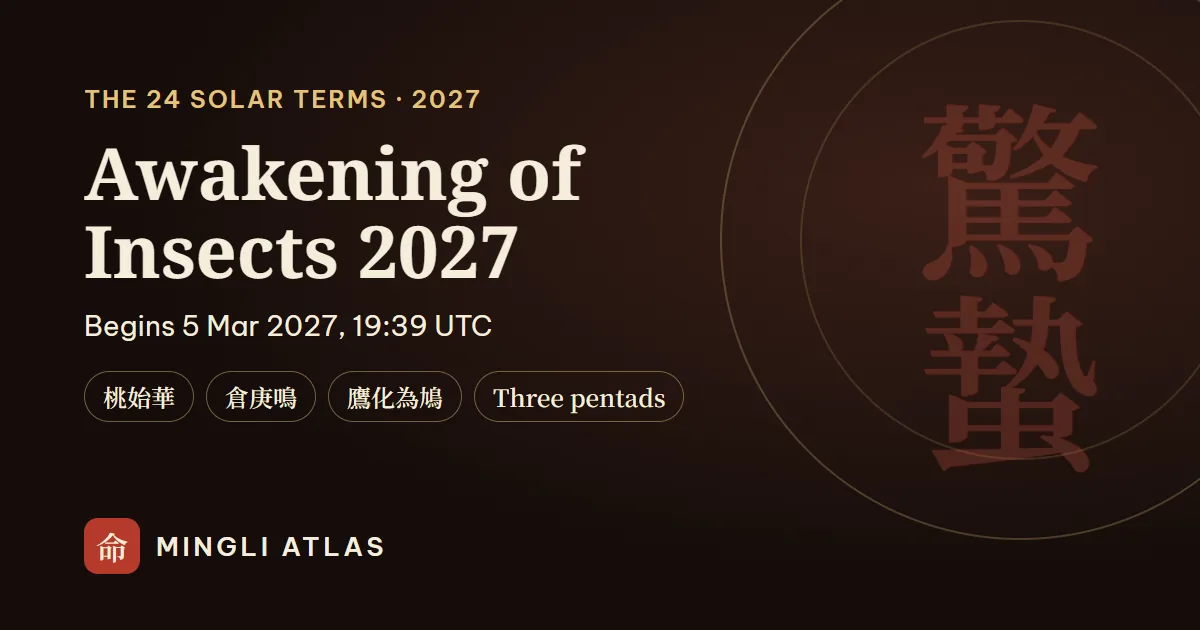
The Awakening of Insects (驚蟄, Jingzhe) begins on Friday 5 March 2027 at 19:39 UTC, which is already 03:39 on Saturday 6 March in Beijing and 02:39 in Vietnam, and lasts until the Spring Equinox on 20 March. It is a sectional term (節), so at that minute the BaZi month pillar changes from Ren Yin to Gui Mao, while the year pillar stays Ding Wei. This guide gives the 2027 pentad dates, explains the name from the classical source, and suggests three habits for the fortnight when everything that slept through winter “wakes with a start”.
When is the Awakening of Insects 2027?
The Awakening of Insects 2027 begins on 5 March at 19:39 UTC, when the sun reaches 345° of ecliptic longitude. In London that is 19:39 on 5 March; in New York 14:39 the same afternoon. In China and Vietnam the date is 6 March. The moment falls on a Jia Shen (甲申) day, in a Gui Mao (癸卯) month of a Ding Wei (丁未) year. The term lasts fifteen days, until the Spring Equinox (春分) on 20 March 2027 at 20:24 UTC.
| Milestone | UTC | Beijing (UTC+8) |
|---|---|---|
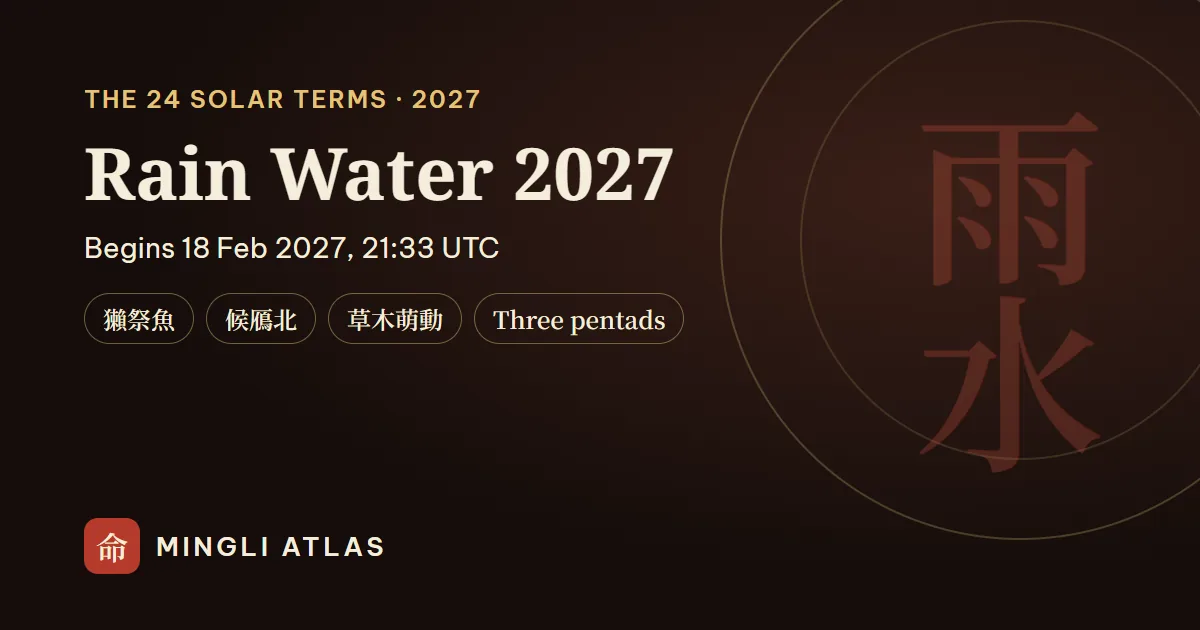
| Rain Water (previous term) | 18 Feb 2027, 21:33 | 19 Feb, 05:33 |
| Awakening of Insects | 5 Mar 2027, 19:39 | 6 Mar, 03:39 |
| Spring Equinox (next term) | 20 Mar 2027, 20:24 | 21 Mar, 04:24 |
The time comes from the same calendar function that drives the Mingli Atlas chart tools. Pages that list the month as Ren Yin for the whole of 6 March are right only for the first hours of that day in Asia; from the boundary minute the month is Gui Mao.
The three pentads of the Awakening of Insects 2027
The term splits into three pentads (候) of about five days. In 2027, counted by Vietnam calendar days, they fall as follows.
| Pentad | Dates (2027) | Chinese | Meaning |
|---|---|---|---|
| First | 6 to 10 March | 桃始華 | Peach trees begin to blossom |
| Second | 11 to 15 March | 倉庚鳴 | Orioles sing |
| Third | 16 to 20 March | 鷹化為鳩 | Hawks turn into doves |
The first two are easy to picture. The third should be read as the old observers meant it: hawks become scarce and doves become common, so they wrote that hawks “turn into” doves. It describes a seasonal change in which birds are seen, not a real biological transformation.
Why is it called the Awakening of Insects?
「驚蟄,二月節。《夏小正》曰:正月啟蟄,言發蟄也。萬物出乎震,震為雷,故曰驚蟄。是蟄蟲驚而出走矣。」
Yueling Qishier Hou Jijie (月令七十二候集解), section 驚蟄
In plain words: the Awakening of Insects is the sectional term of the second month. The Xia Xiaozheng speaks of “opening the hibernation” in the first month. All things come forth from the Zhen trigram, and Zhen is thunder, hence the name: hibernating insects are startled and come out. The “second month” is the Mao (卯) month of the solar calendar, which opens at this minute. Notice that the Jijie quotes an older text placing the awakening a month earlier: the borders between terms were never as fixed as a modern table suggests.
The Huangdi Neijing names the whole season:
「春三月,此謂發陳。天地俱生,萬物以榮。」
Huangdi Neijing, Suwen (素問), chapter 四氣調神大論
The three months of spring are called “issuing forth and spreading out”: heaven and earth give life together, and all things flourish. The Awakening of Insects is when that issuing forth is most visible: what lay still all winter comes out.
What should you do during the Awakening of Insects?
The spring advice in the same chapter reads:
「夜臥早起,廣步於庭,被髮緩形,以使志生,生而勿殺,予而勿奪,賞而勿罰」
Huangdi Neijing, Suwen (素問), chapter 四氣調神大論
Go to bed a little later and rise early; take long, easy strides; loosen the hair and the body, so that the will can grow; nurture rather than kill, give rather than take, reward rather than punish. These three habits draw on different phrases from the two earlier spring terms:
- Move your wake time earlier, fifteen minutes a week. “Go to bed later, rise early” (夜臥早起) follows the lengthening mornings of March. Shift the alarm a little at a time so your body keeps pace with the light, instead of one sudden change.
- Get out and do one thing you put off all winter. “The hibernating insects are startled and come out” (蟄蟲驚而出走) invites the same: a bike ride, a class you meant to join, a visit to a friend far away. Pick one and do it in the first pentad.
- Get the house ready for storms. “Zhen is thunder” (震為雷) is a practical reminder. Check the roof, gutters, windows and outdoor sockets before the first spring storms arrive.
These are lifestyle readings of a classical text, not medical advice. Weather swings quickly at this time of year; anyone with asthma, allergies, a heart or blood pressure condition should follow their doctor’s guidance.
Does it always thunder at the Awakening of Insects?
No. The name ties the term to the first spring thunder of the Yellow River basin. In northern Vietnam the first storms may come in March or later, depending on the year; the south is still in its hot dry season. Western readers may also know that daylight saving time begins in the United States in mid March, which moves local clock times but not the term itself. South of the equator early March is the start of autumn, so the insects there are heading the other way.
The Awakening of Insects changes the BaZi month
At 19:39 UTC on 5 March 2027 the month pillar changes from Ren Yin (壬寅) to Gui Mao (癸卯). A person born earlier, for example in Vietnam late on 5 March or before 02:39 local time on 6 March, still has the Ren Yin month. The year pillar stays Ding Wei (丁未), which began at the Start of Spring.
Because the boundary falls in the middle of the night in Asia, a rounded birth time on a certificate can put you on the wrong side of it. Enter the full date, hour and minute in the BaZi chart calculator; it converts your local time zone and applies the exact boundary.
Follow the Awakening of Insects day by day
The Today page shows the solar term, pentad and day pillar of each day, and sets the day beside your own chart if you have made one. For the term itself, read what the Awakening of Insects is in the solar terms section. The previous term is Rain Water 2027; the next is Spring Equinox 2027.
Keep reading
From reading to your chart
See your own chart
Free BaZi and Zi Wei charts, read against the classical texts, with no email needed.