Start of Spring 2028: When the BaZi Year Turns Wu Shen
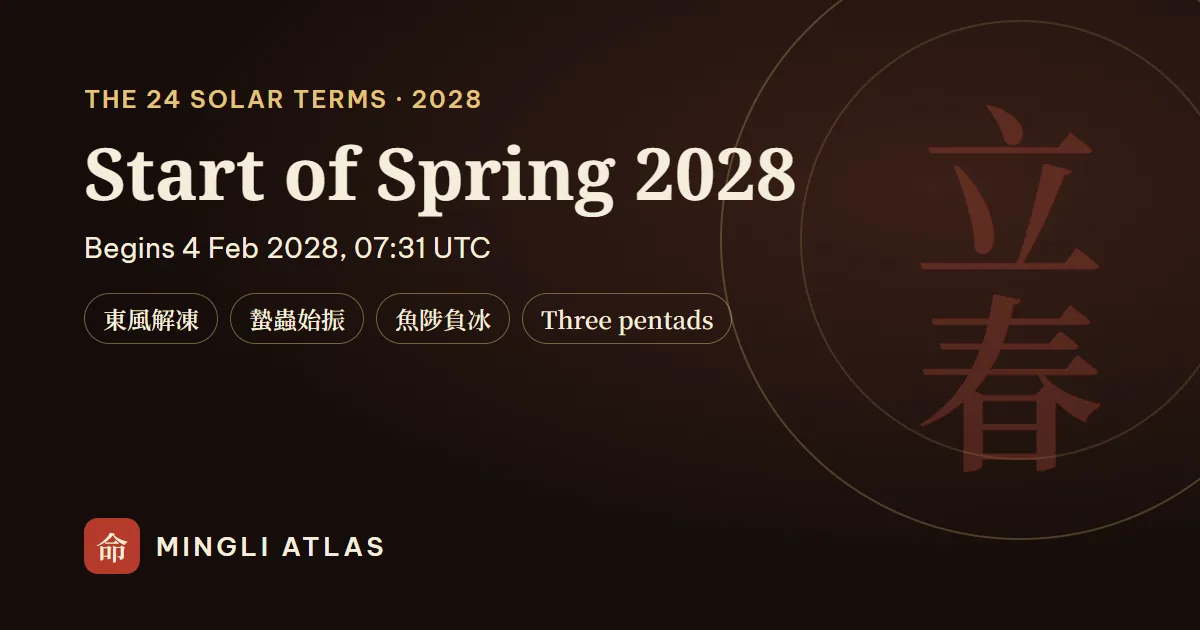
The Start of Spring (立春, Lichun) begins on Friday 4 February 2028 at 07:31 UTC (15:31 in Beijing, 14:31 in Vietnam, 02:31 in New York), nine days after the Lunar New Year of 26 January. At that minute a BaZi chart changes year and month together: the year from Ding Wei to Wu Shen, the month from Gui Chou to Jia Yin. The term lasts until Rain Water on 19 February. This year the order is the reverse of 2027: the lunar year opens first, the BaZi year follows. This guide gives the exact boundary, the pentad dates, the classical texts, three habits for the first days back after the holiday, and what changed since last year.
When is the Start of Spring 2028?
The sun reaches 315° of ecliptic longitude on 4 February 2028 at 07:31 UTC. In London that is 07:31; in New York 02:31 in the early hours of the same day, so this year the whole world shares the date of 4 February. The moment falls on a Ji Wei (己未) day, and from that minute the chart shows a Jia Yin (甲寅) month of a Wu Shen (戊申) year. The term lasts fifteen days, until Rain Water (雨水) begins on 19 February 2028 at 03:26 UTC.
| Milestone | UTC | Beijing (UTC+8) |
|---|---|---|
| Major Cold (previous term) | 20 Jan 2028, 13:21 | 20 Jan, 21:21 |
| Lunar New Year | 26 Jan 2028 (date only) | 26 Jan, a Wednesday |
| Start of Spring | 4 Feb 2028, 07:31 | 4 Feb, 15:31 |
| Rain Water (next term) | 19 Feb 2028, 03:26 | 19 Feb, 11:26 |
The times come from the calendar function behind the Mingli Atlas chart tools. English pages we checked while writing this give “around 4 February” without an hour; the hour is what settles the year pillar for anyone born that day.
The three pentads of the Start of Spring 2028
The term divides into three pentads (候) of about five days. The dates are Vietnam calendar days; the Lantern Festival, the fifteenth day of the first lunar month, falls on 9 February and opens the second pentad.
| Pentad | Dates (2028) | Chinese | Meaning |
|---|---|---|---|
| First | 4 to 8 February | 東風解凍 | The east wind thaws the ice |
| Second | 9 to 13 February | 蟄蟲始振 | Hibernating insects begin to stir |
| Third | 14 to 18 February | 魚陟負冰 | Fish rise up beneath the ice |
The three pentads show one thaw at three levels: the wind turns and the ice softens, creatures in the soil begin to move, then fish rise until they touch what is left of the ice. For the third, the Jijie writes 魚陟負冰 (fish climb up, as if carrying the ice), while the Book of Rites and the Yi Zhou Shu write simply 魚上冰 (fish rise to the ice).
What do the classical texts say about the Start of Spring?
「立春,正月節。立,建始也。五行之氣往者過來者續于此。而春木之氣始至,故謂之立也。」
Yueling Qishier Hou Jijie (月令七十二候集解), section 立春
In plain words: the Start of Spring is the sectional term of the first month. “Li” means to set up, to begin; the passing qi of the old season gives way here to the new, and the Wood qi of spring first arrives. In 2028 the line helps separate two “first months”: the first lunar month opened on 26 January, while the first solar month, the Yin (寅) month, opens only at 07:31 UTC on 4 February.
The Book of Rites records how the court prepared for the day:
「是月也,以立春。先立春三日,大史謁之天子曰:「某日立春,盛德在木。」天子乃齊。」
Book of Rites, Monthly Ordinances (禮記·月令), 孟春之月
This month holds the Start of Spring. Three days before it, the Grand Historian tells the Son of Heaven, “On such a day spring begins; the flourishing virtue is in Wood.” The Son of Heaven then fasts. What stands out is the three quiet days before the boundary, not a ceremony on the day.
What should you do at the Start of Spring, just after the holiday?
The Huangdi Neijing opens its spring passage with:
「春三月,此謂發陳。天地俱生,萬物以榮。」
Huangdi Neijing, Suwen (素問), chapter 四氣調神大論
The three months of spring are called “issuing forth and spreading out”: heaven and earth give life together, and all things flourish. The advice follows:
「夜臥早起,廣步於庭,被髮緩形,以使志生,生而勿殺,予而勿奪,賞而勿罰」
Huangdi Neijing, Suwen (素問), chapter 四氣調神大論
Go to bed a little later and rise early; take long, easy strides; loosen the hair and the body so that the will can grow; nurture rather than kill, give rather than take, reward rather than punish. Last year the term fell in holiday week; this year it arrives as people return to work, so the habits take a different angle:
- Use the three days before to close the holiday. “Three days before the Start of Spring” (先立春三日) is when the court prepared. From 1 to 3 February, put away the festive things, answer the messages you left waiting and return to your usual bedtime, so you meet the new BaZi year with a clear head.
- Plant or tend something green. “The flourishing virtue is in Wood” (盛德在木) points at growing things. A plant on your desk, a few seeds sown in a balcony box, or a neighbourhood planting day all fit the season.
- Open the first meeting back with recognition. “Reward rather than punish” (賞而勿罰). Before targets for the year, name one or two specific things your colleagues did well in the last one.
These are lifestyle readings of a classical text, not medical advice. After the holiday meals, anyone with diabetes, high blood pressure, gout or a stomach condition should follow their doctor when changing diet and exercise again.
How the Start of Spring 2028 differs from 2027
The Start of Spring 2027 began on Thursday 4 February 2027 at 01:46 UTC. This year the date is the same, but the moment comes about 5 hours 45 minutes later in the day (345 minutes after the same clock time 365 days on), on a Friday. Because it comes before the leap day of 29 February 2028, it has not yet shifted a calendar day earlier, as the later terms of 2028 will.
At the 2027 boundary the chart read year Ding Wei (丁未), month Ren Yin (壬寅), day Jia Yin (甲寅); in 2028 it reads year Wu Shen, month Jia Yin, day Ji Wei. In 2027 the minute fell on the evening of 3 February in New York; in 2028 it falls on 4 February there too. And in 2027 the Start of Spring came two days before the Lunar New Year, while in 2028 it comes nine days after.
The Start of Spring changes both the year and the month
The Start of Spring is a sectional term (節) and the BaZi new year. At 07:31 UTC on 4 February 2028 the year pillar changes from Ding Wei (丁未) to Wu Shen (戊申) and the month pillar from Gui Chou (癸丑) to Jia Yin (甲寅). Anyone born from the Lunar New Year up to that minute keeps Ding Wei and Gui Chou, even though the popular lunar reckoning already calls them a Monkey. The Jia Yin month lasts until the Awakening of Insects on 5 March 2028 at 01:24 UTC.
Some pages mention customs of “hiding from spring” at the boundary hour. They are folk practice, not part of the texts quoted here; keep them or not as you like. For a chart, the exact birth time is what counts: enter the full date, hour, minute and place in the BaZi chart calculator, which converts your local time zone.
Is it spring already?
Not by the thermometer. In northern Vietnam early February can still bring cold spells and drizzle, mixed with the first humid days; the south is in its sunny dry season. Western convention starts spring at the March equinox, and south of the equator early February is late summer. The name marks the turn of the solar calendar in the northern sky, not a sudden warm spell.
Follow the Start of Spring day by day
The Today page shows the solar term, pentad and day pillar of each day, and sets the day beside your own chart if you have made one. For the term itself, read what the Start of Spring is in the solar terms section. The previous term is Major Cold 2028; the next is Rain Water 2028.
Keep reading
From reading to your chart
See your own chart
Free BaZi and Zi Wei charts, read against the classical texts, with no email needed.