Major Cold 2028: Lunar New Year Inside the Coldest Term
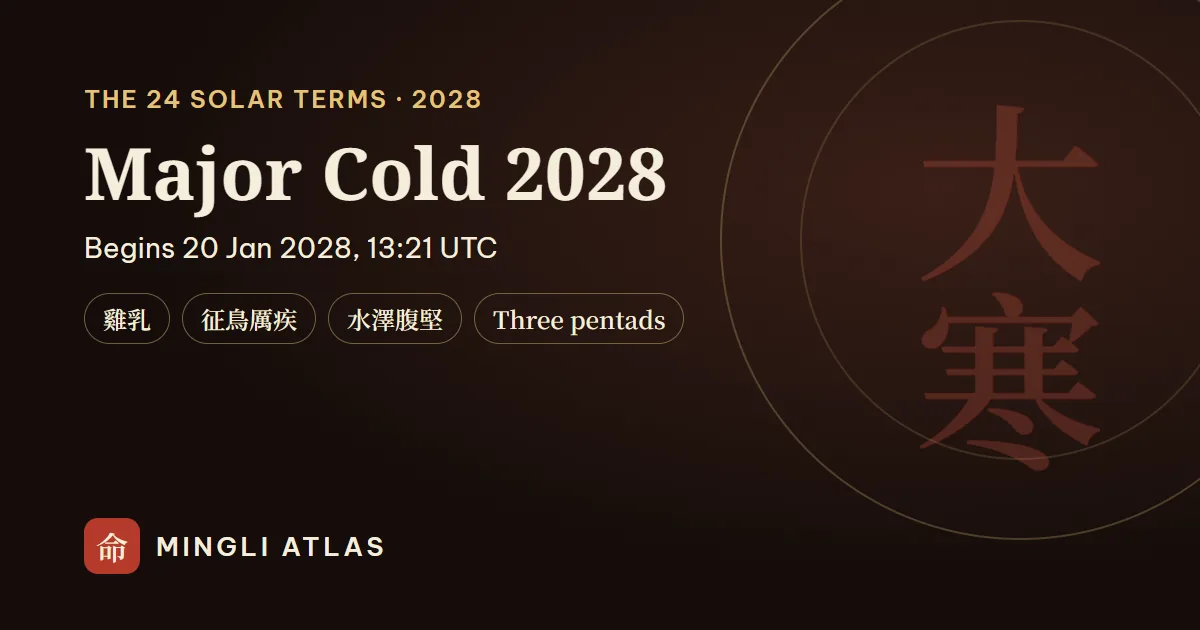
Major Cold (大寒, Dahan) begins on Thursday 20 January 2028 at 13:21 UTC (21:21 in Beijing, 20:21 in Vietnam, 08:21 in New York) and runs until the Start of Spring on 4 February. This year the Lunar New Year, on Wednesday 26 January 2028, falls in the middle of the term, nine days before the Start of Spring. Major Cold is a midpoint term (中氣), so nothing changes in a BaZi chart at this minute: the month stays Gui Chou and the year stays Ding Wei, right through the New Year holiday. Below are the 2028 pentad dates, the classical lines on the great cold, three habits for a New Year that lands in the coldest fortnight, and what differs from last year.
What time does Major Cold 2028 begin?
The sun reaches 300° of ecliptic longitude on 20 January 2028 at 13:21 UTC. In London that is 13:21; in New York, 08:21 the same morning; in Beijing, 21:21 in the evening. The moment falls on a Jia Chen (甲辰) day, in a Gui Chou (癸丑) month of a Ding Wei (丁未) year. Almost fifteen days later, on 4 February 2028 at 07:31 UTC, the Start of Spring (立春) opens a new cycle; Major Cold is the last of the 24 terms.
| Milestone | UTC | Beijing (UTC+8) |
|---|---|---|
| Minor Cold (previous term) | 5 Jan 2028, 19:54 | 6 Jan, 03:54 |
| Major Cold | 20 Jan 2028, 13:21 | 20 Jan, 21:21 |
| Lunar New Year | 26 Jan 2028 (date only) | 26 Jan, a Wednesday |
| Start of Spring (next term) | 4 Feb 2028, 07:31 | 4 Feb, 15:31 |
The times come from the calendar function behind the Mingli Atlas chart tools. Pages that rank for this term give the date and little else; few point out that in 2028 the lunar year and the BaZi year start about ten days apart, with the lunar year first.
The three pentads of Major Cold 2028
The term divides into three pentads (候) of about five days. The dates below are Vietnam calendar days; the second pentad covers the whole New Year holiday.
| Pentad | Dates (2028) | Chinese | Meaning |
|---|---|---|---|
| First | 20 to 24 January | 雞乳 | Hens begin to brood |
| Second | 25 to 29 January | 征鳥厲疾 | Birds of prey fly fierce and swift |
| Third | 30 January to 3 February | 水澤腹堅 | Ice thickens on ponds and marshes |
Read together, the pentads pull in two directions. Indoors, hens are already brooding the first eggs of the year; outdoors, hunting birds fly harder because prey is scarce, and the marsh water freezes to the bottom. New life starts before the cold lets go. The Shi Xun chapter of the Yi Zhou Shu words the first two a little differently: 鷄始乳 (hens begin to brood) and 鷙鳥厲 (birds of prey grow fierce, without “swift”).
What do the classical texts say about Major Cold?
「大寒,十二月中。解見前。」
Yueling Qishier Hou Jijie (月令七十二候集解), section 大寒
The entry is little more than a cross reference: Major Cold is the midpoint of the twelfth month, and the explanation is under the previous term. There, under Minor Cold, the text says the cold is minor early in the month and major by mid month. The “twelfth month” is the Chou (丑) month of the solar calendar, which opened at Minor Cold on 5 January 2028 (UTC), so it does not match the twelfth lunar month, which ends on the eve of the New Year.
The Huangdi Neijing sums up winter in one line:
「冬三月,此謂閉藏。水冰地坼,無擾乎陽。」
Huangdi Neijing, Suwen (素問), chapter 四氣調神大論
The three winter months are called “closing and storing”: water freezes and the ground cracks, so do not stir up the yang. In 2028 there is a small irony in it: the days that most call for closing in are the busiest of the year.
What should you do when the New Year falls in Major Cold?
The detailed winter advice follows in the same chapter:
「早臥晚起,必待日光,使志若伏若匿,若有私意,若已有得,去寒就溫,無泄皮膚,使氣亟奪」
Huangdi Neijing, Suwen (素問), chapter 四氣調神大論
Go to bed early and rise late, waiting for the sunlight; keep your intentions as if hidden, as if private, as if already fulfilled; leave the cold for warmth; do not let sweat drain the body’s qi. This year the term holds both the run up to the New Year and the holiday itself, so these three habits use different phrases from last year’s post:
- Protect your bedtime in the week of preparations. “Go to bed early and rise late” (早臥晚起) is hardest to keep from 20 to 25 January, when cleaning, cooking and shopping run late. Set a fixed stopping time, say 22:30, and leave what is unfinished for the morning.
- Exercise once the sun is up. “Wait for the sunlight” (必待日光) is a timing rule. On the coldest days, move your walk or workout from first light to mid morning, when the sun is out and the wind has less bite.
- Keep the holiday to a pace you can sustain. “Do not stir up the yang” (無擾乎陽) argues against a packed holiday. Before the New Year, choose the two or three visits that matter most, and allow yourself one full day at home during the first three days.
These are lifestyle readings of a classical text, not medical advice. During hard cold spells, older people, small children and anyone with a heart, blood pressure or breathing condition should follow their doctor and local health guidance, including on holiday food and alcohol.
How Major Cold 2028 differs from 2027
In 2027, Major Cold 2027 began on Wednesday 20 January at 07:29 UTC. This year the date is the same but the moment comes about 5 hours 52 minutes later in the day (352 minutes after the same clock time 365 days on), and on a Thursday. The reason is that a solar year runs close to a quarter of a day longer than 365 days. The leap day on 29 February 2028 will also pull the terms after it one calendar day earlier; Major Cold comes before it, so it keeps 20 January.
The pillars differ too. At the start of Major Cold 2027 the chart read year Bing Wu (丙午), month Xin Chou (辛丑), day Ji Hai (己亥); in 2028 it reads year Ding Wei, month Gui Chou, day Jia Chen. The bigger change is the order of the two new years: in 2027 the Start of Spring came two days before the Lunar New Year; in 2028 the Lunar New Year comes nine days before the Start of Spring.
Major Cold keeps the month, and the New Year keeps the BaZi year
Major Cold is the midpoint of the Chou month, so nothing changes at 13:21 UTC on 20 January 2028. Everyone born from Minor Cold (5 January 2028, 19:54 UTC) up to the Start of Spring (4 February 2028, 07:31 UTC) has the month pillar Gui Chou (癸丑) and the year pillar Ding Wei (丁未). At the Start of Spring both change at once: the year to Wu Shen (戊申) and the month to Jia Yin (甲寅).
So a baby born between 26 January and that minute on 4 February is usually called a Monkey by the popular lunar reckoning, yet has the BaZi year Ding Wei, the Goat. The two systems answer different questions. Enter the full date, hour and minute in the BaZi chart calculator; it converts your local time zone and applies the exact boundary.
Is Major Cold the coldest time where you live?
Only in the north, and only roughly. The name follows the Yellow River basin, where late January is usually the depth of winter, and northern Vietnam often has hard cold spells now; a New Year inside Major Cold there may well be cold and drizzly. In any given year the coldest day depends on real cold waves, so check the forecast before you travel for the holiday. Southern Vietnam is in its dry season, and south of the equator these are high summer days.
Follow Major Cold day by day
The Today page shows the solar term, pentad and day pillar of each day, and sets the day beside your own chart if you have made one. For the term itself, read what Major Cold is in the solar terms section. The previous term is Minor Cold 2028; the next is Start of Spring 2028.
Keep reading
From reading to your chart
See your own chart
Free BaZi and Zi Wei charts, read against the classical texts, with no email needed.