Hai (亥), the Pig branch in BaZi: hidden stems, hours and clashes
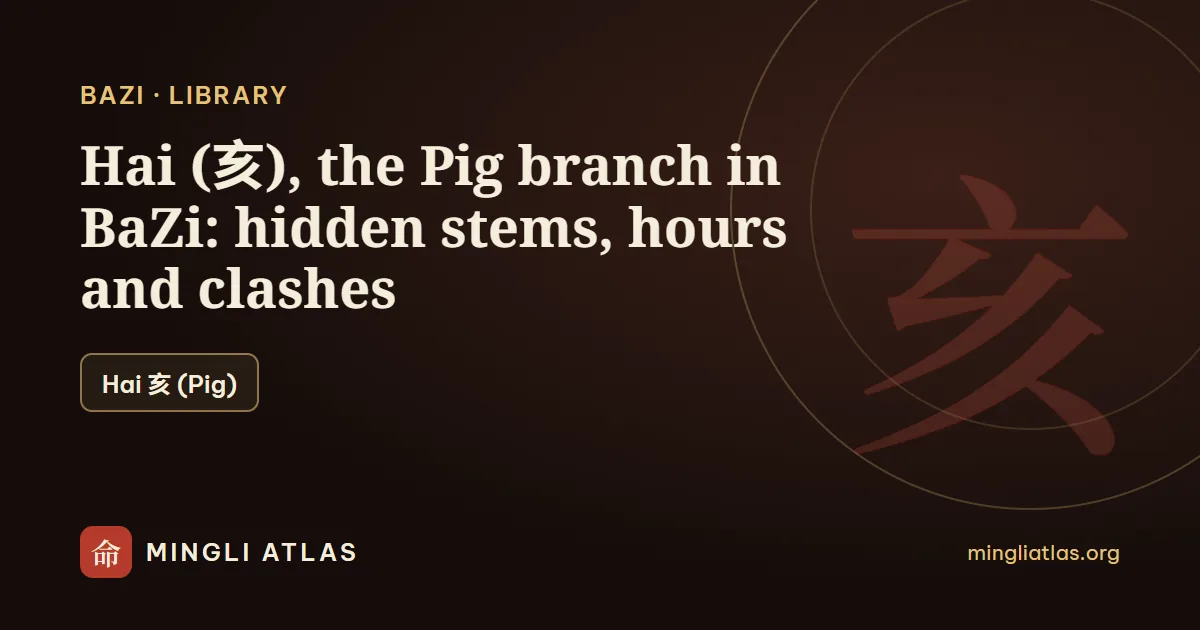
Hai (亥), the Pig, is branch 12 of 12: Yin Water, hiding Ren, Jia. Its hour runs 21:00 to 23:00; it harmonises with Yin and clashes with Si.
At a glance
- Animal: Pig
- Element: Water
- Polarity: Yin
- Hidden stems: Ren 壬, Jia 甲
What is Hai in BaZi?
Rule fact
Hai (亥) is branch 12 of the twelve Earthly Branches. Its animal is the pig, its element Yin Water. The Hai hour runs from 21:00 to 23:00. The Hai month, the tenth month of the solar-term calendar, is opened by Start of Winter (the start of winter); BaZi months follow the solar terms, not the lunar calendar.
Hidden stems of Hai
Rule fact
Hai hides Ren 壬, Jia 甲; Ren is the main qi and the others are secondary qi. Hidden stems (藏干) are the Heavenly Stems held inside a branch, so each one also counts as a Ten God against your Day Master.
| Day Master | Ren 壬 (main qi) is | Jia 甲 is |
|---|---|---|
| Jia 甲 | Indirect Resource | Friend (the same stem) |
| Yi 乙 | Direct Resource | Rob Wealth |
| Bing 丙 | Seven Killings | Indirect Resource |
| Ding 丁 | Direct Officer | Direct Resource |
| Wu 戊 | Indirect Wealth | Seven Killings |
| Ji 己 | Direct Wealth | Direct Officer |
| Geng 庚 | Eating God | Indirect Wealth |
| Xin 辛 | Hurting Officer | Direct Wealth |
| Ren 壬 | Friend (the same stem) | Eating God |
| Gui 癸 | Rob Wealth | Hurting Officer |
Which branches does Hai combine and clash with?
Rule fact
Hai forms a Six Harmony with Yin 寅 and a Six Clash with Si 巳.
| Relation | Branches |
|---|---|
| Six Harmony (六合) | Yin 寅 |
| Six Clash (六沖) | Si 巳 |
| Six Harm (六害) | Shen 申 |
| Three Harmony (三合) | Hai 亥, Mao 卯, Wei 未 (Wood) |
| Directional combination (三會) | Hai 亥, Zi 子, Chou 丑 (Water, North) |
| Self-punishment (自刑) | Hai 亥 meets Hai 亥 |
Pig years: the Hai pillars
Rule fact
Pig years come round every twelve years. Because a branch only pairs with stems of its own polarity, Hai meets just the five yin stems Yi, Ding, Ji, Xin, Gui, giving the pillars below.
| Pillar | Years |
|---|---|
| Yi 乙 Hai | 1935, 1995 |
| Ding 丁 Hai | 1947, 2007 |
| Ji 己 Hai | 1959, 2019 |
| Xin 辛 Hai | 1971, 2031 |
| Gui 癸 Hai | 1983, 2043 |
Born in the Hai hour, according to the Sanming Tonghui
Traditional view
The Sanming Tonghui (vols. 8 and 9) has 5 lines on people born in the Hai hour, each tied to a day stem.
| Day stem | Condition | Life rhythm in the book | Original |
|---|---|---|---|
| Jia 甲 | born in a Shen 申 or You 酉 month | The book holds that money tends to be tight when young and to grow comfortable later. At the end of each month, review your largest expense and ask whether you would repeat it. | 申酉月,先贫后富 |
| Geng 庚 | day Geng 庚 Yin 寅 | The book holds that money tends to be tight early, to pick up in middle age and to be ample in later life. Each time your income rises, raise your savings first and your spending second. | 庚寅日丁亥时,平,初贫,中秀,末主富旺 |
| Ren 壬 | day Ren 壬 Xu 戌 | The book holds that you tend to have plenty and be respected early. Use that head start to learn a solid skill and set your own spending rules early. | 壬戌日辛亥时,少年富贵 |
| Gui 癸 | day Gui 癸 Hai 亥 | The book describes a clever, free-spirited person whose finances tend to pick up strongly in middle age. Because a free spirit can overspend, set a cap on impulse purchases. | 癸亥日癸亥时,性聪飘逸,中年大富 |
| Gui 癸 | any day with this stem | The book holds that your time tends not to come when young, that you change course often and that success follows failure. Before dropping a path, commit to it for three more months and measure the results. | 少年未遇且蹉跎……一身不定好翻腾,先败后成之命 |
The Hai palace in Zi Wei: which stars are bright?
Traditional view
In a palace at Hai, Tian Tong and Tai Yin reach Temple brightness, the highest level found here. The table gives every main star’s brightness at Hai, following the Ziwei Doushu Quanshu.
| Brightness | Main stars |
|---|---|
| Temple (廟) | Tian Tong, Tai Yin |
| Prosperous (旺) | Zi Wei, Ju Men |
| Favourable (得地) | Tian Fu, Tian Xiang |
| Neutral (平和) | Tian Ji, Wu Qu, Qi Sha, Po Jun |
| Fallen (落陷) | Tai Yang, Lian Zhen, Tan Lang, Tian Liang |
Related concepts
Put it into practice
Scope: this page explains a traditional symbolic system. It is not a scientific finding and does not replace your own judgement or professional advice. Sources and calculation rules: see the Methodology page.
From reading to your chart
See your own chart
Free BaZi and Zi Wei charts, read against the classical texts, with no email needed.