Ji Earth (己) Day Master: personality and meaning in BaZi
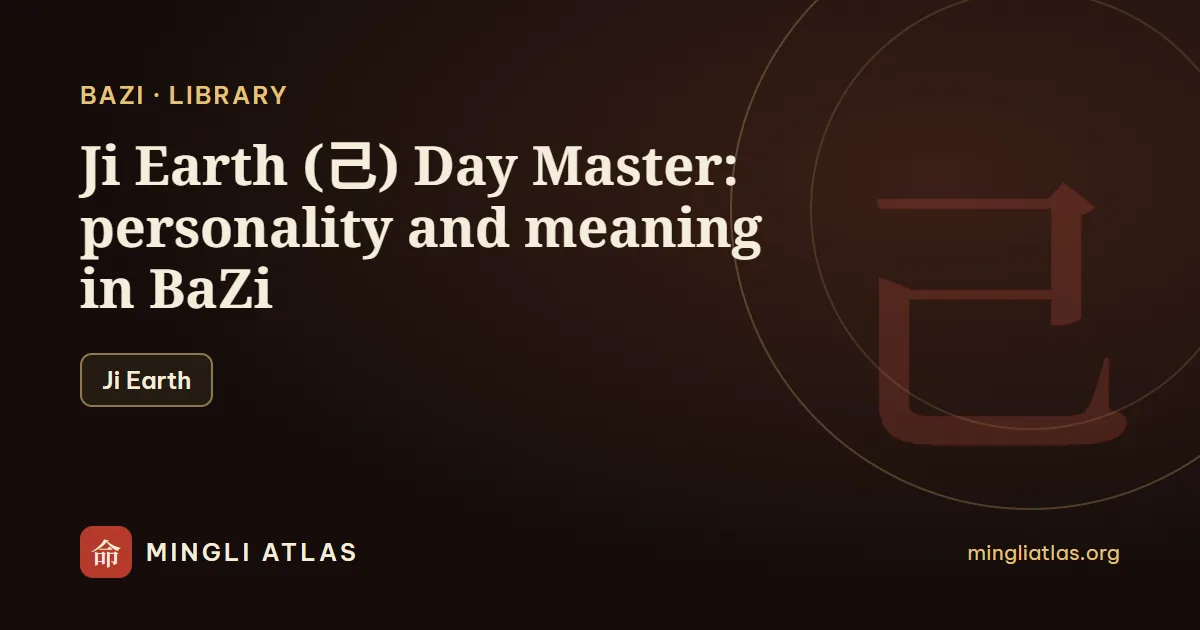
Ji (己) is Yin Earth, pictured as garden and field soil. It combines with Jia 甲. Ji years end in 9; how Ji reads as your Day Master.
At a glance
- Element: Earth
- Polarity: Yin
- Order: 6 of 10
- Combines with: Jia 甲
What is Ji Earth in BaZi?
Rule fact
Ji (己) is stem 6 of the ten Heavenly Stems, Yin Earth. Tradition pictures Ji as garden and field soil: hard-working, nurturing, good at tending and building up.
Ji Earth Day Master personality
Reading in context
As a Ji Day Master, Yin Earth, your image is garden and field soil: by nature you are hard-working, nurturing, modest and good at tending and building things up.
Which years are Ji years?
Rule fact
Ji years are the Gregorian years ending in 9, one in every ten. Across the sixty-year cycle Ji pairs with Chou, Mao, Si, Wei, You, Hai, and each year begins at Start of Spring, not on 1 January.
| Pillar | Years (Gregorian, counted from Start of Spring) |
|---|---|
| Ji Chou 丑 | 1949, 2009 |
| Ji Mao 卯 | 1939, 1999 |
| Ji Si 巳 | 1989, 2049 |
| Ji Wei 未 | 1979, 2039 |
| Ji You 酉 | 1969, 2029 |
| Ji Hai 亥 | 1959, 2019 |
What Ten God is Ji for each Day Master?
Rule fact
It depends on your own Day Master: find it in the left column. Ji also hides inside Chou 丑 (main qi), Wu 午, Wei 未 (main qi), so it can count in your chart even when no Ji stem shows.
| Day Master | Ji is |
|---|---|
| Jia 甲 | Direct Wealth |
| Yi 乙 | Indirect Wealth |
| Bing 丙 | Hurting Officer |
| Ding 丁 | Eating God |
| Wu 戊 | Rob Wealth |
| Ji 己 | Friend (the same stem) |
| Geng 庚 | Direct Resource |
| Xin 辛 | Indirect Resource |
| Ren 壬 | Direct Officer |
| Gui 癸 | Seven Killings |
Which stem does Ji combine with?
Traditional view
Ji combines with Jia 甲; the Sanming Tonghui calls it the combination of central uprightness (中正之合). Ji combining with Jia is the combination of central uprightness: people with this pair tend to be dignified, generous and upright.
「带此合主人尊崇重大,宽厚平直」
Sanming Tonghui (三命通會), vol. 2, On the Combinations of the Ten Stems
Ji Day Master born at each hour
Traditional view
The Sanming Tonghui (vol. 9) reads each birth hour separately for people with a Ji day stem. Below are the 4 lines whose conditions can be computed from a chart; each describes the overall rhythm of a life and is read together with the luck pillars.
| Birth hour | Condition | Life rhythm in the book | Original |
|---|---|---|---|
| Zi 子 hour | day Ji 己 Mao 卯 | The book holds that you tend to leave the family base early to stand on your own, and to flourish later. Even if you live far away, keep a few fixed dates each year for visiting home. | 己卯日甲子时,先破祖后旺 |
| Yin 寅 hour | day Ji 己 Si 巳 | The book holds that the early stage tends to bring setbacks, followed by growth later. Write down what each stumble taught you and reread it before you try something similar. | 己巳日丙寅时,先刑后旺 |
| Yin 寅 hour | any day with this stem | The book holds that your time tends not to come when young but that you are rich in learning, which becomes capital for later. Read for thirty minutes a day in your chosen field and keep notes. | 己日丙寅时异常,少年未遇富文章 |
| You 酉 hour | any day with this stem | The book sees adversity first and smooth going after, with ups and downs but a recurring chance to start again. When something ends, give yourself two weeks to rest and review before you start the next. | 花开花谢再重新,此命先逆后顺 |
Ji and the body
Traditional view
According to the Sanming Tonghui, Ji corresponds to the spleen (脾), the digestive system. In traditional wellbeing lore, the Ji Day Master is Yin Earth, linked with the spleen and absorption; the old practice favours warm, simple meals and less worry, and an easy habit is to eat slowly without working at the same time. This is traditional wellbeing lore, not medical advice.
「己脾」
Sanming Tonghui (三命通會), vol. 7, On Illness
Ji Day Master in work, money and love
Reading in context
As a Ji Day Master, like field soil that feeds the crops, you suit work in care, training or service, where results come from long cultivation. Like a field where you reap what you sow, your money tends to grow from diligence; each month, set aside a small fixed share for savings or for improving your skills before you spend the rest. Like soft earth, you are tolerant and tend to look after the people you love, but do not forget to look after yourself. Like a shared garden, you are the one who tends things, keeps the household’s ways and looks after its members.
Related concepts
Put it into practice
Scope: this page explains a traditional symbolic system. It is not a scientific finding and does not replace your own judgement or professional advice. Sources and calculation rules: see the Methodology page.
From reading to your chart
See your own chart
Free BaZi and Zi Wei charts, read against the classical texts, with no email needed.