Jia Wood (甲) Day Master: personality and meaning in BaZi
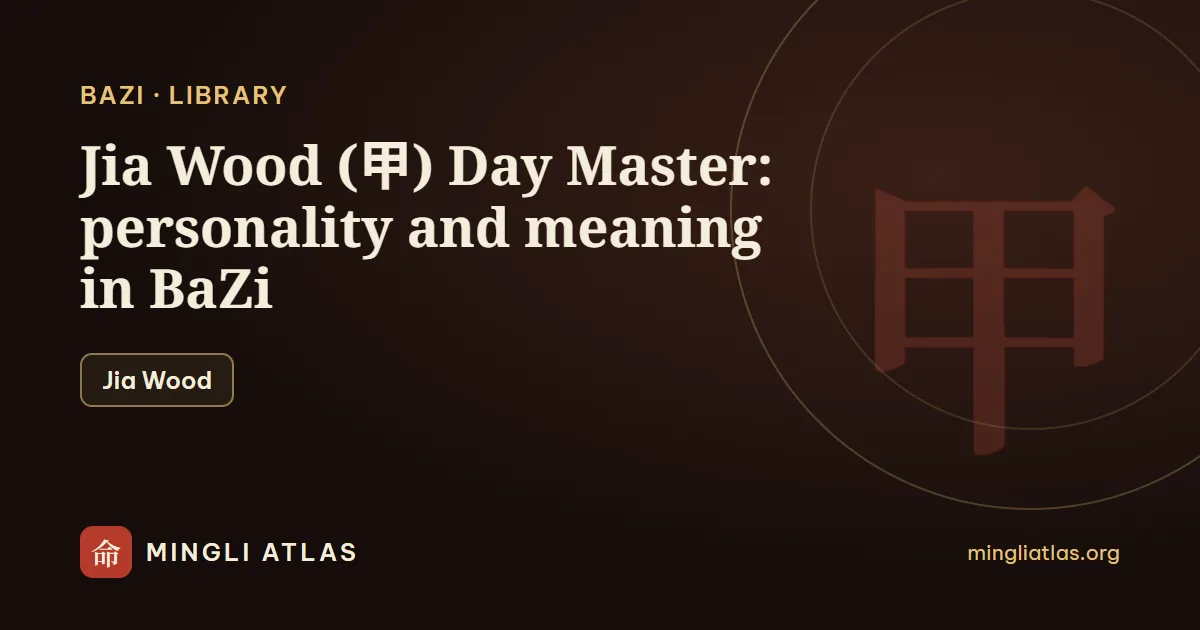
Jia (甲) is Yang Wood, pictured as a towering tree. It combines with Ji 己. Jia years end in 4; how Jia reads as your Day Master.
At a glance
- Element: Wood
- Polarity: Yang
- Order: 1 of 10
- Combines with: Ji 己
What is Jia Wood in BaZi?
Rule fact
Jia (甲) is stem 1 of the ten Heavenly Stems, Yang Wood. Tradition pictures Jia as a towering tree: straight, growing upward, needing earth to root in.
Jia Wood Day Master personality
Reading in context
As a Jia Day Master, Yang Wood, your image is the towering tree: by nature you are upright, aim to grow upward and prefer to stand on your own rather than lean on others.
Which years are Jia years?
Rule fact
Jia years are the Gregorian years ending in 4, one in every ten. Across the sixty-year cycle Jia pairs with Zi, Yin, Chen, Wu, Shen, Xu, and each year begins at Start of Spring, not on 1 January.
| Pillar | Years (Gregorian, counted from Start of Spring) |
|---|---|
| Jia Zi 子 | 1984, 2044 |
| Jia Yin 寅 | 1974, 2034 |
| Jia Chen 辰 | 1964, 2024 |
| Jia Wu 午 | 1954, 2014 |
| Jia Shen 申 | 1944, 2004 |
| Jia Xu 戌 | 1934, 1994 |
What Ten God is Jia for each Day Master?
Rule fact
It depends on your own Day Master: find it in the left column. Jia also hides inside Yin 寅 (main qi), Hai 亥, so it can count in your chart even when no Jia stem shows.
| Day Master | Jia is |
|---|---|
| Jia 甲 | Friend (the same stem) |
| Yi 乙 | Rob Wealth |
| Bing 丙 | Indirect Resource |
| Ding 丁 | Direct Resource |
| Wu 戊 | Seven Killings |
| Ji 己 | Direct Officer |
| Geng 庚 | Indirect Wealth |
| Xin 辛 | Direct Wealth |
| Ren 壬 | Eating God |
| Gui 癸 | Hurting Officer |
Which stem does Jia combine with?
Traditional view
Jia combines with Ji 己; the Sanming Tonghui calls it the combination of central uprightness (中正之合). In relationships, people with the Jia Ji combination tend to be dignified, generous and upright, trusted and respected by others.
「带此合主人尊崇重大,宽厚平直」
Sanming Tonghui (三命通會), vol. 2, On the Combinations of the Ten Stems
Jia Day Master born at each hour
Traditional view
The Sanming Tonghui (vol. 8) reads each birth hour separately for people with a Jia day stem. Below are the 7 lines whose conditions can be computed from a chart; each describes the overall rhythm of a life and is read together with the luck pillars.
| Birth hour | Condition | Life rhythm in the book | Original |
|---|---|---|---|
| Yin 寅 hour | any day with this stem | The book holds that this life tends to start hard and grow smoother later, often with help from others. Once a month, ask someone more experienced for advice; that kind of support usually starts with such a conversation. | 生来贵显有人提,此命先难后易 |
| Si 巳 hour | day Jia 甲 Zi 子 | The book holds that money tends to be tight when young and to grow more comfortable later. Starting now, move a fixed share of every income into a separate fund before you spend anything. | 甲子日己巳时,先贫后富 |
| Si 巳 hour | any day with this stem | The book describes an unusual character and holds that good fortune tends to arrive in later years. Choose one skill you want to master over the next ten years and give it two hours every week. | 为人性格不寻常,运至晚年气象 |
| Wu 午 hour | any day with this stem | The book holds that family life tends to bring challenges early on, and that you stand out more as you grow older. When tension builds at home, set a calm time to talk within the week instead of settling it in the heat of the moment. | 妻子早年刑害,晚年出众超群 |
| Wu 午 hour | any day with this stem | The book sees a life of several fresh starts, where success tends to follow a breakdown. After each setback, write down three lessons before you start the next thing. | 平生反复好翻腾,先破后成之命 |
| Wei 未 hour | day Jia 甲 Xu 戌 | The book holds that the early stage tends to bring setbacks and that respect tends to come later. Keep a written record of the commitments you have kept, since later standing is built from exactly those. | 甲戌日辛未时,先刑后贵 |
| Hai 亥 hour | born in a Shen 申 or You 酉 month | The book holds that money tends to be tight when young and to grow comfortable later. At the end of each month, review your largest expense and ask whether you would repeat it. | 申酉月,先贫后富 |
Jia and the body
Traditional view
According to the Sanming Tonghui, Jia corresponds to the gallbladder (膽). In traditional wellbeing lore, the Jia Day Master is Yang Wood, linked with stretching out and with not bottling up feelings; an easy habit to start is a ten-minute walk outdoors each morning. This is traditional wellbeing lore, not medical advice.
「甲胆」
Sanming Tonghui (三命通會), vol. 7, On Illness
Jia Day Master in work, money and love
Reading in context
As a Jia Day Master, like a great tree that needs time to take root, your career is most lasting when you choose one long-term direction and keep growing within it. Like a large tree that needs earth to root in, your money tends to be steadiest when it rests on your main profession rather than on quick gains; before any offer of fast money, ask whether it makes your main work stronger. Like a large tree giving shade, you are usually the protector in your relationships, but you also need to learn to let others care for you in return. Like a large tree in the middle of a garden, you tend to take on the role of bearing the brunt for your family.
Related concepts
Put it into practice
Scope: this page explains a traditional symbolic system. It is not a scientific finding and does not replace your own judgement or professional advice. Sources and calculation rules: see the Methodology page.
From reading to your chart
See your own chart
Free BaZi and Zi Wei charts, read against the classical texts, with no email needed.