Wei (未), the Goat branch in BaZi: hidden stems, hours and clashes
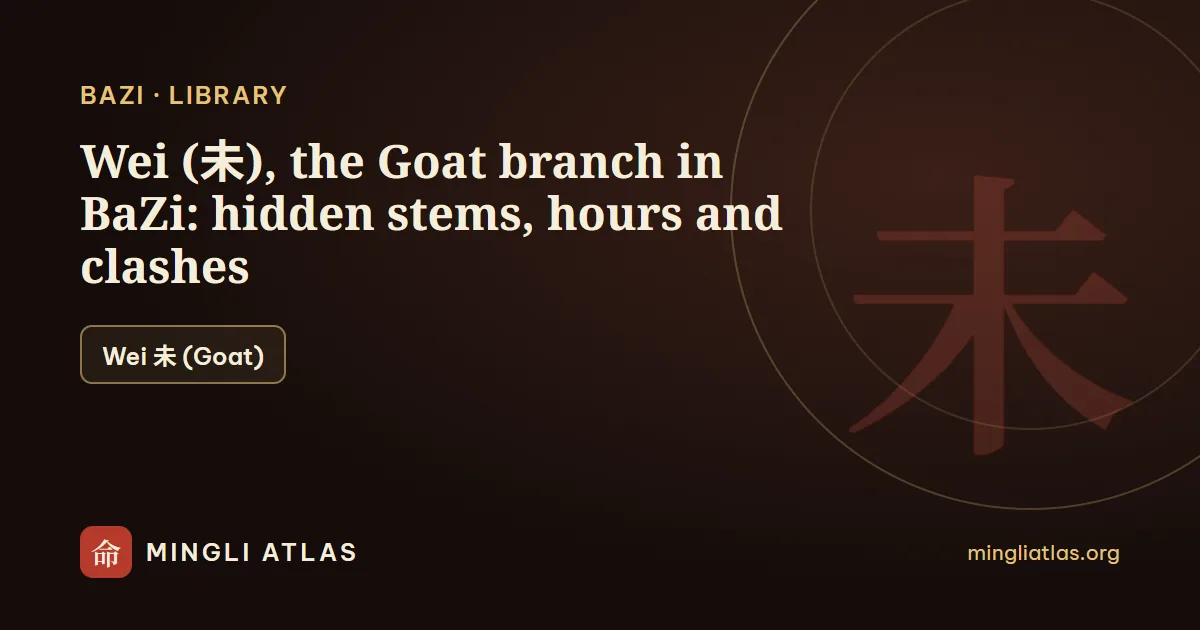
Wei (未), the Goat, is branch 8 of 12: Yin Earth, hiding Ji, Ding, Yi. Its hour runs 13:00 to 15:00; it harmonises with Wu and clashes with Chou.
At a glance
- Animal: Goat
- Element: Earth
- Polarity: Yin
- Hidden stems: Ji 己, Ding 丁, Yi 乙
What is Wei in BaZi?
Rule fact
Wei (未) is branch 8 of the twelve Earthly Branches. Its animal is the goat, its element Yin Earth. The Wei hour runs from 13:00 to 15:00. The Wei month, the sixth month of the solar-term calendar, is opened by Minor Heat (the end of summer); BaZi months follow the solar terms, not the lunar calendar.
Hidden stems of Wei
Rule fact
Wei hides Ji 己, Ding 丁, Yi 乙; Ji is the main qi and the others are secondary qi. Hidden stems (藏干) are the Heavenly Stems held inside a branch, so each one also counts as a Ten God against your Day Master.
| Day Master | Ji 己 (main qi) is | Ding 丁 is | Yi 乙 is |
|---|---|---|---|
| Jia 甲 | Direct Wealth | Hurting Officer | Rob Wealth |
| Yi 乙 | Indirect Wealth | Eating God | Friend (the same stem) |
| Bing 丙 | Hurting Officer | Rob Wealth | Direct Resource |
| Ding 丁 | Eating God | Friend (the same stem) | Indirect Resource |
| Wu 戊 | Rob Wealth | Direct Resource | Direct Officer |
| Ji 己 | Friend (the same stem) | Indirect Resource | Seven Killings |
| Geng 庚 | Direct Resource | Direct Officer | Direct Wealth |
| Xin 辛 | Indirect Resource | Seven Killings | Indirect Wealth |
| Ren 壬 | Direct Officer | Direct Wealth | Hurting Officer |
| Gui 癸 | Seven Killings | Indirect Wealth | Eating God |
Which branches does Wei combine and clash with?
Rule fact
Wei forms a Six Harmony with Wu 午 and a Six Clash with Chou 丑.
| Relation | Branches |
|---|---|
| Six Harmony (六合) | Wu 午 |
| Six Clash (六沖) | Chou 丑 |
| Six Harm (六害) | Zi 子 |
| Three Harmony (三合) | Hai 亥, Mao 卯, Wei 未 (Wood) |
| Directional combination (三會) | Si 巳, Wu 午, Wei 未 (Fire, South) |
| Three Punishments (三刑) | Chou 丑, Xu 戌, Wei 未 |
Goat years: the Wei pillars
Rule fact
Goat years come round every twelve years. Because a branch only pairs with stems of its own polarity, Wei meets just the five yin stems Yi, Ding, Ji, Xin, Gui, giving the pillars below.
| Pillar | Years |
|---|---|
| Yi 乙 Wei | 1955, 2015 |
| Ding 丁 Wei | 1967, 2027 |
| Ji 己 Wei | 1979, 2039 |
| Xin 辛 Wei | 1931, 1991 |
| Gui 癸 Wei | 1943, 2003 |
Born in the Wei hour, according to the Sanming Tonghui
Traditional view
The Sanming Tonghui (vols. 8 and 9) has 11 lines on people born in the Wei hour, each tied to a day stem.
| Day stem | Condition | Life rhythm in the book | Original |
|---|---|---|---|
| Jia 甲 | day Jia 甲 Xu 戌 | The book holds that the early stage tends to bring setbacks and that respect tends to come later. Keep a written record of the commitments you have kept, since later standing is built from exactly those. | 甲戌日辛未时,先刑后贵 |
| Yi 乙 | day Yi 乙 Si 巳 | The book holds that things tend to start hard and grow easier, bringing later either standing or means. In the hard years, set one small goal per quarter so you can see your progress. | 乙巳日癸未时,不贵则富,先难后易 |
| Yi 乙 | any day with this stem | The book holds that you tend to build your career yourself with help from supporters, tight on money early and comfortable later. When someone helps you, thank them specifically within 24 hours and stay in touch afterwards. | 自立自成事业,六亲骨肉亲疏,贵人得合两相扶,此命先贫后富 |
| Ding 丁 | any day with this stem | The book holds that breaking through is hard when young, and that after several difficult stretches things tend to pick up in middle age. Split big goals into three-month milestones and log each one you pass to keep your stamina. | 二丁相遇未时排,险路中年发福来……少年难发等时来 |
| Wu 戊 | day Wu 戊 Yin 寅 | The book holds that things tend to start hard and grow easier, with mentors guiding you. Find a mentor in your field and meet them regularly, once a quarter. | 戊寅日己未时,先难后易,贵人提携 |
| Wu 戊 | any day with this stem | The book holds that things tend to be quiet at first and brighter later, with someone helping you out of hard times. Let people know what you are doing: once a month, share your progress with someone in your field. | 先暗后明凶变吉,贵人提携出尘埋 |
| Geng 庚 | any day with this stem | The book holds that much is uncertain at first and becomes solid later. Test each plan with one small step whose result you can measure before you put more into it. | 先虚后实 |
| Xin 辛 | any day with this stem | The book holds that good fortune tends to come early, from your first years. While things go well, set aside a steady share for less favourable years. | 经历初年发福 |
| Ren 壬 | day Ren 壬 Xu 戌 | The book warns that family life tends to be tested in middle age. Keep a fixed time each week just for your loved ones and do not let work crowd into it. | 中年又损妻子 |
| Ren 壬 | any day with this stem | The book holds that love and children tend not to go smoothly when young, and that life is peaceful from middle age on. In a disagreement, talk about how you feel rather than pointing out the other person’s fault. | 鸳帏子息早年乖,中末依然享泰 |
| Gui 癸 | any day with this stem | The book holds that money tends to be tight early and comfortable later, and that letting go of the old to welcome the new is one of your strengths. Each year, review one habit or commitment that no longer fits and drop it. | 纵然先贫后富来,弃旧迎新无碍 |
The Wei palace in Zi Wei: which stars are bright?
Traditional view
In a palace at Wei, Zi Wei, Wu Qu, Tian Fu, Tan Lang and Qi Sha reach Temple brightness, the highest level found here. The table gives every main star’s brightness at Wei, following the Ziwei Doushu Quanshu.
| Brightness | Main stars |
|---|---|
| Temple (廟) | Zi Wei, Wu Qu, Tian Fu, Tan Lang, Qi Sha |
| Prosperous (旺) | Tian Liang, Po Jun |
| Favourable (得地) | Tai Yang, Tian Xiang |
| Beneficial (利益) | Lian Zhen |
| Unfavourable (不得地) | Tian Tong, Tai Yin, Ju Men |
| Fallen (落陷) | Tian Ji |
Related concepts
Put it into practice
Scope: this page explains a traditional symbolic system. It is not a scientific finding and does not replace your own judgement or professional advice. Sources and calculation rules: see the Methodology page.
From reading to your chart
See your own chart
Free BaZi and Zi Wei charts, read against the classical texts, with no email needed.