Spring Equinox 2027 (Chunfen): Date, Pentads, BaZi Month
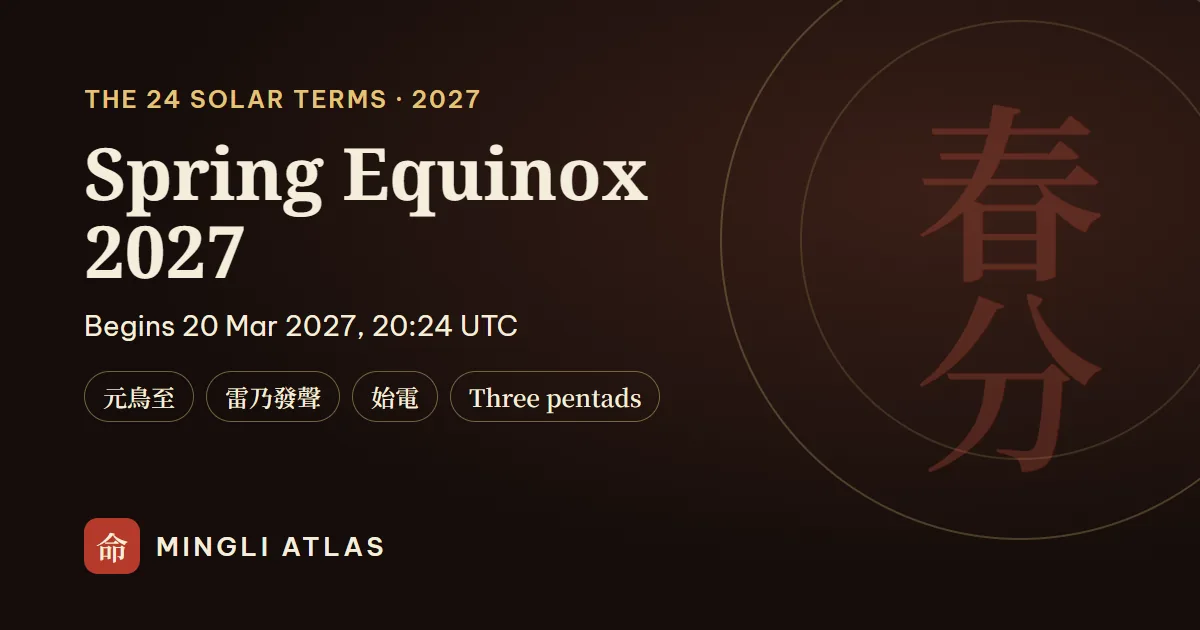
The Spring Equinox (春分, Chunfen) of 2027 falls on Saturday 20 March 2027 at 20:24 UTC, which is already 04:24 on Sunday 21 March in Beijing and 03:24 in Vietnam. In the Chinese calendar it is the midpoint of spring, and it lasts until Clear and Bright on 5 April. It is a midpoint term (中氣), so the BaZi month stays Gui Mao throughout. This guide gives the 2027 pentad dates, the classical lines behind them, and three habits for the middle of spring.
When is the Spring Equinox 2027?
The Spring Equinox 2027 falls on 20 March at 20:24 UTC, when the sun reaches 0° of ecliptic longitude. In London that is 20:24 on 20 March; in New York 16:24 the same afternoon. In China and Vietnam the date is 21 March. The moment falls on a Ji Hai (己亥) day, in a Gui Mao (癸卯) month of a Ding Wei (丁未) year. The term lasts fifteen days, until Clear and Bright (清明) begins on 5 April 2027 at 00:17 UTC.
| Milestone | UTC | Beijing (UTC+8) |
|---|---|---|
| Awakening of Insects (previous term) | 5 Mar 2027, 19:39 | 6 Mar, 03:39 |
| Spring Equinox | 20 Mar 2027, 20:24 | 21 Mar, 04:24 |
| Clear and Bright (next term) | 5 Apr 2027, 00:17 | 5 Apr, 08:17 |
This is why Western almanacs give 20 March and Chinese calendars give 21 March: it is the same instant in different time zones. The time comes from the same calendar function that drives the Mingli Atlas chart tools.
The three pentads of the Spring Equinox 2027
Each solar term splits into three pentads (候) of about five days. In 2027, counted by Vietnam calendar days, they fall as follows.
| Pentad | Dates (2027) | Chinese | Meaning |
|---|---|---|---|
| First | 21 to 25 March | 元鳥至 | Swallows return |
| Second | 26 to 30 March | 雷乃發聲 | Thunder begins to sound |
| Third | 31 March to 4 April | 始電 | Lightning first appears |
The commentary on the pentads writes the swallow as 元鳥, while the Book of Rites and the Shi Xun chapter of the Yi Zhou Shu write 玄鳥. It is the same bird; 元 for 玄 is most likely the Qing taboo on the Kangxi emperor’s personal name (玄燁), though the transcription does not say so. The other two pentads are thunder and lightning: the first storms of the year.
What do the classical texts say about the Spring Equinox?
「春分,二月中。分者,半也。此當九十日之半,故謂之分。」
Yueling Qishier Hou Jijie (月令七十二候集解), section 春分
In plain words: the Spring Equinox is the midpoint of the second month. “Fen” means half: it falls at the middle of spring’s ninety days. The “second month” is the Mao (卯) month of the solar calendar, not the second lunar month.
The Book of Rites puts three signs of mid spring in one line:
「是月也,日夜分,雷乃發聲,始電。」
Book of Rites, Monthly Ordinances (禮記·月令), 仲春之月
This month day and night are equal, thunder begins to sound and lightning first appears. The second and third pentads come straight from this line.
What should you do at the Spring Equinox?
The Huangdi Neijing opens its spring passage like this:
「春三月,此謂發陳。天地俱生,萬物以榮。」
Huangdi Neijing, Suwen (素問), chapter 四氣調神大論
The three months of spring are called “issuing forth and spreading out”: heaven and earth give life together, and all things flourish. The concrete advice follows:
「夜臥早起,廣步於庭,被髮緩形,以使志生,生而勿殺,予而勿奪,賞而勿罰」
Huangdi Neijing, Suwen (素問), chapter 四氣調神大論
In plain words: go to bed a little later and rise early, walk with long easy strides in the courtyard, let your hair down and loosen the body, so that the will can grow; nurture rather than kill, give rather than take, reward rather than punish. Three habits fit the middle of spring:
- Review your goals at the halfway point. “Fen means half” (分者,半也). The equinox also falls near the end of the first quarter. Spend one evening in the week of 21 March rereading the list you wrote in January: keep what still fits and strike out what no longer matters to you.
- Take an easy walk after dinner. “Walk with long strides in the courtyard” (廣步於庭) is plain advice. The days are lengthening; twenty slow minutes around the block after the evening meal is the simplest way to follow it.
- Loosen what binds you. “Let the hair down, loosen the body” (被髮緩形) suggests comfort over constraint. Wear loose clothes at home, and when you work for long stretches, stand and stretch for a few minutes every hour.
These are lifestyle readings of a classical text, not medical advice. If you have asthma, allergies or a heart condition, ask your doctor how much outdoor activity suits you as the season turns.
Does the Spring Equinox change the BaZi month?
No. The equinox is a midpoint term (中氣) inside the Mao month, so everyone born from Awakening of Insects (5 March 2027, 19:39 UTC) up to Clear and Bright (5 April 2027, 00:17 UTC) has the month pillar Gui Mao (癸卯). The year pillar is Ding Wei (丁未): the BaZi year already changed at the Start of Spring on 4 February 2027.
The next boundary to watch is Clear and Bright, when the month pillar becomes Jia Chen (甲辰). For a birth near that moment, enter the exact hour and minute in the BaZi chart calculator, which converts your local time zone for you.
Is it spring everywhere?
Only in the Northern Hemisphere. South of the equator the same instant is the autumn equinox, and the days there now grow shorter. Everywhere on Earth, day and night are close to twelve hours each; measured carefully, daytime runs a few minutes longer, because sunrise and sunset are timed by the upper edge of the sun and the atmosphere bends its light. The Chinese name and its pentads follow the northern sky.
Follow the Spring Equinox day by day
The Today page shows the solar term, pentad and day pillar of each day, and sets the day beside your own chart if you have made one. For the term itself, read what the Spring Equinox is in the solar terms section. The previous term is Awakening of Insects 2027; the next is Clear and Bright 2027.
Keep reading
From reading to your chart
See your own chart
Free BaZi and Zi Wei charts, read against the classical texts, with no email needed.