End of Heat 2028: When the Heat Stops, Pentads, Habits
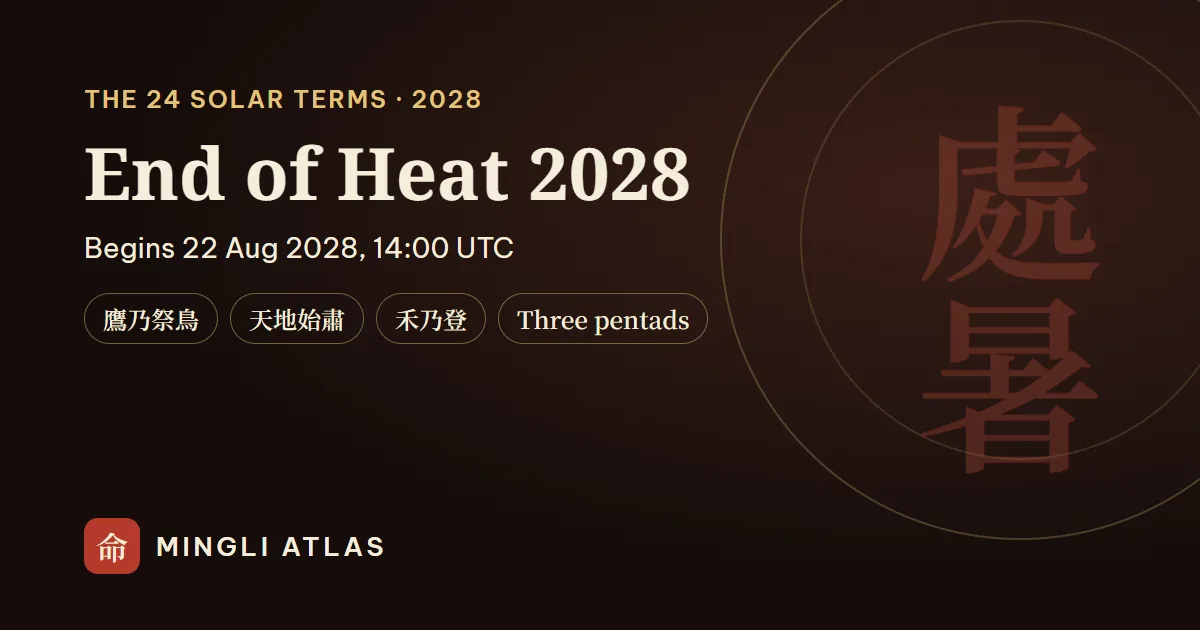
End of Heat (處暑, Chushu) begins on Tuesday 22 August 2028 at 14:00 UTC: 22:00 in Beijing, 21:00 in Vietnam, 15:00 in London and 10:00 in New York, all on the same date. It lasts until White Dew on 7 September (UTC). The name means “the heat stops here”. It is a midpoint term (中氣), so the BaZi month does not change: the whole term sits inside the Geng Shen month of a Wu Shen year. This guide gives the 2028 pentad dates, what is different from last year, and three habits for closing out the summer.
When does End of Heat 2028 begin?
End of Heat 2028 begins on 22 August 2028 at 14:00 UTC, when the sun reaches 150° of ecliptic longitude. The moment falls on a Ji Mao (己卯) day, in a Geng Shen (庚申) month of a Wu Shen (戊申) year. The term lasts about fifteen and a half days, until White Dew (白露) begins on 7 September at 02:22 UTC.
| Milestone | UTC | Beijing (UTC+8) |
|---|---|---|
| Start of Autumn (previous term) | 6 Aug 2028, 23:21 | 7 Aug, 07:21 |
| End of Heat | 22 Aug 2028, 14:00 | 22 Aug, 22:00 |
| White Dew (next term) | 7 Sep 2028, 02:22 | 7 Sep, 10:22 |
The times come from the same calendar function that drives the Mingli Atlas chart tools. Many general references say the term begins “around 23 August”; in 2028 it comes a day earlier than that.
End of Heat 2028 pentad dates
Each solar term splits into three pentads (候). The dates below are Vietnam calendar days; the third runs six days, because White Dew arrives there on the morning of 7 September.
| Pentad | Dates (2028) | Chinese | Meaning |
|---|---|---|---|
| First | 22 to 26 August | 鷹乃祭鳥 | Hawks lay out their prey |
| Second | 27 to 31 August | 天地始肅 | Heaven and earth turn austere |
| Third | 1 to 6 September | 禾乃登 | The grain ripens for harvest |
The first pentad is a striking image: the hawk sets out the birds it has caught before eating, as if making an offering. The old calendar used it to mark the season when hunters start building reserves for the cold. For the third pentad the Book of Rites has “the farmers bring in the grain” (農乃登穀), shifting the focus from the crop to the people harvesting it.
Why is it called End of Heat?
「處暑,七月中。處,止也。暑氣至此而止矣。」
Yueling Qishier Hou Jijie (月令七十二候集解), section 處暑
In plain words: End of Heat is the midpoint of the seventh month. “Chu” (處) means to stop; the heat stops here. The character usually means “place”, but the classical gloss settles it as “stop”. The “seventh month” is the Shen (申) month of the solar calendar.
「秋三月,此謂容平。天氣以急,地氣以明。」
Huangdi Neijing, Suwen (素問), chapter 四氣調神大論
The three months of autumn are called “form settled and level”: things have taken their shape, heaven’s qi turns brisk and earth’s qi turns clear. Around End of Heat the briskness starts to show in quicker changes of wind and sudden showers.
What to do during End of Heat 2028
The Huangdi Neijing’s advice for autumn:
「早臥早起,與雞俱興,使志安寧,以緩秋刑,收斂神氣,使秋氣平,無外其志,使肺氣清」
Huangdi Neijing, Suwen (素問), chapter 四氣調神大論
Go to bed early and rise early, with the rooster; keep the mind calm; gather your spirit in and do not let your intent scatter; keep the breath of the lungs clear. Last year’s post was about the harvest; this year’s three habits start from the word “stop” and the hawk:
- Stop one thing that no longer helps. The gloss is blunt: “chu means stop” (處,止也). Pick one subscription, noisy group chat or standing meeting that costs time or money without giving much back, and end it in the first week of the term.
- Take stock before you buy more. The first pentad has the hawk laying out its prey before eating (鷹乃祭鳥). Before your next shop, open the fridge and cupboards, cook what is close to its date, and only then write the list.
- Clear the small jobs quickly. The Neijing says “heaven’s qi turns brisk” (天氣以急). Spend twenty minutes each evening on tasks that take under five minutes: one reply, one form, one appointment booked.
These are lifestyle readings of a classical text, not medical advice. Late August is still hot in many places, so keep drinking water and avoid the midday sun. If you are being treated for a breathing, heart or other chronic condition, follow your doctor through the change of season.
How End of Heat 2028 differs from 2027
In 2027, End of Heat began on Monday 23 August at 08:14 UTC. In 2028 it begins on Tuesday 22 August at 14:00 UTC: a day earlier on the calendar, later in the day. Because 2028 is a leap year, 365 days after last year’s moment only reaches 08:14 UTC on 22 August 2028, and the term arrives 5 hours 46 minutes after that.
Last year the moment fell on a Ding Wei year, Wu Shen month and Jia Xu day; this year it is a Wu Shen year, Geng Shen month and Ji Mao day. The month is a Shen month both times; only its stem has moved from Wu to Geng.
Does End of Heat change the month pillar in BaZi?
No. End of Heat is a midpoint term (中氣), so it sits inside the Shen month. Everyone born from Start of Autumn (6 August 2028, 23:21 UTC) up to White Dew (7 September 2028, 02:22 UTC) has the month pillar Geng Shen (庚申) and the year pillar Wu Shen (戊申).
The next boundary is White Dew, when the month becomes Xin You (辛酉). It falls at 22:22 on 6 September in New York but 03:22 on 7 September in London and 10:22 in Beijing. Enter the exact hour and minute in the BaZi chart calculator, which converts your local time zone for you.
Does the heat really end now?
Only in a climate like northern China’s, and only roughly. In much of the northern hemisphere late August is still summer; in monsoon Asia the rains and typhoons carry on into September. In the Southern Hemisphere late August is the end of winter. Read the term as the sun passing 150° of ecliptic longitude, an instant shared by the whole planet.
Follow End of Heat day by day
The Today page shows the solar term, pentad and day pillar of each day, and sets the day beside your own chart if you have made one. For the term itself, read what End of Heat is in the solar terms section. The previous term is Start of Autumn 2028; the next is White Dew 2028.
Keep reading
From reading to your chart
See your own chart
Free BaZi and Zi Wei charts, read against the classical texts, with no email needed.