Grain Buds 2028 (Xiaoman): 20 May Start and Pentads
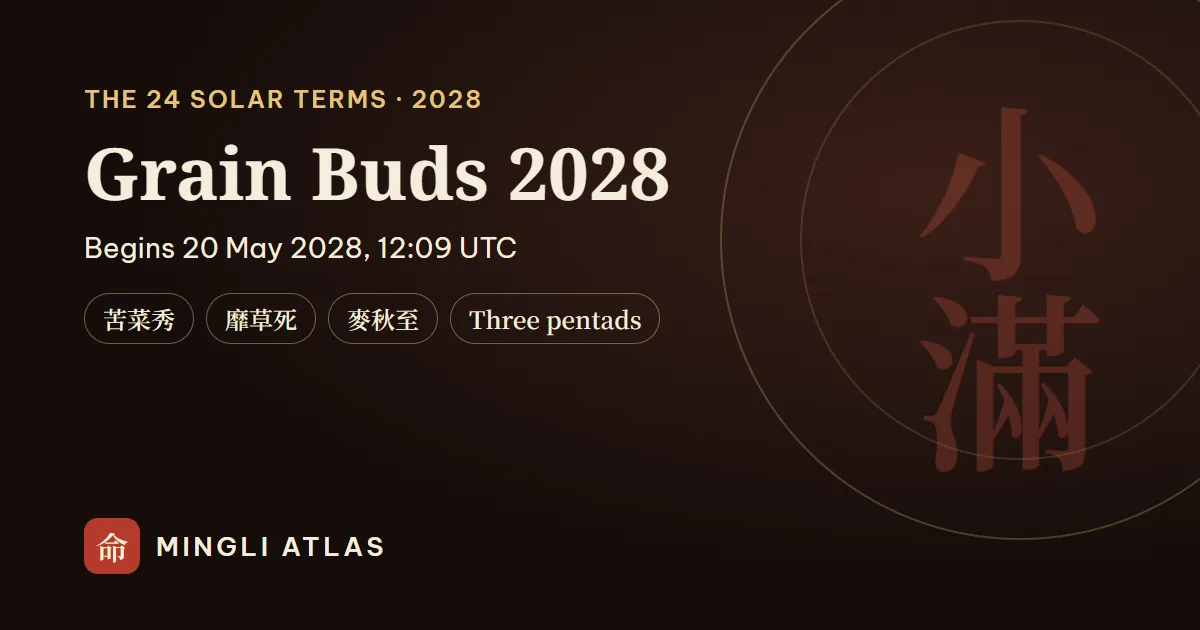
Grain Buds (小滿, Xiaoman) begins on Saturday 20 May 2028 at 12:09 UTC (20:09 in Beijing, 19:09 in Vietnam) and lasts until Grain in Ear, which begins early on 5 June in UTC. It is a midpoint term (中氣), so the BaZi month stays Ding Si throughout. This guide gives the 2028 pentad dates, explains why the timing has shifted since 2027, reads the name “slight fullness” from the classical commentary, and suggests three habits for the weeks when the sun climbs.
When is Grain Buds 2028?
Grain Buds 2028 begins on 20 May at 12:09 UTC, when the sun reaches 60° of ecliptic longitude. In London that is 13:09 (British Summer Time); in New York 08:09 the same morning, so every major time zone shares the date. The moment falls on a Yi Si (乙巳) day, in a Ding Si (丁巳) month of a Wu Shen (戊申) year. The term lasts about fifteen and a half days, until Grain in Ear (芒種) begins on 5 June 2028 at 03:16 UTC.
| Milestone | UTC | Beijing (UTC+8) |
|---|---|---|
| Start of Summer (previous term) | 4 May 2028, 23:12 | 5 May, 07:12 |
| Grain Buds | 20 May 2028, 12:09 | 20 May, 20:09 |
| Grain in Ear (next term) | 5 Jun 2028, 03:16 | 5 Jun, 11:16 |
The time comes from the same calendar function that drives the Mingli Atlas chart tools. Note that the next boundary, Grain in Ear, is still the evening of 4 June in New York.
The three pentads of Grain Buds 2028
Each solar term splits into three pentads (候). Counted by Vietnam calendar days, the third runs six days, from 30 May to 4 June, because Grain in Ear arrives only on the morning of 5 June in Vietnam.
| Pentad | Dates (2028) | Chinese | Meaning |
|---|---|---|---|
| First | 20 to 24 May | 苦菜秀 | Sow thistle flowers |
| Second | 25 to 29 May | 靡草死 | Delicate grasses wither |
| Third | 30 May to 4 June | 麥秋至 | The wheat harvest arrives |
Bitter greens bloom, fine grasses wilt as the sun strengthens, and the wheat ripens; the “autumn” in 麥秋 is the wheat’s harvest time, not the season. The witnesses disagree about the third pentad: the Shi Xun chapter of the Yi Zhou Shu puts 小暑至 (“minor heat arrives”) here, while the Book of Rites keeps 麥秋至 in the first month of summer and moves 小暑至 to the second. The table follows the commentary on the pentads, which is what the Mingli Atlas tools use.
How 2028 differs from 2027
In 2027 Grain Buds began on 21 May at 06:18 UTC; in 2028 it begins on 20 May at 12:09 UTC. The sun needs nearly six hours more than 365 days to return to the same point, so adding exactly 365 days to last year’s moment reaches 20 May 2028 at 06:18 UTC, and this year’s start comes 351 minutes later, about 5 hours 51 minutes. The date moves back a day because 2028 is a leap year: with 29 February in the calendar, terms after February fall one date earlier than in a common year.
The pillars at the start change as well: in 2027 a Geng Zi (庚子) day, Yi Si (乙巳) month and Ding Wei (丁未) year; in 2028 a Yi Si day, Ding Si month and Wu Shen year. By coincidence, this year’s day carries the same name as last year’s month. Last year’s guide is Grain Buds 2027.
Why is it called Grain Buds?
「小滿,四月中。小滿者,物至于此小得盈滿。」
Yueling Qishier Hou Jijie (月令七十二候集解), section 小滿
In plain words: Grain Buds is the midpoint of the fourth month; by now things have filled out a little, but not completely. Think of a wheat kernel at the milky stage, with substance inside but not yet hard. The “fourth month” is the Si month of the solar calendar, so the term sits in its middle, halfway between the Start of Summer and Grain in Ear.
What should you do during Grain Buds?
Grain Buds sits in the three months of summer that the Huangdi Neijing describes:
「夏三月,此謂蕃秀。天地氣交,萬物華實。」
Huangdi Neijing, Suwen (素問), chapter 四氣調神大論
The three months of summer are called “lush and flowering”: the qi of heaven and earth mingle, and all things blossom and bear fruit. Its advice for the season:
「夜臥早起,無厭於日,使志無怒,使華英成秀,使氣得泄,若所愛在外」
Huangdi Neijing, Suwen (素問), chapter 四氣調神大論
In plain words: go to bed a little later and rise early, do not resent the sun; keep the mind free of anger, let the flowers ripen, let the qi flow out, as if what you love were outside. This year, three habits fit the fortnight:
- Welcome the early sun, avoid the noon sun. “Do not resent the sun” (無厭於日) does not mean baking at midday. Late May mornings start early; spend fifteen minutes walking outdoors before eight, and keep to the shade between about ten and three.
- Book difficult conversations for the cool hours. “Keep the mind free of anger” (使志無怒). If you need to give someone feedback or talk money at home, choose the morning or a cool evening rather than a sticky afternoon, when everyone is quicker to snap.
- Harvest one small result before the end of May. The third pentad is “the wheat harvest arrives” (麥秋至). Five months of the year have passed; take fifteen minutes to write down three things you have finished since January, however small, and one you will wrap up before midyear.
These are lifestyle readings of a classical text, not medical advice. In hot weather drink water regularly and avoid heavy outdoor work at midday; older people, small children and anyone with a heart, blood pressure or kidney condition should follow their doctor’s advice and local heat warnings.
Does Grain Buds change the BaZi month?
No. Grain Buds is a midpoint term (中氣) inside the Si month, so everyone born from the Start of Summer (4 May 2028, 23:12 UTC) up to Grain in Ear (5 June 2028, 03:16 UTC) has the month pillar Ding Si (丁巳). The year pillar is Wu Shen (戊申).
The next boundary is Grain in Ear, when the month pillar becomes Wu Wu (戊午). It falls in the small hours of 5 June in London but at 23:16 on 4 June in New York, so a birth around that night can fall on either side. Enter the exact hour and minute in the BaZi chart calculator, which converts your local time zone for you.
What does “slight fullness” look like outside China?
The pentads describe the wheat country of the Yellow River basin. Vietnam grows almost no wheat, yet the sense of “nearly full” still fits: in the Red River Delta the spring rice crop is usually filling and ripening now, central Vietnam often sees hot, dry westerly winds from May, and in the south the rains have typically begun. In the Southern Hemisphere the same instant falls in late autumn. Read the term as a note about ripeness: close, but not the moment to rush.
Follow Grain Buds day by day
The Today page shows the solar term, pentad and day pillar of each day, and sets the day beside your own chart if you have made one. For the term itself, read what Grain Buds is in the solar terms section. The previous term is Start of Summer 2028; the next is Grain in Ear 2028.
Keep reading
From reading to your chart
See your own chart
Free BaZi and Zi Wei charts, read against the classical texts, with no email needed.