Grain Buds 2027 (Xiaoman): Date, Pentads and BaZi Month
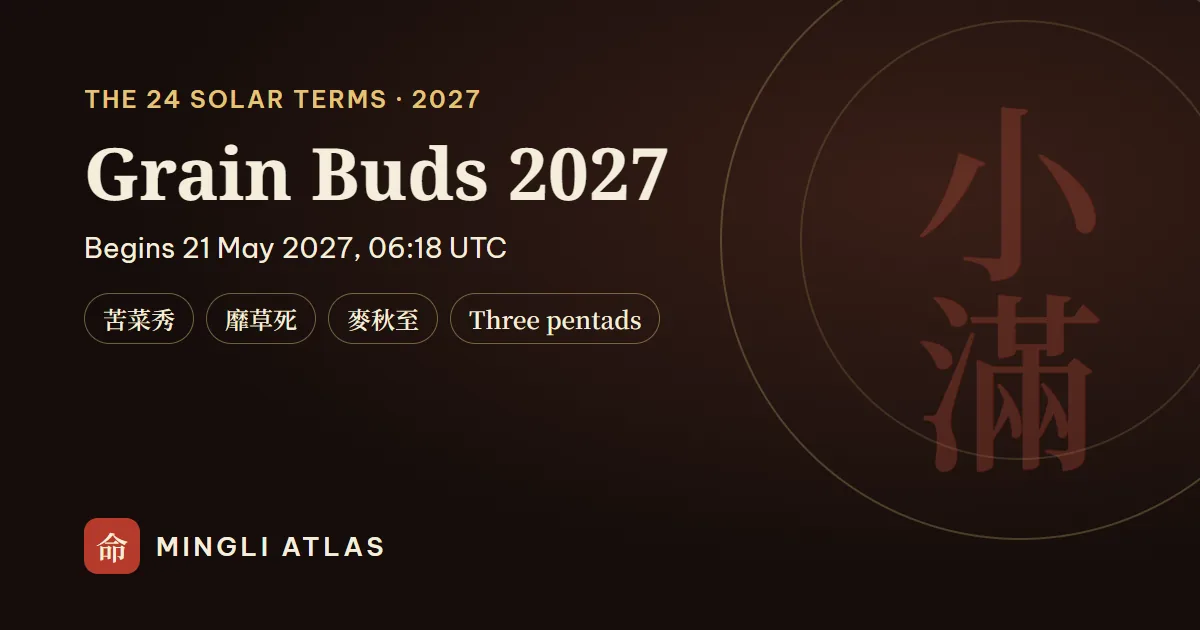
Grain Buds (小滿, Xiaoman) begins on Friday 21 May 2027 at 06:18 UTC (14:18 in Beijing, 13:18 in Vietnam) and lasts until Grain in Ear, which begins on the evening of 5 June in UTC. It is a midpoint term (中氣), so the BaZi month stays Yi Si throughout. This guide gives the 2027 pentad dates, explains “slight fullness” from the classical commentary, shows where the old witnesses disagree on the third pentad, and suggests three habits for early summer.
When is Grain Buds 2027?
Grain Buds 2027 begins on 21 May at 06:18 UTC, when the sun reaches 60° of ecliptic longitude. In London that is 07:18 (British Summer Time); in New York 02:18 the same night. The moment falls on a Geng Zi (庚子) day, in a Yi Si (乙巳) month of a Ding Wei (丁未) year. The term lasts a little over fifteen days, until Grain in Ear (芒種) begins on 5 June 2027 at 21:25 UTC, which is already early on 6 June in East Asia.
| Milestone | UTC | Beijing (UTC+8) |
|---|---|---|
| Start of Summer (previous term) | 5 May 2027, 17:25 | 6 May, 01:25 |
| Grain Buds | 21 May 2027, 06:18 | 21 May, 14:18 |
| Grain in Ear (next term) | 5 Jun 2027, 21:25 | 6 Jun, 05:25 |
The time comes from the same calendar function that drives the Mingli Atlas chart tools.
The three pentads of Grain Buds 2027
Each solar term splits into three pentads (候). In 2027, counted by Vietnam calendar days, they fall as follows; the third runs six days, because Grain in Ear arrives before dawn on 6 June in Vietnam.
| Pentad | Dates (2027) | Chinese | Meaning |
|---|---|---|---|
| First | 21 to 25 May | 苦菜秀 | Sow thistle flowers |
| Second | 26 to 30 May | 靡草死 | Delicate grasses wither |
| Third | 31 May to 5 June | 麥秋至 | The wheat harvest arrives |
The third pentad says literally “the wheat’s autumn arrives” (麥秋): autumn here means harvest time, not the season. The witnesses disagree about it. The Shi Xun chapter of the Yi Zhou Shu gives 小暑至 (“minor heat arrives”) as the third pentad of Grain Buds instead, and the Book of Rites keeps 麥秋至 in the first month of summer and opens the second month with 小暑至. The table follows the commentary on the pentads, which is what the Mingli Atlas tools use.
Why is it called Grain Buds?
「小滿,四月中。小滿者,物至于此小得盈滿。」
Yueling Qishier Hou Jijie (月令七十二候集解), section 小滿
In plain words: Grain Buds is the midpoint of the fourth month; by now things have filled out a little, but not completely. Note that the 24 terms pair Minor Cold with Major Cold and Minor Heat with Major Heat, yet there is no “major fullness”. The name stops at enough.
What should you do during Grain Buds?
Grain Buds sits in the three months of summer that the Huangdi Neijing describes:
「夏三月,此謂蕃秀。天地氣交,萬物華實。」
Huangdi Neijing, Suwen (素問), chapter 四氣調神大論
The three months of summer are called “lush and flowering”: the qi of heaven and earth mingle, and all things blossom and bear fruit. Its advice for the season:
「夜臥早起,無厭於日,使志無怒,使華英成秀,使氣得泄,若所愛在外」
Huangdi Neijing, Suwen (素問), chapter 四氣調神大論
In plain words: go to bed a little later and rise early, do not resent the sun; keep the mind free of anger, let the flowers ripen, let the qi flow out, as if what you love were outside. Read together with “slightly full, not overflowing”, three habits fit this fortnight:
- Fill your week, but not to the brim. “Slightly full” (小得盈滿). When you plan the week, book about four fifths of your time and leave one half day entirely open, for what comes up or for rest.
- Finish one thing that is half done. “Let the flowers ripen into fruit” (使華英成秀). Pick one project you started earlier in the year and left unfinished, set a deadline before Grain in Ear on 6 June, and hold off on starting anything new.
- Air the house in the cool hours. “Let the qi flow out” (使氣得泄). Open the windows in the early morning and evening, wear breathable fabrics, and avoid keeping the house sealed with the air conditioning on all day.
These are lifestyle readings of a classical text, not medical advice. In hot weather, older people, small children and anyone with a heart, blood pressure or kidney condition should follow their doctor’s advice on fluids, activity and staying cool.
Does Grain Buds change the BaZi month?
No. Grain Buds is a midpoint term (中氣) inside the Si month, so everyone born from the Start of Summer (5 May 2027, 17:25 UTC) up to Grain in Ear (5 June 2027, 21:25 UTC) has the month pillar Yi Si (乙巳). The year pillar is Ding Wei (丁未).
The next boundary is Grain in Ear, when the month pillar becomes Bing Wu (丙午). It falls on the evening of 5 June in Europe and the Americas but before dawn on 6 June in Asia, so enter the exact hour and minute in the BaZi chart calculator, which converts your local time zone for you.
What if there is no wheat where you live?
The pentads describe the Yellow River basin, where wheat ripens in early summer. Vietnam grows almost no wheat, yet the rhythm of “nearly full, nearly harvest” still holds there: in the Red River Delta, late May and June are usually when the winter and spring rice crop is cut, and in the south the rains have often begun. In the Southern Hemisphere the same instant falls in late autumn. Read Grain Buds as a note about ripeness: close, but not the moment to rush.
Follow Grain Buds day by day
The Today page shows the solar term, pentad and day pillar of each day, and sets the day beside your own chart if you have made one. For the term itself, read what Grain Buds is in the solar terms section. The previous term is Start of Summer 2027; the next is Grain in Ear 2027.
Keep reading
From reading to your chart
See your own chart
Free BaZi and Zi Wei charts, read against the classical texts, with no email needed.