Start of Summer 2027 (Lixia): Date, Pentads, BaZi Month
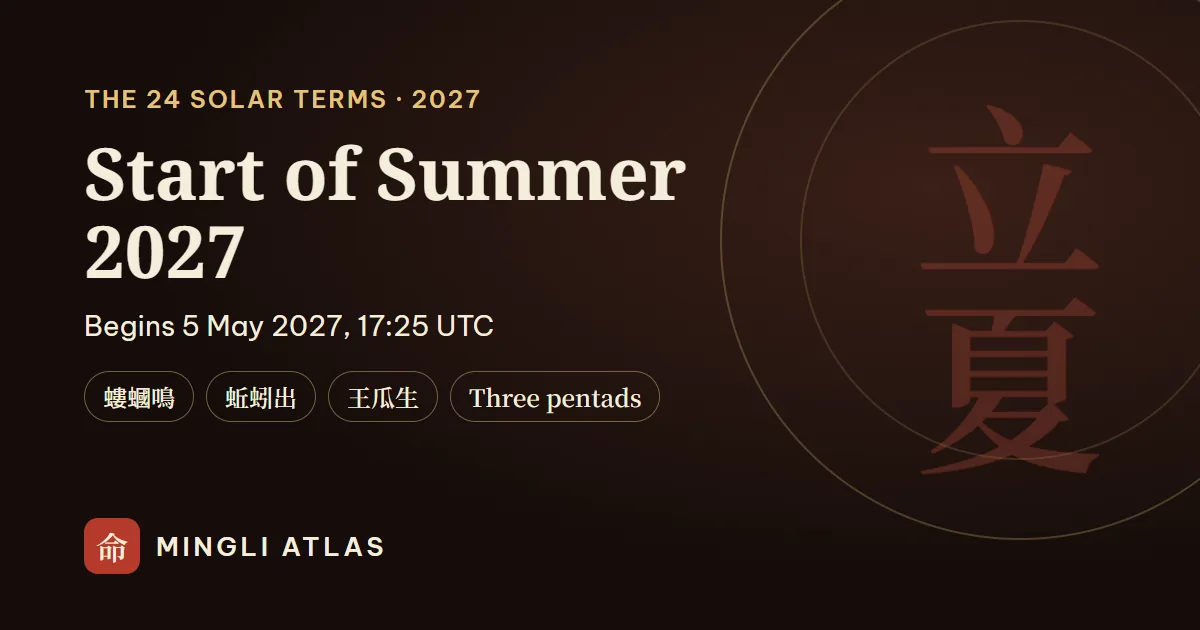
Start of Summer (立夏, Lixia), the first solar term of summer in the Chinese calendar, begins on Wednesday 5 May 2027 at 17:25 UTC, which is already 01:25 on Thursday 6 May in Beijing and 00:25 in Vietnam. It lasts until Grain Buds on 21 May. It is a sectional term (節), so at that minute the BaZi month pillar changes from Jia Chen to Yi Si. This guide gives the 2027 pentad dates, explains why the term belongs to Fire, and turns the classical summer advice into three practical habits.
When is Start of Summer 2027?
Start of Summer 2027 begins on 5 May at 17:25 UTC, when the sun reaches 45° of ecliptic longitude. In London that is 18:25 (British Summer Time); in New York 13:25 the same afternoon. In China and Vietnam the date is 6 May. The moment falls on a Yi You (乙酉) day, in a Yi Si (乙巳) month of a Ding Wei (丁未) year. The term lasts fifteen days, until Grain Buds (小滿) begins on 21 May 2027 at 06:18 UTC.
| Milestone | UTC | Beijing (UTC+8) |
|---|---|---|
| Grain Rain (previous term) | 20 Apr 2027, 07:17 | 20 Apr, 15:17 |
| Start of Summer | 5 May 2027, 17:25 | 6 May, 01:25 |
| Grain Buds (next term) | 21 May 2027, 06:18 | 21 May, 14:18 |
This is why Western almanacs give 5 May and Chinese calendars give 6 May: it is the same instant in different time zones. The time comes from the same calendar function that drives the Mingli Atlas chart tools.
The three pentads of Start of Summer 2027
Each solar term splits into three pentads (候) of about five days. In 2027, counted by Vietnam calendar days, they fall as follows.
| Pentad | Dates (2027) | Chinese | Meaning |
|---|---|---|---|
| First | 6 to 10 May | 螻蟈鳴 | Mole crickets chirp |
| Second | 11 to 15 May | 蚯蚓出 | Earthworms come out |
| Third | 16 to 20 May | 王瓜生 | Snake gourds sprout |
All three come from warming ground: insects call, worms surface, vines sprout. The witnesses differ in small ways: the Shi Xun chapter of the Yi Zhou Shu punctuates 螻 and 蟈 as two creatures, while the commentary on the pentads reads 螻蟈 as one, the mole cricket; the Book of Rites writes the earthworm as 丘蚓.
Which element is Start of Summer?
Fire. Summer belongs to Fire, and the month that Start of Summer opens, the Si (巳) month, is a Fire branch. The Book of Rites records the court astronomer announcing the day to the ruler three days ahead:
「是月也,以立夏。先立夏三日,大史謁之天子曰:「某日立夏,盛德在火。」天子乃齊。」
Book of Rites, Monthly Ordinances (禮記·月令), 孟夏之月
In plain words: this month holds Start of Summer. Three days before it the Grand Historian tells the Son of Heaven, “On such a day summer begins; the flourishing virtue is in Fire.” The Son of Heaven then fasts.
The classical commentary on the solar terms glosses the word for summer itself:
「立夏,四月節。……夏,假也。物至此時皆假大也。」
Yueling Qishier Hou Jijie (月令七十二候集解), section 立夏
Start of Summer is the sectional term of the fourth month; “xia” is glossed as “great”, because at this time all things grow large. The “fourth month” is the Si month of the solar calendar, not the fourth lunar month.
What should you do at Start of Summer?
The Huangdi Neijing opens its summer passage like this:
「夏三月,此謂蕃秀。天地氣交,萬物華實。」
Huangdi Neijing, Suwen (素問), chapter 四氣調神大論
The three months of summer are called “lush and flowering”: the qi of heaven and earth mingle, and all things blossom and bear fruit. The concrete advice follows:
「夜臥早起,無厭於日,使志無怒,使華英成秀,使氣得泄,若所愛在外」
Huangdi Neijing, Suwen (素問), chapter 四氣調神大論
In plain words: go to bed a little later and rise early, do not resent the sun; keep the mind free of anger, let the flowers ripen, let the qi flow out, as if what you love were outside. Three habits follow from it:
- Take the early sun, not the midday sun. “Do not resent the sun” (無厭於日) is not an instruction to bake at noon. Move your walk or workout outdoors to the early morning, while the light is still gentle, rather than staying indoors all season.
- Put a pause before an angry reply. “Keep the mind free of anger” (使志無怒). Heat shortens tempers; try a ten minute rule before answering a message that annoys you.
- Arrange to see a friend you have not met in a while. “As if what you love were outside” (若所愛在外). Winter advice turns inward; summer turns outward. In this fortnight, invite one friend for a walk or a drink on a cool evening.
These are lifestyle readings of a classical text, not medical advice. During heat warnings, older people, small children and anyone with a heart, blood pressure or kidney condition should follow their doctor and local health guidance.
Start of Summer changes the BaZi month pillar
Start of Summer is a sectional term (節), so at 17:25 UTC on 5 May 2027 the month pillar changes from Jia Chen (甲辰) to Yi Si (乙巳). A person born earlier that day in UTC still has the Jia Chen month; from that moment on, the month is Yi Si. The year pillar stays Ding Wei (丁未).
In Vietnam the boundary falls 25 minutes after midnight, so a birth late on the evening of 5 May still has the Jia Chen month while one in the small hours of 6 May has Yi Si. Enter the hour and minute in the BaZi chart calculator; it uses that year’s exact term time and converts your local time zone.
Is 5 May really the first day of summer?
In the Chinese calendar, yes. Its seasons begin at the four “starts” (立春, 立夏, 立秋, 立冬), halfway between an equinox and a solstice, so summer begins in early May. Western astronomical summer begins at the June solstice instead, which the Chinese calendar treats as midsummer (夏至). Neither is wrong: they divide the same solar year at different points. In tropical places such as southern Vietnam, the hottest weeks often come before this date, at the end of the dry season. In the Southern Hemisphere the same instant falls in late autumn.
Follow Start of Summer day by day
The Today page shows the solar term, pentad and day pillar of each day, and sets the day beside your own chart if you have made one. For the term itself, read what Start of Summer is in the solar terms section. The previous term is Grain Rain 2027; the next is Grain Buds 2027.
Keep reading
From reading to your chart
See your own chart
Free BaZi and Zi Wei charts, read against the classical texts, with no email needed.