Grain in Ear 2027 (Mangzhong): Date, Pentads, BaZi Month
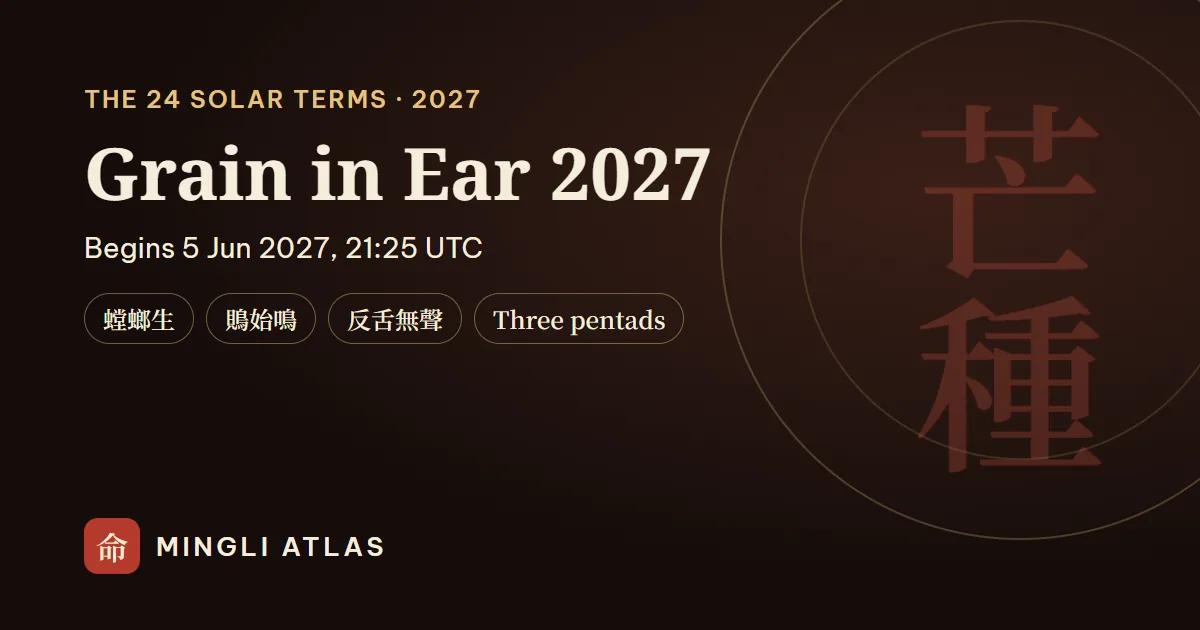
Grain in Ear (芒種, Mangzhong) begins on Saturday 5 June 2027 at 21:25 UTC, which is already 05:25 on Sunday 6 June in Beijing and 04:25 in Vietnam, and lasts until the Summer Solstice on 21 June. It is a sectional term (節), so at that minute the BaZi month pillar changes from Yi Si to Bing Wu. This guide gives the pentad dates, what the name actually means in the classical gloss, and three habits for the first fortnight of high summer.
When is Grain in Ear 2027?
Grain in Ear 2027 begins on 5 June at 21:25 UTC, when the sun reaches 75° of ecliptic longitude. In London that is 22:25 on Saturday evening; in New York 17:25 the same afternoon. In China and Vietnam the date is already 6 June. The moment falls on a Bing Chen (丙辰) day, in a Bing Wu (丙午) month of a Ding Wei (丁未) year. The term lasts fifteen days, until the Summer Solstice (夏至) begins on 21 June 2027 at 14:10 UTC.
| Milestone | UTC | Beijing (UTC+8) |
|---|---|---|
| Grain Buds (previous term) | 21 May 2027, 06:18 | 21 May, 14:18 |
| Grain in Ear | 5 Jun 2027, 21:25 | 6 Jun, 05:25 |
| Summer Solstice (next term) | 21 Jun 2027, 14:10 | 21 Jun, 22:10 |
This is why Western almanacs list 5 June and Chinese calendars list 6 June: it is one instant in different time zones. The time comes from the same calendar function that drives the Mingli Atlas chart tools.
The three pentads of Grain in Ear 2027
Each solar term splits into three pentads (候) of about five days. In 2027, counted by Vietnam calendar days, they fall as follows.
| Pentad | Dates (2027) | Chinese | Meaning |
|---|---|---|---|
| First | 6 to 10 June | 螳螂生 | Mantises hatch |
| Second | 11 to 15 June | 鵙始鳴 | Shrikes begin to call |
| Third | 16 to 20 June | 反舌無聲 | Mockingbirds fall silent |
The pentads describe a changing of the guard: mantises hatch into a season full of insects, the shrike (a small predatory songbird) starts calling, and the mimic songbird that sang all spring goes quiet. The Book of Rites writes the first two with variant characters (螳蜋生, 鶪始鳴) without changing the meaning.
What does “Grain in Ear” mean?
「芒種,五月節。謂有芒之種穀可稼種矣。」
Yueling Qishier Hou Jijie (月令七十二候集解), section 芒種
In plain words: Grain in Ear is the sectional term of the fifth month; grains with awns can now be sown. “Mang” (芒) is the awn, the bristle on an ear of grain, and “zhong” (種) is both the seed and the act of sowing. The usual English name stresses ripening ears, but the classical gloss is about sowing awned grain. The “fifth month” is the Wu (午) month of the solar calendar, not the fifth lunar month.
The Huangdi Neijing names the whole summer in one line:
「夏三月,此謂蕃秀。天地氣交,萬物華實。」
Huangdi Neijing, Suwen (素問), chapter 四氣調神大論
The three months of summer are called “lush and flowering”: the qi of heaven and earth mingle, and all things blossom and bear fruit.
What should you do during Grain in Ear?
The same chapter goes on with advice for summer:
「夜臥早起,無厭於日,使志無怒,使華英成秀,使氣得泄,若所愛在外」
Huangdi Neijing, Suwen (素問), chapter 四氣調神大論
Go to bed a little later and rise early, do not resent the sun; keep the mind free of anger, let what is flowering come to full bloom, let the qi flow outward, as if what you love were outside. Three habits fit the start of high summer:
- Sow one project you have been postponing. The gloss says “awned grain can now be sown” (有芒之種穀可稼種). Pick one plan that is still on paper and take its first concrete step in the first pentad, 6 to 10 June, then let it grow through the summer.
- Move exercise to the early morning. “Go to bed late, rise early” (夜臥早起) suits June, when dawn comes early. Walk or train before the sun is high, while the air is still mild.
- Leave a pause before replying in the heat. “Keep the mind free of anger” (使志無怒) is practical in sticky weather and short nights. When you notice irritation, drink some water and wait a few minutes before you answer.
These are lifestyle readings of a classical text, not medical advice. In hot weather drink enough water and avoid heavy exertion at midday; anyone with a heart, blood pressure or other chronic condition should ask their doctor what level of activity suits them.
Grain in Ear changes the BaZi month pillar
At 21:25 UTC on 5 June 2027 the month pillar changes from Yi Si (乙巳) to Bing Wu (丙午). A person born earlier, even on the same local date, still has the Yi Si month; from that minute on it is Bing Wu. The year pillar stays Ding Wei (丁未) throughout.
Because the boundary falls on the evening of 5 June in Europe and the afternoon in the Americas, a birth on that date can fall on either side. Enter the full date, hour and minute in the BaZi chart calculator; it converts your local time zone for you.
Is it a sowing or a harvest season?
The name follows the farming calendar of the Yellow River plain, where early June typically brought both the wheat harvest and the sowing of awned grain. In the Southern Hemisphere the same instant falls in early winter, and in the tropics planting follows the local monsoon rather than this date. Read Grain in Ear as a reminder that it is time to sow, not as a planting date for your region.
Follow Grain in Ear day by day
The Today page shows the solar term, pentad and day pillar of each day, and sets the day beside your own chart if you have made one. For the term itself, read what Grain in Ear is in the solar terms section. The previous term is Grain Buds 2027; the next is Summer Solstice 2027.
Keep reading
From reading to your chart
See your own chart
Free BaZi and Zi Wei charts, read against the classical texts, with no email needed.