Spring Equinox 2028: 20 March at 02:17 UTC, Pentads
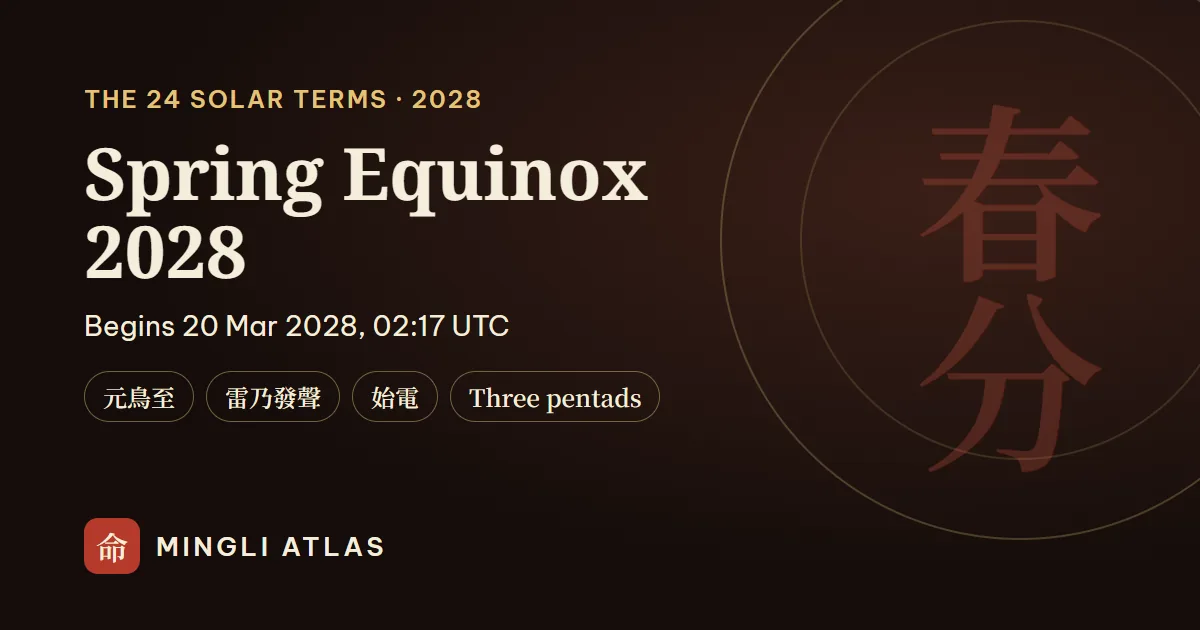
The Spring Equinox (春分, Chunfen) of 2028 falls on Monday 20 March 2028 at 02:17 UTC, which is 10:17 in Beijing, 09:17 in Vietnam and still 22:17 on Sunday 19 March in New York. In the Chinese calendar it marks the middle of spring and lasts until Clear and Bright on 4 April. It is a midpoint term (中氣), so the BaZi month stays Yi Mao throughout, in a Wu Shen year. This year Asia and UTC agree on the date, unlike 2027. This guide gives the 2028 pentad dates, the classical lines behind them, three habits for mid spring and what changed since last year.
When is the Spring Equinox 2028?
The sun crosses 0° of ecliptic longitude on 20 March 2028 at 02:17 UTC. In London that is 02:17 on 20 March; in New York, which moved to daylight saving time on 12 March, it is 22:17 on 19 March. The moment falls on a Jia Chen (甲辰) day, in a Yi Mao (乙卯) month of a Wu Shen (戊申) year. The term lasts fifteen days, until Clear and Bright (清明) begins on 4 April 2028 at 06:03 UTC.
| Milestone | UTC | Beijing (UTC+8) |
|---|---|---|
| Awakening of Insects (previous term) | 5 Mar 2028, 01:24 | 5 Mar, 09:24 |
| Spring Equinox | 20 Mar 2028, 02:17 | 20 Mar, 10:17 |
| Clear and Bright (next term) | 4 Apr 2028, 06:03 | 4 Apr, 14:03 |
The times come from the calendar function behind the Mingli Atlas chart tools. Some English pages we checked give a different hour or a placeholder midnight for the 2028 equinox; the 02:17 UTC figure above matches the published astronomical value.
The three pentads of the Spring Equinox 2028
Each solar term divides into three pentads (候) of about five days. The dates below are Vietnam calendar days.
| Pentad | Dates (2028) | Chinese | Meaning |
|---|---|---|---|
| First | 20 to 24 March | 元鳥至 | Swallows return |
| Second | 25 to 29 March | 雷乃發聲 | Thunder begins to sound |
| Third | 30 March to 3 April | 始電 | Lightning first appears |
The sequence moves from something you see to something you hear and then see in the sky: swallows, thunder, lightning. The first pentad’s 元鳥 is the spelling of the commentary on the pentads; the Book of Rites and the Shi Xun chapter of the Yi Zhou Shu write 玄鳥. Both mean the swallow; 元 for 玄 is most likely the Qing taboo on the Kangxi emperor’s personal name (玄燁), though the transcription does not say so.
What do the classical texts say about the Spring Equinox?
「春分,二月中。分者,半也。此當九十日之半,故謂之分。」
Yueling Qishier Hou Jijie (月令七十二候集解), section 春分
In plain words: the Spring Equinox is the midpoint of the second month. “Fen” means half; it stands at the middle of spring’s ninety days, hence the name. Note that this gloss counts the season, not daylight: the equinox halves the spring that runs from the Start of Spring to the Start of Summer. The “second month” is the Mao (卯) month of the solar calendar, open since the Awakening of Insects.
The Book of Rites supplies the rest, the daylight and the weather:
「是月也,日夜分,雷乃發聲,始電。」
Book of Rites, Monthly Ordinances (禮記·月令), 仲春之月
This month day and night are equal, thunder begins to sound and lightning first appears. The second and third pentads are lifted word for word from this line, so the later table of 72 pentads keeps the wording of a much older text.
What should you do at the Spring Equinox?
The Huangdi Neijing describes the season:
「春三月,此謂發陳。天地俱生,萬物以榮。」
Huangdi Neijing, Suwen (素問), chapter 四氣調神大論
The three months of spring are called “issuing forth and spreading out”: heaven and earth give life together, and all things flourish. The advice follows:
「夜臥早起,廣步於庭,被髮緩形,以使志生,生而勿殺,予而勿奪,賞而勿罰」
Huangdi Neijing, Suwen (素問), chapter 四氣調神大論
Go to bed a little later and rise early; take long, easy strides in the courtyard; loosen the hair and the body so that the will can grow; nurture rather than kill, give rather than take, reward rather than punish. Last year’s habits were a halfway review, an evening walk and loosening up; this year’s draw on the Book of Rites and a different Neijing phrase:
- Split your day into two clear halves. “Day and night are equal” (日夜分). In the first week of the term, set an end to the working day and keep it, for example no laptop or work messages after 19:00, so the evening is really evening.
- Say the thing you kept to yourself all winter. “Thunder begins to sound” (雷乃發聲). A proposal at work, an apology, thanks you still owe: choose one and say it during the second pentad, calmly and specifically.
- Wake with the light. “Go to bed later, rise early” (夜臥早起). Open the curtains as soon as you wake and spend a few minutes outdoors in the morning, so your body clock keeps pace with the lengthening days.
These are lifestyle readings of a classical text, not medical advice. If you have long term insomnia, asthma, allergies or a heart condition, ask your doctor before changing your sleep times or adding outdoor exercise.
How the Spring Equinox 2028 differs from 2027
The Spring Equinox 2027 fell on Saturday 20 March 2027 at 20:24 UTC, already 21 March in Asia. This year the moment comes about 5 hours 53 minutes later in the clock day (353 minutes after the same clock time 365 days on), yet in Asia the date moves a day earlier, to 20 March. The leap day explains it: 365 days after 21 March 2027 is already 20 March 2028.
The pillars at the start changed as well: in 2027, year Ding Wei (丁未), month Gui Mao (癸卯), day Ji Hai (己亥); in 2028, year Wu Shen, month Yi Mao, day Jia Chen. And where Western almanacs and Asian calendars disagreed by a day in 2027, in 2028 only the Americas still show a different date, 19 March.
Does the Spring Equinox change the BaZi month?
No. The equinox is a midpoint term inside the Mao month, so everyone born from the Awakening of Insects (5 March 2028, 01:24 UTC) up to Clear and Bright (4 April 2028, 06:03 UTC) has the month pillar Yi Mao (乙卯) and the year pillar Wu Shen (戊申).
The next boundary is Clear and Bright, when the month pillar becomes Bing Chen (丙辰). For a birth near that moment, enter the exact hour and minute in the BaZi chart calculator, which converts your local time zone and daylight saving time for you.
Is it spring everywhere?
Only in the Northern Hemisphere. South of the equator the same instant is the autumn equinox. Everywhere, day and night are close to twelve hours each; measured closely, daytime runs a few minutes longer, because sunrise and sunset are timed by the upper edge of the sun and the atmosphere bends its light. In Vietnam, from the far north to the southern tip, the days now begin to outrun the nights until the autumn equinox.
Follow the Spring Equinox day by day
The Today page shows the solar term, pentad and day pillar of each day, and sets the day beside your own chart if you have made one. For the term itself, read what the Spring Equinox is in the solar terms section. The previous term is Awakening of Insects 2028; the next is Clear and Bright 2028.
Keep reading
From reading to your chart
See your own chart
Free BaZi and Zi Wei charts, read against the classical texts, with no email needed.