Major Heat 2027 (Dashu): Date, Pentads and BaZi Month
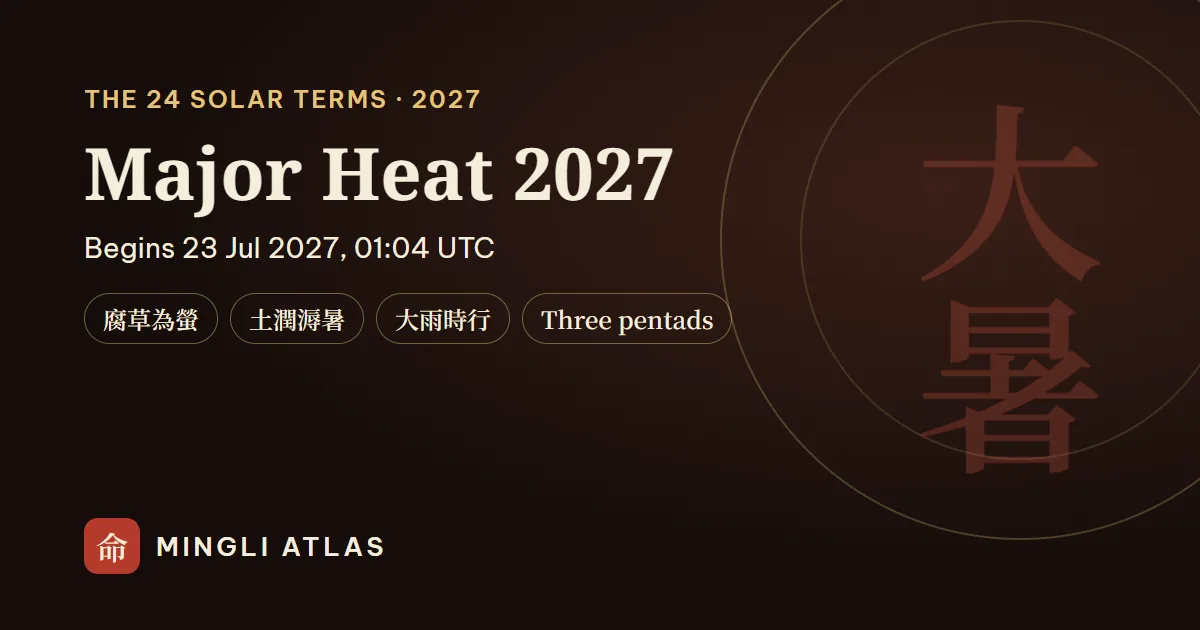
Major Heat (大暑, Dashu) begins on Friday 23 July 2027 at 01:04 UTC (09:04 in Beijing, 08:04 in Vietnam, and still 21:04 on 22 July in New York) and lasts until the Start of Autumn on 7 August UTC. It is a midpoint term (中氣), so it does not change the BaZi month: the whole term stays in the Ding Wei month. This guide gives the pentad dates, explains why two of its three pentads are about damp soil and heavy rain, and suggests three habits for the sticky, stormy end of summer.
When is Major Heat 2027?
Major Heat 2027 begins on 23 July at 01:04 UTC, when the sun reaches 120° of ecliptic longitude. In London that is 02:04 on 23 July; in New York it is 21:04 on the evening of 22 July, so American calendars list the earlier date. The moment falls on a Gui Mao (癸卯) day, in a Ding Wei (丁未) month of a Ding Wei (丁未) year. The term lasts about sixteen days, until the Start of Autumn (立秋) begins on 7 August 2027 at 17:26 UTC.
| Milestone | UTC | Beijing (UTC+8) |
|---|---|---|
| Minor Heat (previous term) | 7 Jul 2027, 07:37 | 7 Jul, 15:37 |
| Major Heat | 23 Jul 2027, 01:04 | 23 Jul, 09:04 |
| Start of Autumn (next term) | 7 Aug 2027, 17:26 | 8 Aug, 01:26 |
Both boundaries straddle a date line: Major Heat is 22 July in the Americas and 23 July elsewhere, and the Start of Autumn is 7 August in Europe and the Americas but 8 August in China and Vietnam. The time comes from the same calendar function that drives the Mingli Atlas chart tools.
The three pentads of Major Heat 2027
Each solar term splits into three pentads (候). In 2027, counted by Vietnam calendar days, they fall as follows; the second runs from July into August.
| Pentad | Dates (2027) | Chinese | Meaning |
|---|---|---|---|
| First | 23 to 27 July | 腐草為螢 | Rotting grass turns into fireflies |
| Second | 28 July to 1 August | 土潤溽暑 | The soil is damp and the heat is sticky |
| Third | 2 to 7 August | 大雨時行 | Heavy rains come in season |
The first pentad records an old belief: fireflies seemed to rise out of damp, decaying grass. The Shi Xun chapter of the Yi Zhou Shu says the grass “transforms” into fireflies (腐草化爲螢); the Jijie drops the word “transform” because, it explains, this change does not turn back. It is a seasonal marker, not biology. The other two pentads describe a humid monsoon summer remarkably well.
Why is it called Major Heat?
「大暑,六月中。解見小暑。」
Yueling Qishier Hou Jijie (月令七十二候集解), section 大暑
In plain words: Major Heat is the midpoint of the sixth month; see the explanation under Minor Heat. There, the text says that heat is minor at the start of the month and major at its middle. “Major” therefore marks the middle of the Wei (未) month first of all; it does not guarantee that your hottest day of the year falls in this term.
The Huangdi Neijing line for the whole summer shows how the old texts saw the heat:
「夏三月,此謂蕃秀。天地氣交,萬物華實。」
Huangdi Neijing, Suwen (素問), chapter 四氣調神大論
The three months of summer are called “lush and flowering”: the qi of heaven and earth mingle, and all things blossom and bear fruit. In this view late summer heat is what sets the fruit, not only something to endure.
What should you do during Major Heat?
Three habits follow from the pentads and the Neijing’s summer advice:
- Check your home before the heavy rains. The third pentad is “heavy rains come in season” (大雨時行). In the first week of the term, clear gutters and drains, check the roof, put a torch, a power bank and a few days of drinking water aside, and turn on weather alerts on your phone.
- Keep the house dry and food safe. “The soil is damp and the heat is sticky” (土潤溽暑) describes the days when mould grows and food spoils quickly. Refrigerate cooked food promptly, do not leave leftovers out overnight, and dry clothes and bedding fully before putting them away.
- Go outside in the cool hours with people you love. The Neijing’s summer advice ends “as if what you love were outside” (若所愛在外). Plan a few evening walks or a trip to a park or the countryside, perhaps to look for fireflies, instead of spending whole days in an air-conditioned room.
These are lifestyle readings of a classical text, not medical advice. In long spells of heat or humidity drink water regularly, avoid heavy work at midday and check on older relatives and small children; a high temperature, confusion or fainting after time in the heat calls for emergency help. During storms and floods follow your local authorities, and anyone with a heart, blood pressure or other chronic condition should follow their doctor’s advice.
Does Major Heat change the BaZi month?
No. Major Heat is a midpoint term (中氣) inside the Wei (未) month, so everyone born from Minor Heat (7 July 2027, 07:37 UTC) up to the Start of Autumn (7 August 2027, 17:26 UTC) has the month pillar Ding Wei (丁未), the same as the year pillar.
The boundary to watch is the Start of Autumn. In Vietnam and China it falls just after midnight on 8 August, so a birth late on 7 August local time there still has the Ding Wei month. Enter the exact hour and minute in the BaZi chart calculator, which converts your local time zone for you.
Is Major Heat the hottest time everywhere?
No. The name follows the order within the month and the climate of the Yellow River plain. In parts of South and Southeast Asia the fiercest heat often comes earlier, and late July brings monsoon rain and typhoons, which is why “heavy rains come in season” can feel truer than the name itself. In the Southern Hemisphere the same weeks are midwinter.
Follow Major Heat day by day
The Today page shows the solar term, pentad and day pillar of each day, and sets the day beside your own chart if you have made one. For the term itself, read what Major Heat is in the solar terms section. The previous term is Minor Heat 2027; the next is Start of Autumn 2027.
Keep reading
From reading to your chart
See your own chart
Free BaZi and Zi Wei charts, read against the classical texts, with no email needed.