Summer Solstice 2027 (Xiazhi): Date, Pentads, Book of Rites
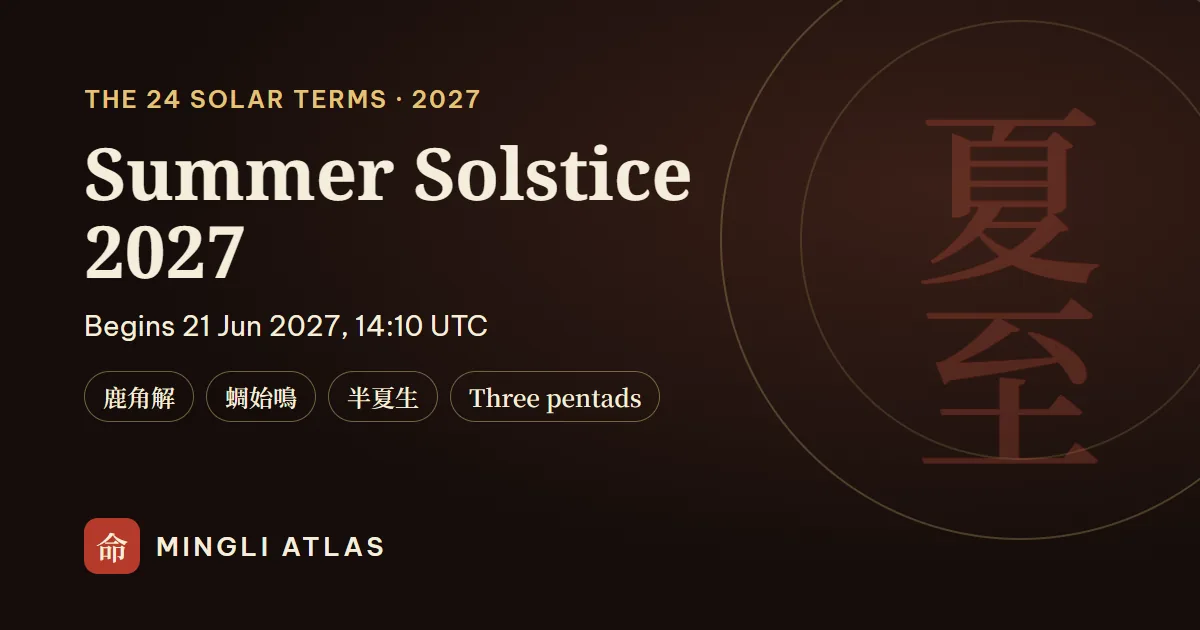
The Summer Solstice (夏至, Xiazhi) of 2027 falls on Monday 21 June 2027 at 14:10 UTC (22:10 in Beijing, 21:10 in Vietnam), the longest day of the year in the Northern Hemisphere, and lasts until Minor Heat on 7 July. It is a midpoint term (中氣), so it does not change the BaZi month pillar. This guide gives the pentad dates, the Book of Rites passage on how to live through the longest days, and three habits drawn from it.
When is the Summer Solstice 2027?
The Summer Solstice 2027 falls on 21 June at 14:10 UTC, when the sun reaches 90° of ecliptic longitude. In London that is 15:10; in New York 10:10 the same morning. This year every major time zone shares the same date. The moment falls on a Xin Wei (辛未) day, in a Bing Wu (丙午) month of a Ding Wei (丁未) year. The term lasts until Minor Heat (小暑) begins on 7 July 2027 at 07:37 UTC.
| Milestone | UTC | Beijing (UTC+8) |
|---|---|---|
| Grain in Ear (previous term) | 5 Jun 2027, 21:25 | 6 Jun, 05:25 |
| Summer Solstice | 21 Jun 2027, 14:10 | 21 Jun, 22:10 |
| Minor Heat (next term) | 7 Jul 2027, 07:37 | 7 Jul, 15:37 |
In East Asia the solstice instant arrives after dark, so the long daylight of 21 June comes first and the turning point follows that evening. The time comes from the same calendar function that drives the Mingli Atlas chart tools.
The three pentads of the Summer Solstice 2027
The solstice splits into three pentads (候), counted here by Vietnam calendar days; this year the third has six days.
| Pentad | Dates (2027) | Chinese | Meaning |
|---|---|---|---|
| First | 21 to 25 June | 鹿角解 | Deer shed their antlers |
| Second | 26 to 30 June | 蜩始鳴 | Cicadas begin to sing |
| Third | 1 to 6 July | 半夏生 | Crow-dipper sprouts |
Deer shed their antlers at the Summer Solstice and elk at the Winter Solstice: the old observers used two animals to mark the two poles of the year. The Book of Rites writes the cicada with the general character 蟬 instead of 蜩, and adds a fourth sign that is not one of the 72 pentads, the rose of Sharon, a hibiscus, blooming (木堇榮).
What do the classical texts say about the Summer Solstice?
「夏至,五月中。《韻會》曰:夏,假也;至,極也;萬物于此皆假大而至極也。」
Yueling Qishier Hou Jijie (月令七十二候集解), section 夏至
In plain words: the Summer Solstice is the midpoint of the fifth month. The Yunhui dictionary glosses “xia” as great and “zhi” as utmost: here all things reach the height of their growth. The peak is also the turn; from now on the days shorten.
The Book of Rites spells out how the noble person should live in this month:
「是月也,日長至,陰陽争,死生分。君子齊戒,處必掩身,毋躁。止聲色,毋或進。薄滋味,毋致和。」
Book of Rites, Monthly Ordinances (禮記·月令), 仲夏之月
This month the day reaches its longest, yin and yang contend, and life and decline part ways. The noble person fasts and keeps restraint, stays covered and is not hasty; sets aside music and sensual pleasure and does not indulge; keeps food plain rather than richly seasoned. It mirrors, almost line for line, the advice for the month of the Winter Solstice.
What should you do at the Summer Solstice?
Read for daily life today, the passage gives three habits:
- Cover up in the sun and do not rush. “Stay covered and do not be hasty” (處必掩身,毋躁) fits the strongest sun of the year. Wear a hat and light long sleeves at midday, and leave extra time for errands so that the heat does not push you to hurry.
- Eat more plainly in solstice week. “Keep food plain, not richly seasoned” (薄滋味,毋致和) suggests a week of lighter cooking: less frying and grilling, more vegetable soups and seasonal fruit.
- Keep the solstice evening quiet. “Set aside music and sensual pleasure, do not indulge” (止聲色,毋或進) argues for one evening with fewer screens. Spend the evening of 21 June outdoors in the cooler air, or sit with family and look back over the first half of the year.
These are lifestyle readings of a classical text, not medical advice. In strong sun drink enough water and rest in the shade; if you feel dizzy, nauseous or faint after time in the heat, move somewhere cool and seek medical help. Older people, small children and anyone with a heart or blood pressure condition should follow their doctor’s advice.
Does the Summer Solstice change the BaZi month?
No. The solstice is a midpoint term (中氣) inside the Wu (午) month, so everyone born from Grain in Ear (5 June 2027, 21:25 UTC) up to Minor Heat (7 July 2027, 07:37 UTC) has the month pillar Bing Wu (丙午). The year pillar stays Ding Wei (丁未).
The boundary to watch is Minor Heat, when the month turns to Ding Wei. If a birth falls near it, enter the exact hour and minute in the BaZi chart calculator, which converts your local time zone for you.
Is the sun directly overhead at the solstice?
Only along the Tropic of Cancer, at about 23.4° north. North of that line, which includes all of Europe, most of China and the continental United States, the noon sun stays to the south. Just south of it, in places such as Hong Kong or Hanoi, the noon sun stands slightly to the north and shadows point south. In the Southern Hemisphere the same instant is the winter solstice; the Chinese name and its customs follow the northern sky.
Follow the Summer Solstice day by day
The Today page shows the solar term, pentad and day pillar of each day, and sets the day beside your own chart if you have made one. For the term itself, read what the Summer Solstice is in the solar terms section. The previous term is Grain in Ear 2027; the next is Minor Heat 2027.
Keep reading
From reading to your chart
See your own chart
Free BaZi and Zi Wei charts, read against the classical texts, with no email needed.