Autumn Equinox 2028: 22 September, Pentads and Habits
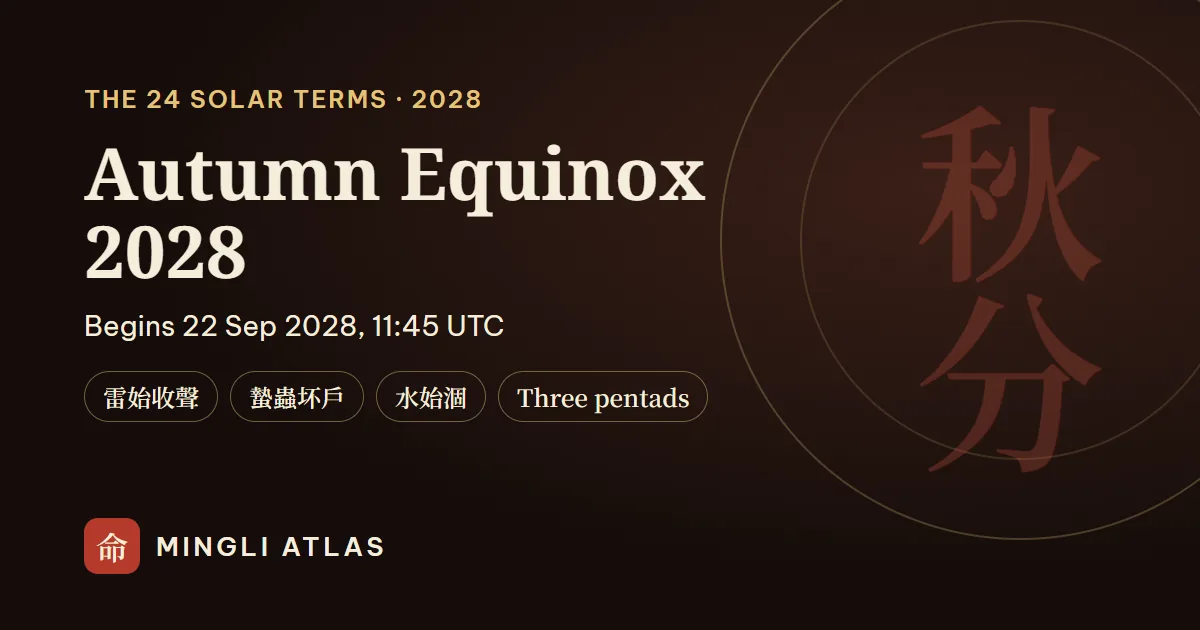
The Autumn Equinox (秋分, Qiufen) begins on Friday 22 September 2028 at 11:45 UTC: 19:45 in Beijing, 18:45 in Vietnam, 12:45 in London and 07:45 in New York, so the whole world shares the date this year. It lasts until Cold Dew on 7 October (UTC). Astronomically this is the September equinox, when the sun crosses the celestial equator. It is a midpoint term (中氣), so the BaZi month does not change: the whole term sits inside the Xin You month of a Wu Shen year. Below are the 2028 pentad dates, the change from last year, and three habits for the season’s turning point.
When is the Autumn Equinox 2028?
The Autumn Equinox 2028 begins on 22 September 2028 at 11:45 UTC, when the sun reaches 180° of ecliptic longitude. The moment falls on a Geng Xu (庚戌) day, in a Xin You (辛酉) month of a Wu Shen (戊申) year. The term lasts a little over fifteen days, until Cold Dew (寒露) begins on 7 October at 18:08 UTC.
| Milestone | UTC | Beijing (UTC+8) |
|---|---|---|
| White Dew (previous term) | 7 Sep 2028, 02:22 | 7 Sep, 10:22 |
| Autumn Equinox | 22 Sep 2028, 11:45 | 22 Sep, 19:45 |
| Cold Dew (next term) | 7 Oct 2028, 18:08 | 8 Oct, 02:08 |
The times come from the same calendar function that drives the Mingli Atlas chart tools, and the equinox minute matches published astronomical tables. Some calendar sites show the equinox at midnight on 22 September; that is a date convention, not the moment itself.
Autumn Equinox 2028 pentad dates
Each solar term splits into three pentads (候). The dates below are Vietnam calendar days; the third runs six days, because Cold Dew begins there at 01:08 on 8 October.
| Pentad | Dates (2028) | Chinese | Meaning |
|---|---|---|---|
| First | 22 to 26 September | 雷始收聲 | Thunder falls silent |
| Second | 27 September to 1 October | 蟄蟲坏戶 | Insects seal their burrows |
| Third | 2 to 7 October | 水始涸 | Waters begin to dry up |
The pentads show yang withdrawing at three levels: thunder leaves the sky, insects close up the ground, and the water level drops. For the second, the Yi Zhou Shu writes “insects bank up their doors” (蟄蟲培户), and the Jijie notes that its 坏 is read the same way.
What the classical texts say about the Autumn Equinox
「秋分,八月中。解見春分。」
Yueling Qishier Hou Jijie (月令七十二候集解), section 秋分
In plain words: the Autumn Equinox is the midpoint of the eighth month; for the explanation, see the Spring Equinox. There, “fen” (分) means to divide in half: the term falls at the middle of the season. The “eighth month” is the You (酉) month of the solar calendar.
「是月也,日夜分,雷始收聲,蟄蟲坏户……陽氣日衰,水始涸。」
Book of Rites, Monthly Ordinances (禮記·月令), 仲秋之月
This month day and night are equal, thunder falls silent and insects seal their burrows; yang qi weakens day by day and the waters begin to dry up. From here on, nights in the northern hemisphere are longer than days until the spring equinox.
What to do during the Autumn Equinox 2028
The Huangdi Neijing gives its advice for the whole of autumn:
「早臥早起,與雞俱興,使志安寧,以緩秋刑,收斂神氣,使秋氣平,無外其志,使肺氣清」
Huangdi Neijing, Suwen (素問), chapter 四氣調神大論
Go to bed early and rise early, with the rooster; keep the mind calm; gather your spirit in; keep the breath of the lungs clear. Last year’s post was about balance; this year’s habits follow the last two pentads and the line on waning yang:
- Seal the gaps around doors and windows. The second pentad has insects closing their burrows (蟄蟲坏戶). Do the same for your home: fix draughty door gaps, replace torn insect screens and check window seals before the cooler, windier months.
- Move your evening walk earlier. The Book of Rites says “yang qi weakens day by day” (陽氣日衰). Evenings darken sooner now, so walk before sunset or choose well lit streets, and wear something reflective near traffic.
- Check taps and toilets for leaks. The last pentad is the waters drying up (水始涸). A dripping tap or a leaking cistern can waste a surprising amount of water; put a few drops of food colouring in the cistern, and if colour reaches the bowl without flushing, there is a leak.
These are lifestyle readings of a classical text, not medical advice. If an eye condition makes walking after dark difficult, if you have long running sleep problems, or if you are being treated for a chronic illness, follow your doctor’s advice.
How the Autumn Equinox 2028 differs from 2027
In 2027 the Autumn Equinox began on Thursday 23 September at 06:01 UTC. In 2028 it begins on Friday 22 September at 11:45 UTC: a day earlier on the calendar, later in the day. Because 2028 is a leap year, 365 days after last year’s moment only reaches 06:01 UTC on 22 September 2028, and the equinox arrives 5 hours 44 minutes after that.
Last year the moment fell on a Ding Wei year, Ji You month and Yi Si day; this year it is a Wu Shen year, Xin You month and Geng Xu day. Last year the US West Coast still had 22 September; this year everyone does.
Does the Autumn Equinox change the month pillar in BaZi?
No. The Autumn Equinox is a midpoint term (中氣), so it sits inside the You month. Everyone born from White Dew (7 September 2028, 02:22 UTC) up to Cold Dew (7 October 2028, 18:08 UTC) has the month pillar Xin You (辛酉) and the year pillar Wu Shen (戊申).
The next boundary is Cold Dew, when the month becomes Ren Xu (壬戌). It falls during the afternoon or evening of 7 October in the Americas and Europe but in the small hours of 8 October in East Asia, so the local date of the change depends on where a birth took place. Enter the exact hour and minute in the BaZi chart calculator, which converts your local time zone for you.
Are day and night really equal?
Almost, but not quite. On the equinox the day is still a few minutes longer than the night, because the atmosphere bends sunlight over the horizon and sunrise is counted from the sun’s upper edge. In the Southern Hemisphere this is the spring equinox; the Chinese name “autumn divides” describes only the north, though the instant is the same everywhere.
Follow the Autumn Equinox day by day
The Today page shows the solar term, pentad and day pillar of each day, and sets the day beside your own chart if you have made one. For the term itself, read what the Autumn Equinox is in the solar terms section. The previous term is White Dew 2028; the next is Cold Dew 2028.
Keep reading
From reading to your chart
See your own chart
Free BaZi and Zi Wei charts, read against the classical texts, with no email needed.