Winter Solstice 2026 (Dongzhi): Date, Pentads, What to Do
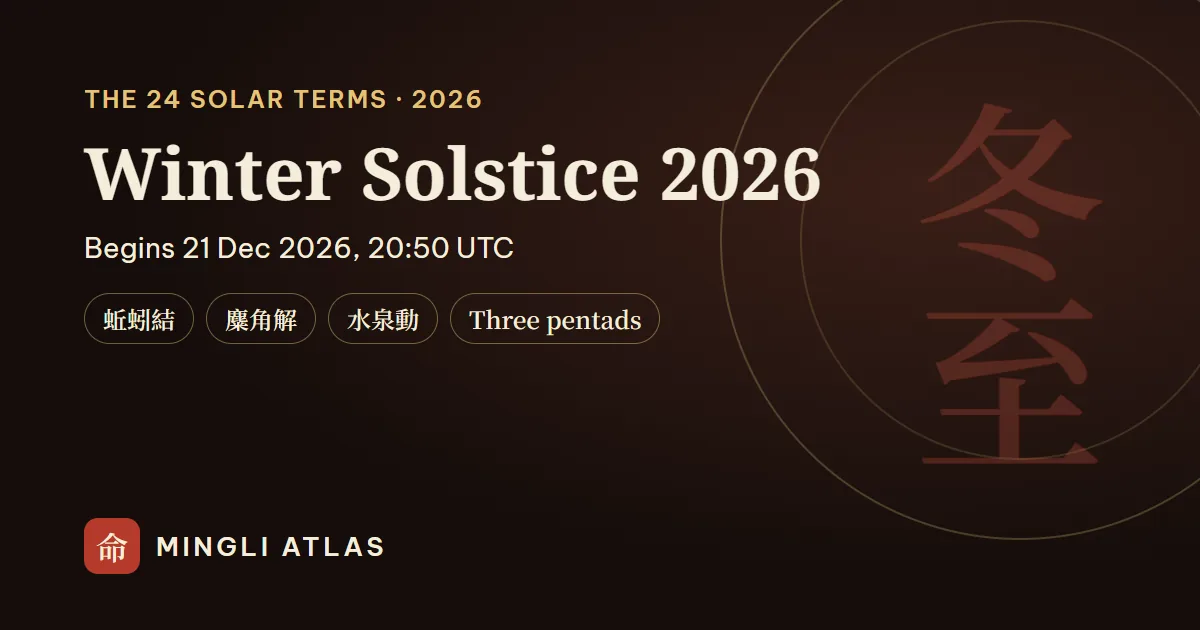
The Winter Solstice (冬至, Dongzhi) of 2026 falls on Monday 21 December 2026 at 20:50 UTC, which is already 04:50 on Tuesday 22 December in Beijing and 03:50 in Vietnam. In the Chinese calendar it is the midpoint of winter, and it lasts until Minor Cold on 5 January 2027. This guide gives the dates of its three pentads, the Book of Rites passage on how to live through the solstice, and three habits drawn from it.
When is the Winter Solstice 2026?
The Winter Solstice 2026 falls on 21 December at 20:50 UTC, when the sun reaches 270° of ecliptic longitude. In London that is 20:50 on 21 December; in New York 15:50 the same afternoon. In China and Vietnam the date is 22 December. The moment falls on a Geng Wu (庚午) day, in a Geng Zi (庚子) month of a Bing Wu (丙午) year. The term lasts until Minor Cold (小寒) begins on 5 January 2027 at 14:09 UTC.
| Milestone | UTC | Beijing (UTC+8) |
|---|---|---|
| Major Snow (previous term) | 7 Dec 2026, 02:52 | 7 Dec, 10:52 |
| Winter Solstice | 21 Dec 2026, 20:50 | 22 Dec, 04:50 |
| Minor Cold (next term) | 5 Jan 2027, 14:09 | 5 Jan, 22:09 |
This is why Chinese sources say 22 December and Western almanacs say 21 December: it is the same instant in different time zones.
The three pentads of the Winter Solstice
The solstice splits into three pentads (候), counted here by Vietnam calendar days; this year the third runs into 2027.
| Pentad | Dates | Chinese | Meaning |
|---|---|---|---|
| First | 22 to 26 December | 蚯蚓結 | Earthworms curl up |
| Second | 27 to 31 December | 麋角解 | Elk shed their antlers |
| Third | 1 to 4 January | 水泉動 | Underground springs begin to stir |
The third pentad has only four days, because Minor Cold arrives on the evening of 5 January in Vietnam. “Underground springs begin to stir” marks yang returning from deep below while the surface is still cold.
What do the classical texts say about the Winter Solstice?
「冬至,十一月中。終藏之氣至此而極也。」
Yueling Qishier Hou Jijie (月令七十二候集解), section 冬至
In plain words: the Winter Solstice is the midpoint of the eleventh month; winter’s storing qi reaches its utmost here. “Zhi” means arriving at the limit: when yin is at its fullest, yang begins.
The Book of Rites spells out how the noble person should live in this month:
「是月也,日短至,陰陽争,諸生蕩。君子齊戒,處必掩身,身欲寧,去聲色,禁耆欲,安形性,事欲静,以待陰陽之所定。」
Book of Rites, Monthly Ordinances (禮記·月令), 仲冬之月
This month the day reaches its shortest, yin and yang contend, and all living things begin to stir. The noble person fasts and keeps restraint, stays covered and keeps the body at rest; sets aside music and sensual pleasure, restrains desires, keeps body and temper calm and affairs quiet, waiting for yin and yang to settle.
What should you do at the Winter Solstice?
The Book of Rites passage reads almost like a list. For daily life today:
- Keep one quiet evening around the solstice. “Set aside music and sensual pleasure” (去聲色) suggests fewer screens and less noise. Pick one evening in the week of 21 December for a warm meal at home and an early night.
- Do not close a big decision in these days. “Affairs quiet, waiting for yin and yang to settle” (事欲静,以待陰陽之所定) argues for patience. If you are weighing a major choice, write out the options and decide a few days after the solstice.
- Stay covered, even indoors. “Wherever you are, keep the body covered” (處必掩身) matters most before dawn, the coldest hour. Put on an extra layer when you get up early and do not step outside straight after a hot shower.
Many families eat tangyuan (sweet rice balls) or dumplings at the solstice. These are folk customs rather than part of the Book of Rites, but they fit the day’s spirit of gathering and warm food.
These are lifestyle readings of a classical text, not medical advice. Older people and anyone with a heart or blood pressure condition should ask their doctor how to stay warm and active on cold nights.
Does the Winter Solstice change the BaZi month or year?
Neither. The solstice is a midpoint term (中氣) inside the Zi month, so everyone born from Major Snow (7 December 2026, 02:52 UTC) up to Minor Cold (5 January 2027, 14:09 UTC) has the month pillar Geng Zi (庚子). The year pillar stays Bing Wu (丙午): the BaZi year changes at the Start of Spring, not at the solstice and not on 1 January.
If a birth falls near Minor Cold, enter the exact hour and minute in the BaZi chart calculator, which converts your local time zone for you.
Is it the shortest day everywhere?
Only in the Northern Hemisphere. South of the equator the same instant is the summer solstice and the longest day. The Chinese name and its customs follow the northern sky.
Follow the Winter Solstice day by day
The Today page shows the solar term, pentad and day pillar of each day, and sets the day beside your own chart if you have made one. For the term itself, read what the Winter Solstice is in the solar terms section. The previous term is Major Snow 2026; the next is Minor Cold 2027.
Keep reading
From reading to your chart
See your own chart
Free BaZi and Zi Wei charts, read against the classical texts, with no email needed.