Major Snow 2026 (Daxue): Date, Pentads and the Zi Month
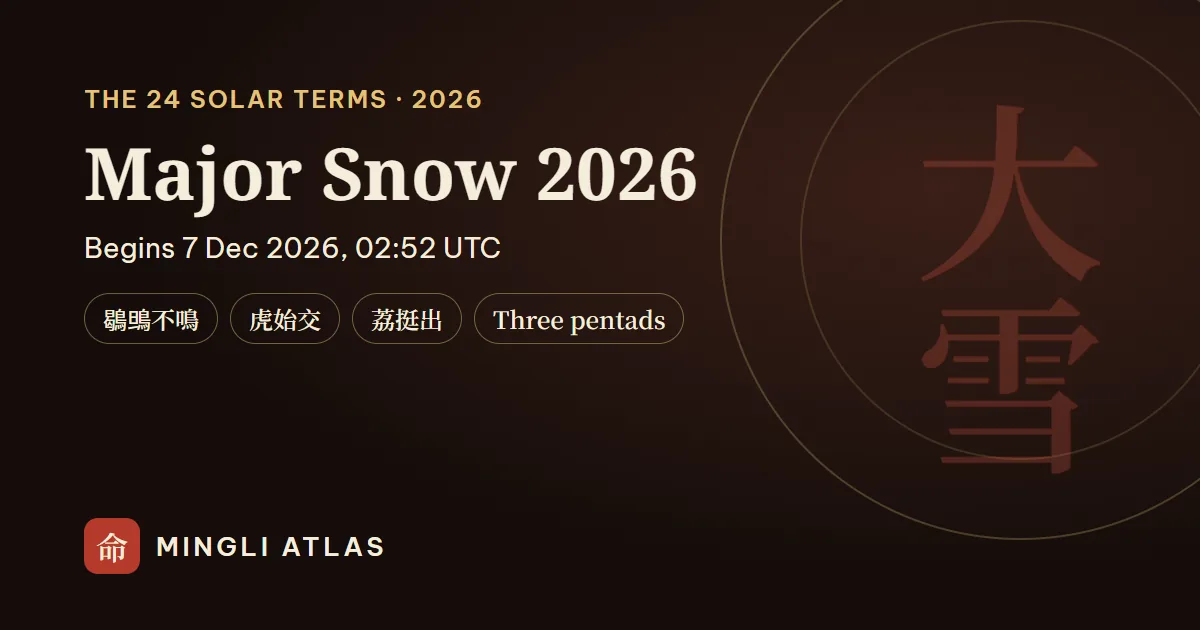
Major Snow (大雪, Daxue), the third solar term of winter in the Chinese calendar, begins on Monday 7 December 2026 at 02:52 UTC (10:52 in Beijing, 09:52 in Vietnam) and lasts until the Winter Solstice. Major Snow is a sectional term (節), so at that minute the BaZi month pillar changes from Ji Hai to Geng Zi. This guide gives the 2026 dates of its three pentads, the classical lines on midwinter, and three habits for the deepening cold.
When is Major Snow 2026?
Major Snow 2026 begins on 7 December at 02:52 UTC, when the sun reaches 255° of ecliptic longitude. In London that is 02:52 on 7 December, but in New York it is still 21:52 on Sunday 6 December. The moment falls on a Yi Mao (乙卯) day, in a Geng Zi (庚子) month of a Bing Wu (丙午) year. The term lasts until the Winter Solstice (冬至) on 21 December at 20:50 UTC.
| Milestone | UTC | Beijing (UTC+8) |
|---|---|---|
| Minor Snow (previous term) | 22 Nov 2026, 07:23 | 22 Nov, 15:23 |
| Major Snow | 7 Dec 2026, 02:52 | 7 Dec, 10:52 |
| Winter Solstice (next term) | 21 Dec 2026, 20:50 | 22 Dec, 04:50 |
Most calendars give the date as 7 December because they use China Standard Time. For readers in the Americas the term begins on the evening of 6 December.
The three pentads of Major Snow 2026
Each solar term splits into three pentads (候) of about five days. In 2026, counted by Vietnam calendar days, they fall as follows.
| Pentad | Dates (2026) | Chinese | Meaning |
|---|---|---|---|
| First | 7 to 11 December | 鶡鴠不鳴 | The night-calling bird falls silent |
| Second | 12 to 16 December | 虎始交 | Tigers begin to pair |
| Third | 17 to 21 December | 荔挺出 | Iris shoots push up |
The pentads hide a subtle point: in the middle of the cold, the old observers already recorded the first signs of returning yang. Tigers pair and iris shoots appear; only the night-calling bird goes quiet.
What do the classical texts say about Major Snow?
「大雪,十一月節。大者,盛也。至此而雪盛矣。」
Yueling Qishier Hou Jijie (月令七十二候集解), section 大雪
In plain words: Major Snow is the sectional term of the eleventh month. “Da” means abundant: by now the snow is heavy. The “eleventh month” is the Zi (子) month of the solar calendar, not the eleventh lunar month.
The Book of Rites opens the second month of winter with four signs, two of which are not among the 72 pentads:
「冰益壯,地始坼,鶡旦不鳴,虎始交」
Book of Rites, Monthly Ordinances (禮記·月令), 仲冬之月
The ice thickens, the ground begins to crack, the night-calling bird falls silent, tigers begin to pair. The Book of Rites writes the bird as 鶡旦, the pentad list as 鶡鴠; both name the same bird.
What should you do during Major Snow?
The Huangdi Neijing describes winter with the same image of cracking ground:
「冬三月,此謂閉藏。水冰地坼,無擾乎陽。」
Huangdi Neijing, Suwen (素問), chapter 四氣調神大論
The three months of winter are called “closing and storing”: water freezes and the ground cracks; do not disturb the yang. Read for daily life today:
- Move hard workouts out of the coldest morning hour. “Do not disturb the yang” (無擾乎陽) is the key phrase. If you usually run before dawn, train a little later in these weeks, once there is daylight, and warm up longer.
- Warm the bedroom before you sleep. When “the ice thickens” (冰益壯), the night is when you are most exposed to cold. Close the window in the afternoon and make the bed ready, so it is warm when you get in.
- Start your year review, but hold the decisions. The pentads show yang stirring under the cold. Write down what this year brought and what it did not; keep the choice of new directions for spring.
These are lifestyle readings of a classical text, not medical advice. If you have a heart, blood pressure or breathing condition, ask your doctor what kind and timing of exercise suits you in cold weather.
Is Major Snow the coldest time of year?
Not in most places. The name reflects snowfall in northern China. In the Northern Hemisphere the coldest weeks usually come later, around Minor Cold and Major Cold in January; in the Southern Hemisphere early December is early summer.
Major Snow changes the BaZi month pillar
Major Snow is a sectional term (節), so at 02:52 UTC on 7 December 2026 the month pillar changes from Ji Hai (己亥) to Geng Zi (庚子). The year pillar stays Bing Wu (丙午) until the Start of Spring in February 2027.
Because the moment falls on the evening of 6 December in the Americas and in the morning in Asia, the same calendar date can carry two different month pillars depending on where and when a person was born. Enter the exact hour, minute and place in the BaZi chart calculator; it converts your local time zone for you.
Follow Major Snow day by day
The Today page shows the solar term, pentad and day pillar of each day, and sets the day beside your own chart if you have made one. For the term itself, read what Major Snow is in the solar terms section. The previous term is Minor Snow 2026; the next is Winter Solstice 2026.
Keep reading
From reading to your chart
See your own chart
Free BaZi and Zi Wei charts, read against the classical texts, with no email needed.