Zi Wei Star Brightness: Temple to Fallen, All 14 Stars
Published , updated
Written by the Mingli Atlas team · Method and sources
Đọc bài này bằng tiếng Việt
Star brightness in Zi Wei Dou Shu is a seven-level label, from Temple to Fallen, that says where a main star stands on a branch of the chart: the same star can be at Temple on one branch and Fallen on another. It describes position, not good or bad luck, and it does not depend on the name of the palace. This guide explains the seven levels, gives the table for all fourteen main stars on all twelve branches as the Mingli Atlas chart calculator produces it, points out the three cells that differ from the Complete Book of Zi Wei Dou Shu (紫微斗數全書, the Quanshu), and uses a sample chart to show how to look a star up.
What are the seven brightness levels?
The seven levels are Temple (廟), Prosperous (旺), Favourable (得地), Beneficial (利益), Neutral (平和), Unfavourable (不得地) and Fallen (落陷), the seven columns of the brightness table in the Quanshu. The book lists the columns in that order, so the words “bright” and “dim” suggest a scale from high to low; but the table only classifies, it assigns no score. Many general pages name only five levels (Temple, Prosperous, Favourable, Neutral, Fallen), so when you compare sources, check which scale each one uses.
| Level | Characters | Cells out of 168 (14 stars × 12 branches) |
|---|---|---|
| Temple | 廟 | 51 |
| Prosperous | 旺 | 35 |
| Favourable | 得地 | 20 |
| Beneficial | 利益 | 12 |
| Neutral | 平和 | 19 |
| Unfavourable | 不得地 | 9 |
| Fallen | 落陷 | 22 |
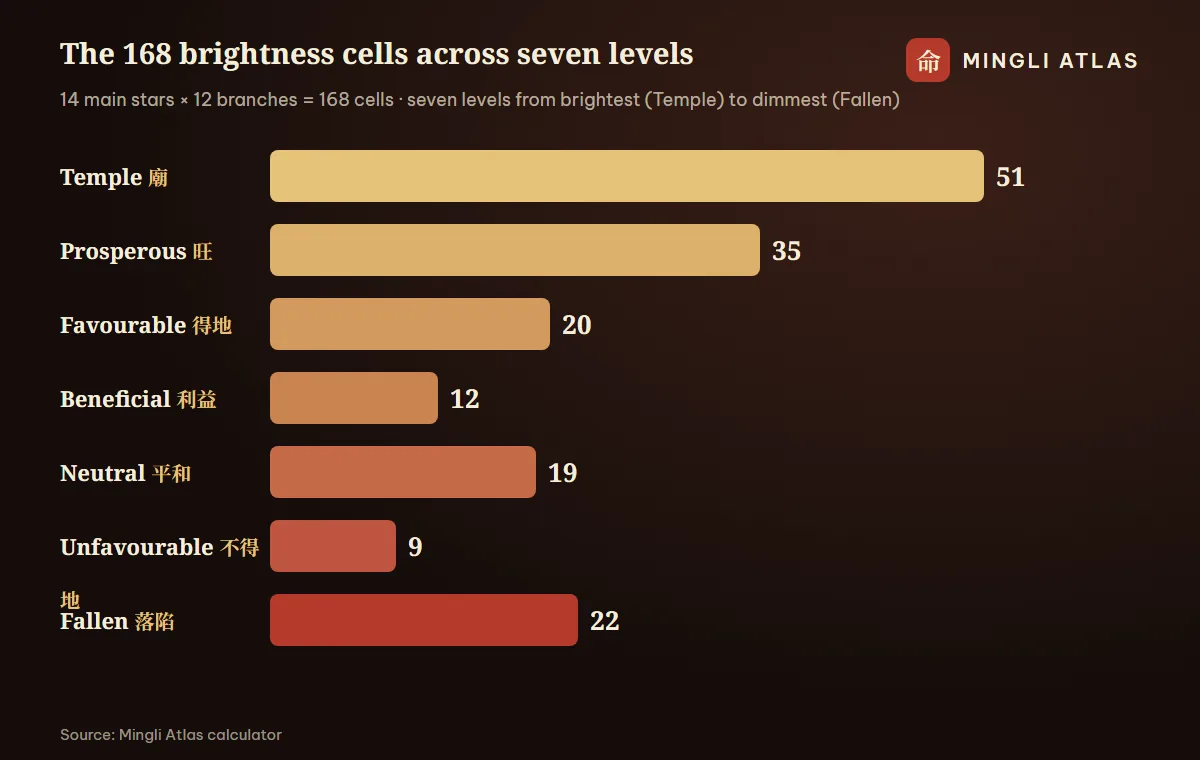
Temple is the most common level, 51 of the 168 cells; Beneficial and Unfavourable are the rarest, with 12 and 9.
What does star brightness depend on?
Brightness depends on two things only: the star and the branch of the palace it sits in. The calculator looks the level up by the pair of star and branch, so Tian Ji at Hai is always Neutral, whether the Hai palace of that chart is Life, Wealth or Parents. The level does not change with the name of the palace, with the other stars in it, with the Bureau or with the Four Transformations. A star that carries Hua Quan and is Fallen has two separate facts attached, its brightness and its transformation, and each is best written down on its own.
The book also treats brightness as something to look at separately. In the lines on grading the Fortune palace, the Quanshu says:
四看福德宮權祿劫空廟陷,以福德宮對財帛宮也。
Complete Book of Zi Wei Dou Shu (紫微斗數全書), vol. 3, Discourse on the essentials of the stars, on grading the stars (談星要論・論格星數高下)
The line names 廟陷, Temple and Fallen, next to Quan, Lu, Jie and Kong. We cite it only to show that the book makes brightness an item to check, not to draw a rule that holds for every chart.
The brightness table of the 14 main stars by branch
The picture below shades the brightness of the fourteen main stars on the twelve branches, and the table under it lists the same data in words: for each star, which branches fall under each level. A dash (—) means the star has no branch at that level. The data is read from the Mingli Atlas chart calculator. The Quanshu has a table with the same seven columns, with the twelve branches running from Yin to Chou, under the heading:
星曜亮度表(寅卯辰巳午未申酉戌亥子丑)
Complete Book of Zi Wei Dou Shu (紫微斗數全書), vol. 2, table 廟/旺/得地/利益/平和/不得地/落陷 (Wikisource transcription)
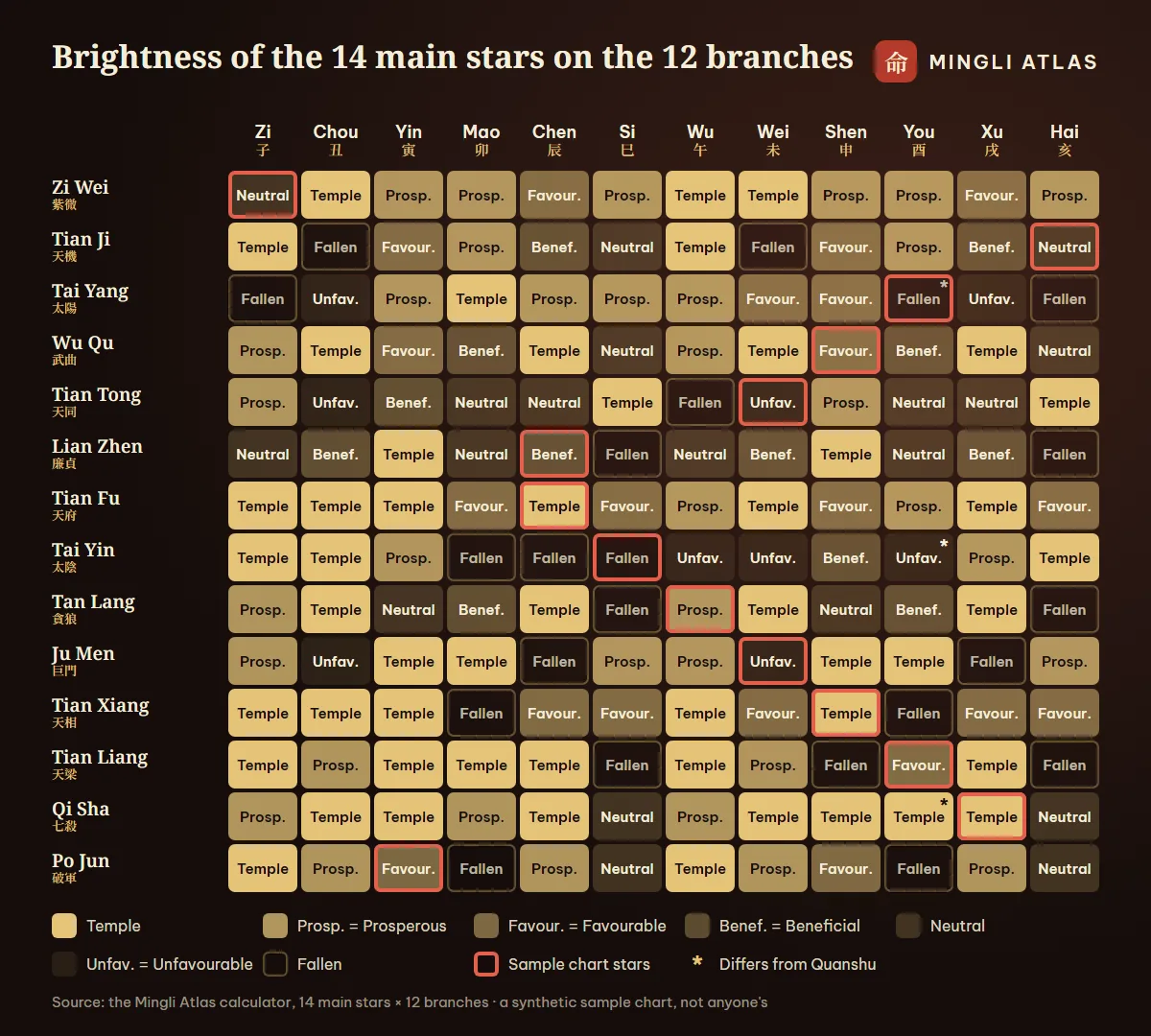
| Main star | Temple | Prosperous | Favourable | Beneficial | Neutral | Unfavourable | Fallen |
|---|---|---|---|---|---|---|---|
| Zi Wei | Chou, Wu, Wei | Yin, Mao, Si, Shen, You, Hai | Chen, Xu | — | Zi | — | — |
| Tian Ji | Zi, Wu | Mao, You | Yin, Shen | Chen, Xu | Si, Hai | — | Chou, Wei |
| Tai Yang | Mao | Yin, Chen, Si, Wu | Wei, Shen | — | — | Chou, Xu | Zi, You, Hai |
| Wu Qu | Chou, Chen, Wei, Xu | Zi, Wu | Yin, Shen | Mao, You | Si, Hai | — | — |
| Tian Tong | Si, Hai | Zi, Shen | — | Yin | Mao, Chen, You, Xu | Chou, Wei | Wu |
| Lian Zhen | Yin, Shen | — | — | Chou, Chen, Wei, Xu | Zi, Mao, Wu, You | — | Si, Hai |
| Tian Fu | Zi, Chou, Yin, Chen, Wei, Xu | Wu, You | Mao, Si, Shen, Hai | — | — | — | — |
| Tai Yin | Zi, Chou, Hai | Yin, Xu | — | Shen | — | Wu, Wei, You | Mao, Chen, Si |
| Tan Lang | Chou, Chen, Wei, Xu | Zi, Wu | — | Mao, You | Yin, Shen | — | Si, Hai |
| Ju Men | Yin, Mao, Shen, You | Zi, Si, Wu, Hai | — | — | — | Chou, Wei | Chen, Xu |
| Tian Xiang | Zi, Chou, Yin, Wu, Shen | — | Chen, Si, Wei, Xu, Hai | — | — | — | Mao, You |
| Tian Liang | Zi, Yin, Mao, Chen, Wu, Xu | Chou, Wei | You | — | — | — | Si, Shen, Hai |
| Qi Sha | Chou, Yin, Chen, Wei, Shen, You, Xu | Zi, Mao, Wu | — | — | Si, Hai | — | — |
| Po Jun | Zi, Wu | Chou, Chen, Wei, Xu | Yin, Shen | — | Si, Hai | — | Mao, You |
The table shows four things that a five-level list does not:
- No star uses all seven levels. Tian Ji and Tian Tong spread over the most, six levels each.
- Zi Wei, Wu Qu, Tian Fu and Qi Sha have no branch at Fallen; the other ten stars each have at least one.
- Tian Fu stays within three levels, Temple, Prosperous and Favourable; Zi Wei is lowest at Neutral on Zi.
- On the same branch the stars get very different levels. On Hai, for example, Tian Tong is at Temple, Tian Ji is Neutral and Tai Yang is Fallen.
To look up a single star, open its own guide, such as Tian Ji, for the levels and branches of that star alone, or the guide to the fourteen main stars to compare the stars with one another.
Which three cells differ from the Quanshu?
Of the 168 cells, 165 agree with the Quanshu table, and the three that differ are all on the You branch. The table below puts the two readings side by side.
| Star | Branch | Quanshu | Chart calculator |
|---|---|---|---|
| Tai Yang | You | Neutral (平和) | Fallen |
| Tai Yin | You | Prosperous (旺) | Unfavourable |
| Qi Sha | You | Prosperous (旺) | Temple |
Our single-star guides, such as Tai Yang and Tai Yin, state the Quanshu table, while the chart the calculator draws uses the calculator’s own table. For these three cells the two places can therefore show two different levels. We do not treat either table as the only correct one: the common tables differ in a few places, and the methodology page describes the table the calculator uses. When you compare two sources, write the name of the table you looked up beside each level.
This guide covers the fourteen main stars only. Some minor stars, such as Wen Chang, Wen Qu, Huo Xing, Ling Xing, Qing Yang and Tuo Luo, also carry a brightness in the calculator, but they are not in the table above.
Reading brightness on the sample chart
The synthetic chart used across these guides was born at 08:00 on 25 March 2003 in Hanoi, male. The table below sorts its fourteen main stars by brightness, with the palace and branch where each one stands.
| Brightness | Stars in the sample chart (palace, branch) |
|---|---|
| Temple | Tian Fu (Friends, Chen); Tian Xiang (Children, Shen); Qi Sha (Siblings, Xu) |
| Prosperous | Tan Lang (Health, Wu) |
| Favourable | Po Jun (Property, Yin); Wu Qu (Children, Shen); Tian Liang (Spouse, You) |
| Beneficial | Lian Zhen (Friends, Chen) |
| Neutral | Tian Ji (Life, Hai); Zi Wei (Parents, Zi) |
| Unfavourable | Tian Tong (Wealth, Wei); Ju Men (Wealth, Wei) |
| Fallen | Tai Yin (Travel, Si); Tai Yang (Spouse, You) |
In the four palaces of Life, which are Life at Hai, Travel at Si, Career at Mao and Wealth at Wei, no star is at Temple or Prosperous: Tian Ji is Neutral, Tai Yin is Fallen, Tian Tong and Ju Men are both Unfavourable, and Career has no main star. Temple and Prosperous are the two levels that our palace guides call “bright” together. This describes where the stars stand in the sample chart; it says nothing about the life of the person born.
The sample chart also holds one of the three differing cells: Tai Yang on You, in the Spouse palace, is Fallen in the calculator and Neutral in the Quanshu. A careful reader writes down both and names the table behind each.
How to use brightness when reading a chart
Look at brightness after you know which star it is and which palace it is in, because it adjusts how sure a sentence can be and does not flip its direction. Our palace guides cite the Quanshu in that way: each line applies only when its stated conditions are met, and whether the star is bright or fallen is one of them.
- Write the star, the branch and the level together, for example “Tian Ji, Hai, Neutral”.
- Write the name of the table you used, above all when the star is one of the three cells that differ on You.
- Phrase the conclusion with “tends to” instead of “will”, then name one concrete thing you could do.
Step 4 of the seven steps for reading a Zi Wei chart is where brightness is used. And because the book reads a palace together with its three companions, look at the brightness of all four palaces in san fang si zheng, not only the Life palace.
Common mistakes
- Treating Fallen as bad and Temple as good, as if they were scores. The table only classifies where a star stands on a branch.
- Thinking brightness changes with the name of the palace. It changes only with the star and the branch.
- Comparing a five-level list with a seven-level table and not knowing why two places differ.
- Ignoring that the schools use different tables in a few cells.
A chart is a frame for reflecting on yourself, not a certain prediction. For how this site calculates and reads a chart, see the methodology, and to see brightness on your own chart, calculate your Zi Wei chart.
Keep reading
From reading to your chart
See your own chart
Free BaZi and Zi Wei charts, read against the classical texts, with no email needed.