How to Read a Zi Wei Chart: 7 Steps in Order for Beginners
Published , updated
Written by the Mingli Atlas team · Method and sources
Đọc bài này bằng tiếng Việt
To read a Zi Wei chart, follow a fixed order: check the birth data, place the Life and Body palaces, find the Five Element Bureau, read the main stars in the Life palace, read the Life palace together with its three companion palaces, look up the Four Transformations, and only then add the decade limits. Each step uses the result of the one before, so a beginner who starts from an unfamiliar star or from the decade limits is reading without a reference point. This guide gives the seven steps, what to write down at each, and which guide explains it in full. We run a synthetic sample chart through all seven, including the sum that places the Zi Wei star, which few pages bother to write out.
Step 1. Check the birth data
A Zi Wei chart is only as sound as the two numbers it is built from: the lunar birth date and the birth hour. Use the time on the birth certificate with the time zone of the birthplace, convert it to a lunar date, and watch for three easy mistakes: a birth near the edge of a double hour, a birth in a leap month, and a birth around the New Year, since the lunar year turns on the first day of the first month. The birth time checklist goes through each case. Then calculate your Zi Wei chart to have a chart to read.
Step 2. Place the Life and Body palaces
The Life palace (命宮) is the origin point of the whole chart, and the Body palace (身宮) is the second palace to mark. Both come from the lunar birth month and the birth hour: start at the Yin palace as the first month, count forwards to the birth month, then treat that palace as the Zi hour and count backwards to the birth hour for Life, forwards for Body. Write down both branches, with the Life ruler and Body ruler the book assigns to them. The guide to finding the Life and Body palaces has the count step by step and three common traps.
Step 3. Find the Bureau and place the Zi Wei star
The Five Element Bureau (五行局) is an element paired with a number from 2 to 6, taken from the stem and branch of the Life palace. The number does two jobs: it tells you where the Zi Wei star sits, which fixes the place of all fourteen main stars, and it tells you the age at which the first decade limit begins. Look up the Bureau, then place Zi Wei from the lunar birth day and the Bureau number. The guide to the Five Element Bureau has the five bureaus and a table placing the star for all thirty days.
Step 4. Read the main stars in the Life palace
Look at the Life palace: which main stars it holds, or none, and how bright each is on that branch. Brightness, from Temple to Fallen, is about where a star stands on a branch, not a rating of good or bad. Write down the star names, their brightness and the minor stars in the same palace. A palace with no main star is a normal result of placing the stars, not a bad palace. The guide to the fourteen main stars lists each star, and a single-star guide such as Tian Ji has the brightness table by branch.
Step 5. Read the Life palace with its three companions
The old books never read a palace alone. Build the four palaces of Life, the opposite Travel palace, Wealth and Career, and write down the stars in all four. The stars in the opposite palace are weighed together with those of the Life palace, and a Life palace with no main star borrows from the palace opposite. The guide to san fang si zheng has the geometry of the four palaces, the book’s sentence on grading them, and the different ways sources use the names.
Step 6. Look up the Four Transformations of the birth year
The stem of the birth year assigns Hua Lu, Hua Quan, Hua Ke and Hua Ji to four stars. Look up those four stars, then find which palace each one sits in. A transformation is not read apart from its star and its palace, and Hua Ji does not automatically mean a bad event. The table for all ten stems is in the guide to the Four Transformations, together with the cells where the table differs from the old book’s verse.
Step 7. Add the decade limits and the annual chart
The natal chart is fixed; time moves through it. A decade limit is a ten-year stage that passes through the palaces in a set direction, and the palace whose turn it is becomes the focus of those ten years. Find the starting age from the Bureau, the direction from the yin or yang of the birth year and the sex, then look at the palace of the stage under study and its companions. Do this last, because a limit is read against a natal chart you already understand. The guide to decade limits gives the sum and a variant on the starting palace, and the annual chart adds the layer of a single year.
From the notes to a conclusion
After seven steps you hold a record of the Life and Body palaces, the Bureau, the stars of four palaces, four transformations and the limit under study. Fold them into a few sentences that begin “tends to” or “is worth a second look”, and name one concrete thing you could do. The schools differ on which stars are good or bad and by how much, so a one-sided verdict is a sign you have gone further than the data.
The sample chart through seven steps
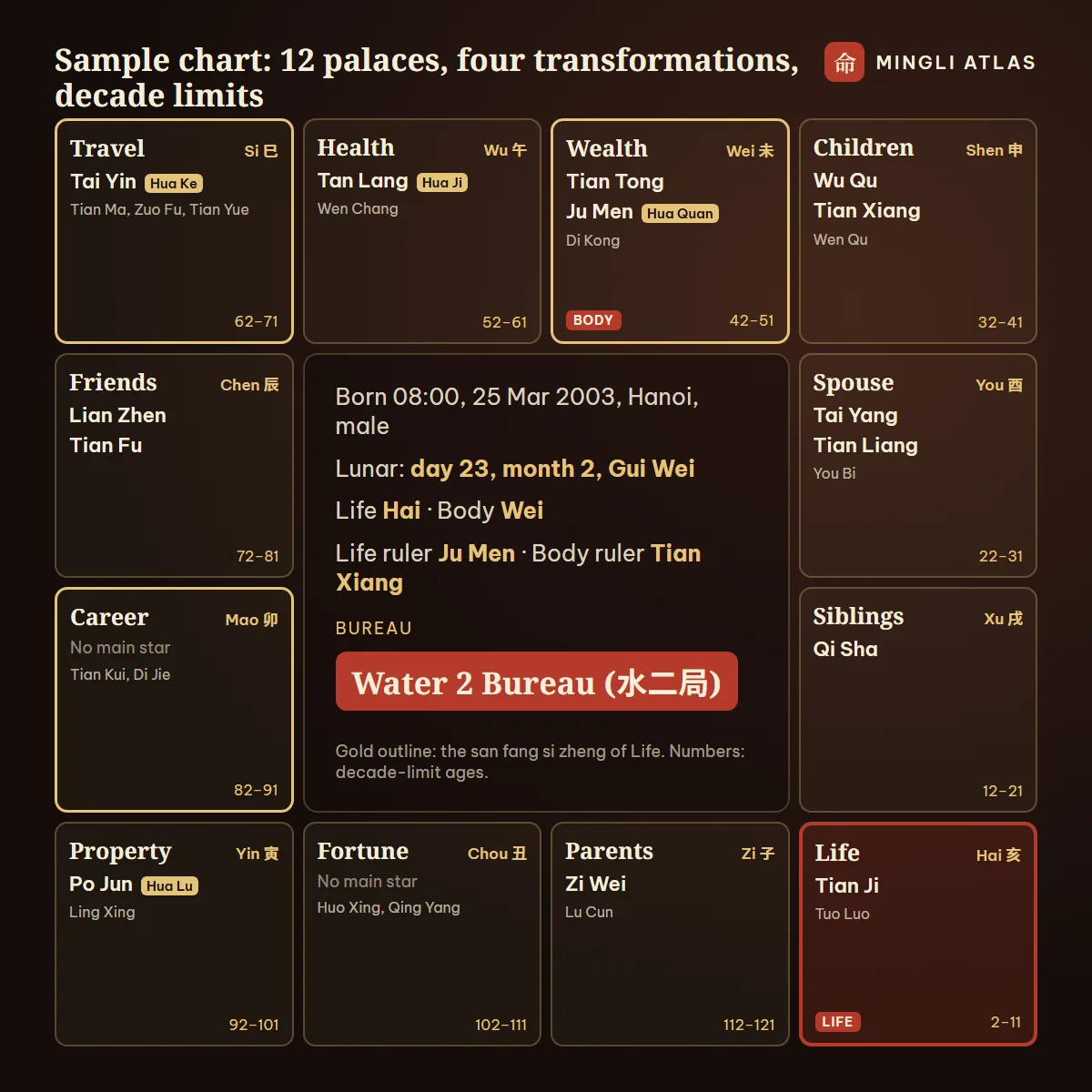
The synthetic chart used across these guides was born at 08:00 on 25 March 2003 in Hanoi, male. In the lunar calendar that is the 23rd day of the second month of the Gui Wei year.
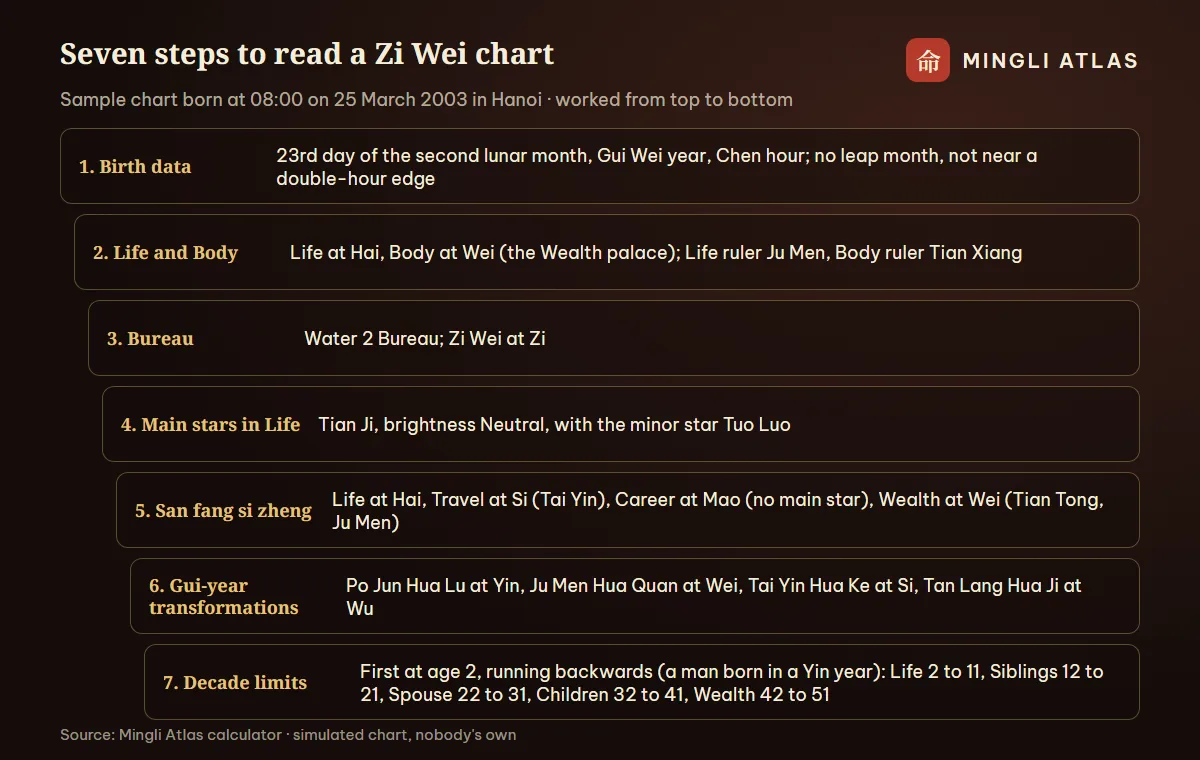
| Step | What the sample chart shows |
|---|---|
| 1. Birth data | 23rd day of the second lunar month, Gui Wei year, Chen hour; no leap month, not near a double-hour edge |
| 2. Life and Body | Life at Hai, Body at Wei (the Wealth palace); Life ruler Ju Men, Body ruler Tian Xiang |
| 3. Bureau | Water 2 Bureau; Zi Wei at Zi |
| 4. Main stars in Life | Tian Ji, brightness Neutral, with the minor star Tuo Luo |
| 5. San fang si zheng | Life at Hai, Travel at Si (Tai Yin), Career at Mao (no main star), Wealth at Wei (Tian Tong, Ju Men) |
| 6. Gui-year transformations | Po Jun Hua Lu at Yin, Ju Men Hua Quan at Wei, Tai Yin Hua Ke at Si, Tan Lang Hua Ji at Wu |
| 7. Decade limits | First at age 2, running backwards (a man born in a Yin year): Life 2 to 11, Siblings 12 to 21, Spouse 22 to 31, Children 32 to 41, Wealth 42 to 51 |
The sum in step 3 shows why the Bureau number matters. Water 2 Bureau has the number 2 and the birth day is 23. The smallest number that makes 23 divisible by 2 is 1, giving 24, and the quotient is 12. Counting Yin as 1, the 12th palace is Chou. The number added, 1, is odd, so move back one palace, to Zi. Zi Wei is at Zi, and the other five stars of the Zi Wei group and the eight stars of the Tian Fu group are placed from there.
Read this sample as a learner would. The Life palace holds one main star at Neutral brightness and one minor star; the Body palace is in Wealth, so Life and Body do not coincide; two of the four transformations fall inside the four palaces of Life, Hua Ke in Travel and Hua Quan in Wealth, while Hua Lu at Yin and Hua Ji at Wu lie outside. A careful reader writes these down and leaves the judgement open. See a full sample reading to see how the pages of a report fit together.
Common mistakes
- Reading the Life palace from the stars inside it alone and skipping the other three palaces.
- Calling a star good or bad from its name, without the palace, its brightness and the stars beside it.
- Converting to the wrong lunar date, especially around the New Year, leap months and double-hour edges.
- Treating Hua Ji as an omen of harm, or Hua Lu as a sure sign of luck.
- Starting from the decade limits before the natal chart is understood.
A chart is a frame for reflecting on yourself, not a certain prediction. For how this site calculates and reads a chart, see the methodology.
Keep reading
From reading to your chart
See your own chart
Free BaZi and Zi Wei charts, read against the classical texts, with no email needed.