San Fang Si Zheng in Zi Wei: Reading Four Palaces Together
Published , updated
Written by the Mingli Atlas team · Method and sources
Đọc bài này bằng tiếng Việt
San fang si zheng (三方四正), the three directions and four correspondences, is the way of reading a Zi Wei palace together with three other palaces that stand in a set position to it, instead of reading each palace alone. For the Life palace, those four are the Life palace itself, the Travel palace opposite it, and the other two, Wealth and Career. The stars in all four are weighed together: the old book grades a chart higher when all four palaces hold auspicious stars, and puts it in the middle grade when good and bad come together. This guide shows where each palace sits, what the old book says, and lays the four palaces over a sample chart to show what reading them together looks like.
What is san fang si zheng?
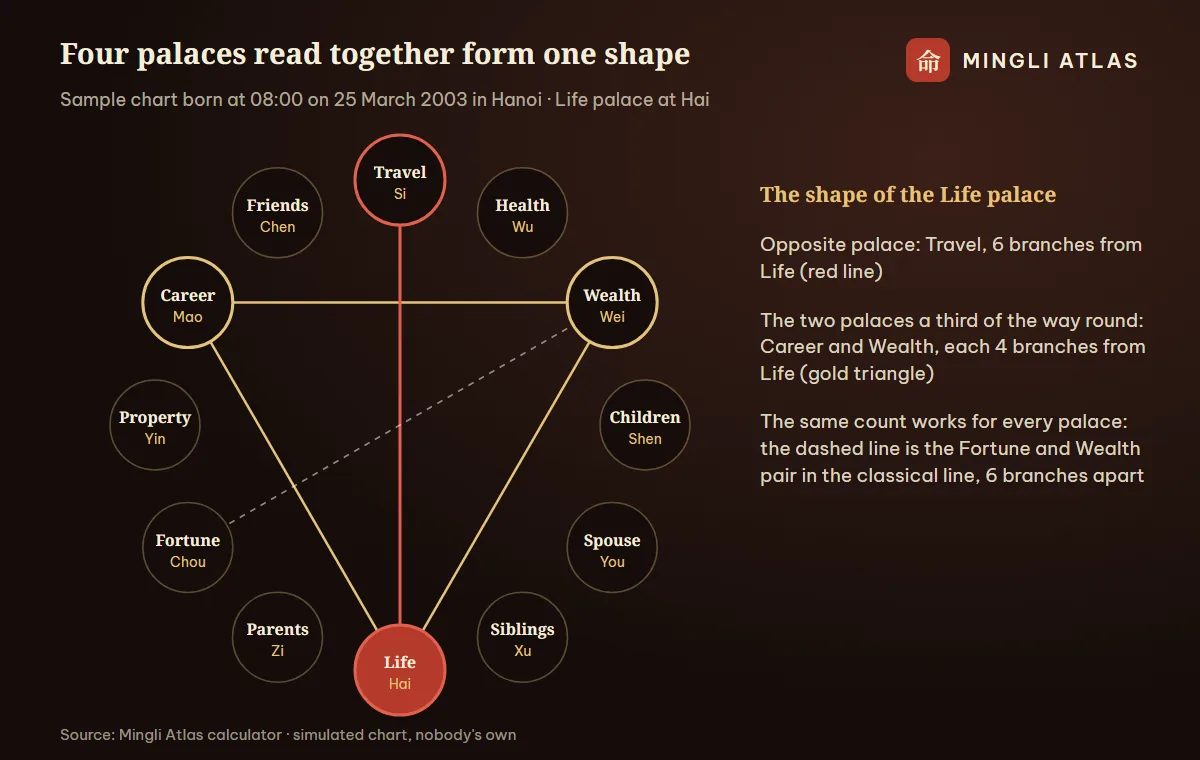
It is four palaces read as a group, counted from one starting palace. For the Life palace they are the Life palace, the palace opposite it across the centre of the chart, and two palaces a third of the circle away on either side. The stars in these four palaces bear on one another, so a reader does not conclude about the Life palace from the stars inside it alone.
The old book says so plainly when it discusses how to read the Life palace.
三看遷移財帛官祿三方星辰刑沖剋破。四看福德宮權祿劫空廟陷,以福德宮對財帛宮也。
Complete Book of Zi Wei Dou Shu (紫微斗數全書), vol. 3, Discourse on the essentials of the stars, on grading the stars (談星要論・論格星數高下)
In plain terms: the third look is at the stars of the three directions, Travel, Wealth and Career, for punishment, clash, restraint or breaking. The fourth look is at the Fortune palace, for power, wealth, robbery, emptiness, and whether its stars are bright or fallen, and the Fortune palace faces the Wealth palace. The second sentence shows that “facing” is also a positional relation: Fortune and Wealth sit opposite each other.
The names “three directions” and “four correspondences” are used a little differently between sources. Many call the three palaces Life, Wealth and Career the three directions and the opposite palace, Travel, the correspondence; together that makes four palaces. The sentence above lists the three palaces Travel, Wealth and Career as the “three directions” around Life. What both ways of naming agree on is that these four palaces are read together.
Where are the four palaces on the chart?
A chart has twelve palaces laid out round the twelve earthly branches. From a starting palace, the opposite palace is six branches away, and the other two are four branches away on either side, so each stands at a third of the circle. For the Life palace, the other three are always Travel (opposite), Wealth and Career, whichever branch the Life palace sits on.
| Position relative to the Life palace | Palace | Distance from Life |
|---|---|---|
| The palace itself | Life | 0 branches |
| Opposite palace | Travel | 6 branches |
| The two palaces at a third of the circle | Wealth and Career | 4 branches on each side |
The same relation holds for every palace, not only Life. In the sentence above, Fortune faces Wealth, two palaces six branches apart. Reading the four palaces round another palace, such as Wealth, uses the same counting, but this guide only works the example for the Life palace. For what each palace speaks about, see the guide to the twelve palaces.
How does the old book grade these four palaces?
In the same volume, the author gives two grades tied to san fang si zheng.
又三方四正皆吉星為上格。吉凶相伴守照為中格。
Complete Book of Zi Wei Dou Shu (紫微斗數全書), vol. 3, Discourse on the essentials of the stars, on grading the stars (談星要論・論格星數高下)
In plain terms: when the three directions and four correspondences are all auspicious stars, that is the upper grade; when good and bad accompany each other, sitting and shining, that is the middle grade. The word shou (守) is a star sitting in the palace itself; the word zhao (照) is a star shining on it from another palace. The sentence uses these two words as terms and does not define them as a geometric formula; this is the usual reading.
Two points matter. First, the book grades the four palaces as a whole, not each one alone. Second, which stars count as auspicious or not, and how heavily, depends on the school and on how bright a star is; this site does not grade a chart as good or bad, so it does not place the sample chart in the upper or middle grade.
Example: the four palaces round the Life palace in the sample chart
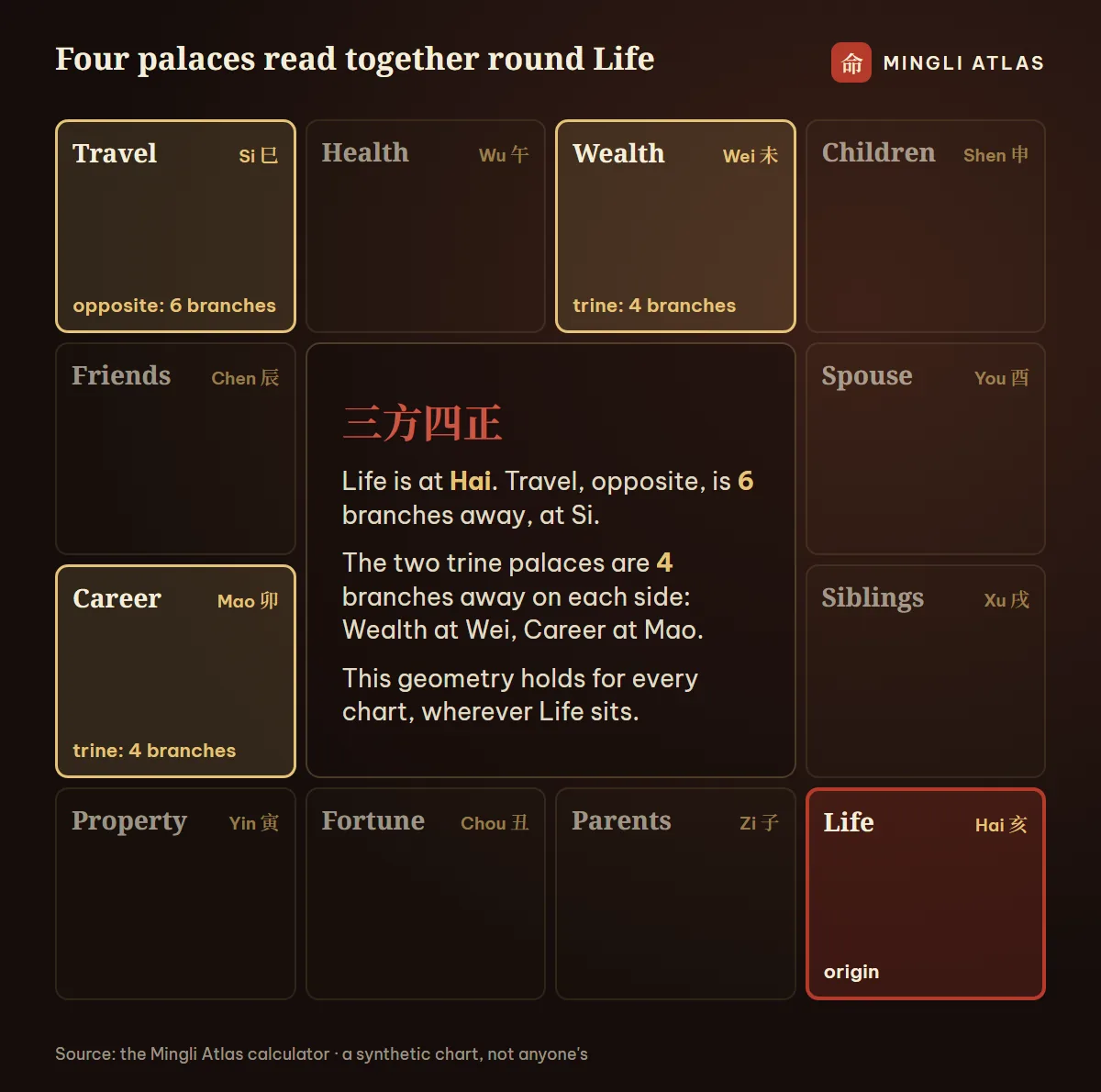
The synthetic chart used across these guides was born at 08:00 on 25 March 2003 in Hanoi, male. The Life palace is at Hai (see how to find the Life and Body palaces for how it is placed). The four palaces read together are the Life palace at Hai, the Travel palace opposite at Si, and the two palaces at a third of the circle, Career at Mao and Wealth at Wei.
| Palace | Branch | Main stars | Other stars |
|---|---|---|---|
| Life | Hai | Tian Ji | Tuo Luo |
| Travel | Si | Tai Yin (Hua Ke) | Tian Ma, Zuo Fu, Tian Yue |
| Career | Mao | No main star | Tian Kui, Di Jie |
| Wealth | Wei | Tian Tong, Ju Men (Hua Quan) | Di Kong |
A few things can be read from the table without grading anything. The four palaces hold four of the fourteen main stars: Tian Ji, Tai Yin, Tian Tong and Ju Men. Two of this chart’s four Transformations sit here: Hua Ke in Travel and Hua Quan in Wealth; Hua Lu in Yin and Hua Ji in Wu lie outside the four palaces. The Career palace has no main star, only two minor stars. And the Body palace also falls in Wealth, so it is one of the palaces in the san fang si zheng of Life. This is a synthetic chart for learning, not anyone’s real chart.
A real reading would also weigh the brightness of each star, which stars are auspicious or not in the school you follow, and the luck periods. To see the four palaces of your own chart, calculate your Zi Wei chart and find the Life palace and the other three.
Common misunderstandings
- Reading the Life palace only from the stars sitting in it and skipping the other three palaces.
- Treating the opposite palace as good or bad on its own; the book reads the four as one block.
- Assuming a palace with no main star is a bad palace. It only means no main star sits there.
- Using one rule of good and bad for every school, when the schools differ on exactly this point.
A chart is a frame for reflecting on yourself, not a certain prediction. To place this step in a whole reading, see how to read a Zi Wei chart. For how this site places and reads a chart, see the methodology.
Keep reading
From reading to your chart
See your own chart
Free BaZi and Zi Wei charts, read against the classical texts, with no email needed.