Cold Dew 2028: Exact Time and the Ren Xu Month
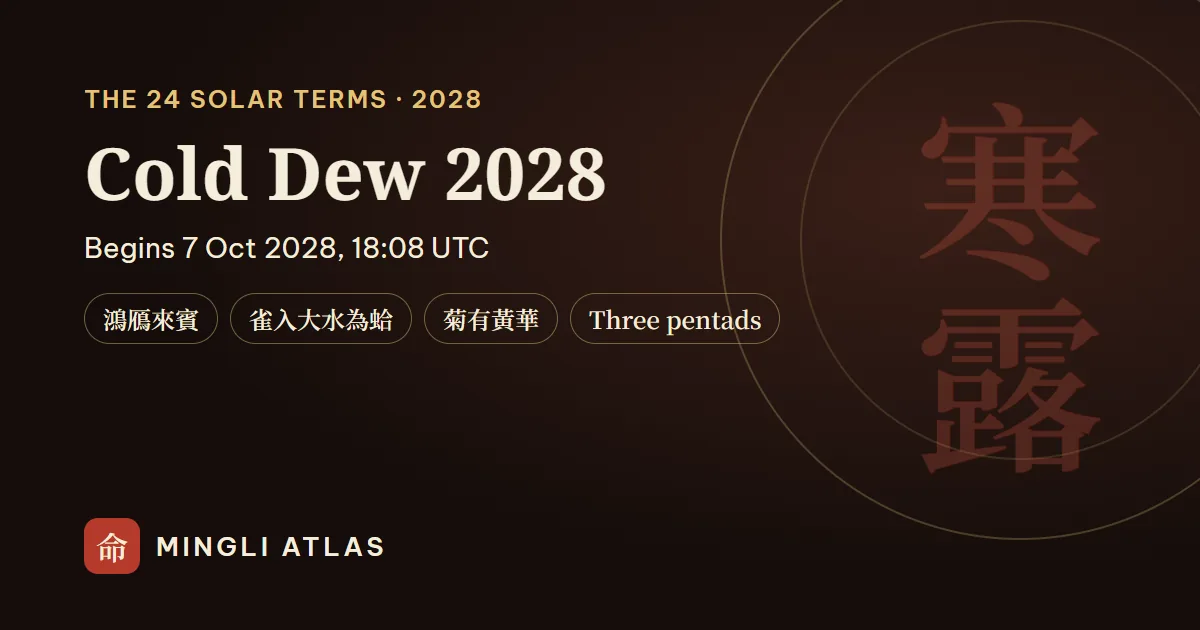
Cold Dew (寒露, Hanlu) begins on Saturday 7 October 2028 at 18:08 UTC: 19:08 in London and 14:08 in New York on Saturday, but 02:08 in Beijing and 01:08 in Vietnam on Sunday 8 October. It lasts until Frost’s Descent on 22 October (UTC). It is a sectional term (節), so at that minute the BaZi month pillar changes from Xin You to Ren Xu. This guide gives the 2028 pentad dates, a calendar quirk compared with last year, and three habits for the first cool weeks of the year.
When does Cold Dew 2028 begin?
Cold Dew 2028 begins on 7 October 2028 at 18:08 UTC, when the sun reaches 195° of ecliptic longitude. The moment falls on a Bing Yin (丙寅) day, in a Ren Xu (壬戌) month of a Wu Shen (戊申) year. The term lasts a little over fifteen days, until Frost’s Descent (霜降) begins on 22 October at 21:13 UTC.
| Milestone | UTC | Beijing (UTC+8) |
|---|---|---|
| Autumn Equinox (previous term) | 22 Sep 2028, 11:45 | 22 Sep, 19:45 |
| Cold Dew | 7 Oct 2028, 18:08 | 8 Oct, 02:08 |
| Frost’s Descent (next term) | 22 Oct 2028, 21:13 | 23 Oct, 05:13 |
The times come from the same calendar function that drives the Mingli Atlas chart tools. Western calendars list 7 October and East Asian calendars 8 October; both describe the same instant. The same split repeats at Frost’s Descent, which is 22 October in UTC but 23 October in East Asia.
Cold Dew 2028 pentad dates
Each solar term splits into three pentads (候) of about five days. The dates below are Vietnam calendar days.
| Pentad | Dates (2028) | Chinese | Meaning |
|---|---|---|---|
| First | 8 to 12 October | 鴻鴈來賓 | Wild geese come as guests |
| Second | 13 to 17 October | 雀入大水為蛤 | Sparrows enter the water and become clams |
| Third | 18 to 22 October | 菊有黃華 | Chrysanthemums bloom yellow |
The first pentad picks up the thread of White Dew a month earlier: then the geese arrived, now they stay “as guests”. The second records the old belief that sparrows went into the sea and turned into clams; the Shi Xun chapter of the Yi Zhou Shu spells it out with the word “transform” (爵入大水,化爲蛤). Read it as seasonal lore, not biology.
What the classical texts say about Cold Dew
「寒露,九月節。露氣寒冷,將凝結也。」
Yueling Qishier Hou Jijie (月令七十二候集解), section 寒露
In plain words: Cold Dew is the sectional term of the ninth month; the dew has turned cold and is about to congeal. The “ninth month” is the Xu (戌) month of the solar calendar, not the ninth lunar month. With White Dew before it and Frost’s Descent after it, Cold Dew is the middle step of a three term sequence about dew.
「秋三月,此謂容平。天氣以急,地氣以明。」
Huangdi Neijing, Suwen (素問), chapter 四氣調神大論
The three months of autumn are called “form settled and level”: things have taken their shape, heaven’s qi turns brisk and earth’s qi turns clear. Cold Dew opens the last of those three months.
What to do during Cold Dew 2028
The Huangdi Neijing’s advice for autumn:
「早臥早起,與雞俱興,使志安寧,以緩秋刑,收斂神氣,使秋氣平,無外其志,使肺氣清」
Huangdi Neijing, Suwen (素問), chapter 四氣調神大論
Go to bed early and rise early, with the rooster; keep the mind calm; gather your spirit in; keep the breath of the lungs clear. Last year’s post used the geese, the chrysanthemums and the dew “about to congeal”; this year’s habits draw on other lines:
- Get the warm things out before the first cold snap. The gloss says “the dew has turned cold” (露氣寒冷). Wash and air blankets, jackets and children’s socks in the first week of the term rather than searching the cupboard on the first chilly night.
- Rewrite the plan for the last quarter. The second pentad has the sparrow changing its whole form for the season (雀入大水為蛤). The fourth quarter has just begun: open the plan you made in January, cross out what no longer fits, and write three priorities for October to December.
- Fix a lights out time. “Go to bed early and rise early” (早臥早起). In Asia the term itself begins after 1 am this year, an hour when many people are still up; take the hint and choose a bedtime before midnight for the next fifteen days.
These are lifestyle readings of a classical text, not medical advice. As the weather cools, older people and anyone with a heart, blood pressure or breathing condition should keep warm and follow their doctor’s advice; if poor sleep goes on for weeks, see a doctor rather than coping alone.
How Cold Dew 2028 differs from 2027
In 2027, Cold Dew began on Friday 8 October at 12:17 UTC. In 2028 it begins on Saturday 7 October at 18:08 UTC, a day earlier on the UTC calendar. Because 2028 is a leap year, 365 days after last year’s moment only reaches 12:17 UTC on 7 October 2028, and the term arrives 5 hours 51 minutes after that. In East Asia those extra hours cross midnight, so the local date stays 8 October in both years.
Last year the moment fell on a Ding Wei year, Geng Xu month and Geng Shen day; this year it is a Wu Shen year, Ren Xu month and Bing Yin day. The new month is a Xu month both times, with the stem moving from Geng to Ren.
Cold Dew changes the BaZi month from Xin You to Ren Xu
At 18:08 UTC on 7 October 2028 the month pillar changes from Xin You (辛酉) to Ren Xu (壬戌). Someone born in London on the evening of 7 October after 19:08 already has the Ren Xu month; someone born in Vietnam late on 7 October, or before 01:08 on 8 October, still has Xin You.
The year pillar stays Wu Shen (戊申) until the Start of Spring of the following year. Because the change sits close to midnight in East Asia, enter the exact date, hour and minute in the BaZi chart calculator, which converts your local time zone for you.
Is it cold at Cold Dew where you live?
In northern China, where the name was coined, mid October brings the first properly cold nights. In much of the northern temperate zone it is crisp autumn weather, while in monsoon Asia parts of the coast are often at the height of the autumn rains. In the Southern Hemisphere October is mid spring; the term begins at the same instant everywhere on Earth.
Follow Cold Dew day by day
The Today page shows the solar term, pentad and day pillar of each day, and sets the day beside your own chart if you have made one. For the term itself, read what Cold Dew is in the solar terms section. The previous term is Autumn Equinox 2028; the next is Frost’s Descent, and you can read ahead in what Frost’s Descent is.
Keep reading
From reading to your chart
See your own chart
Free BaZi and Zi Wei charts, read against the classical texts, with no email needed.