Summer Solstice 2028 (Xiazhi): 20 or 21 June, Pentads
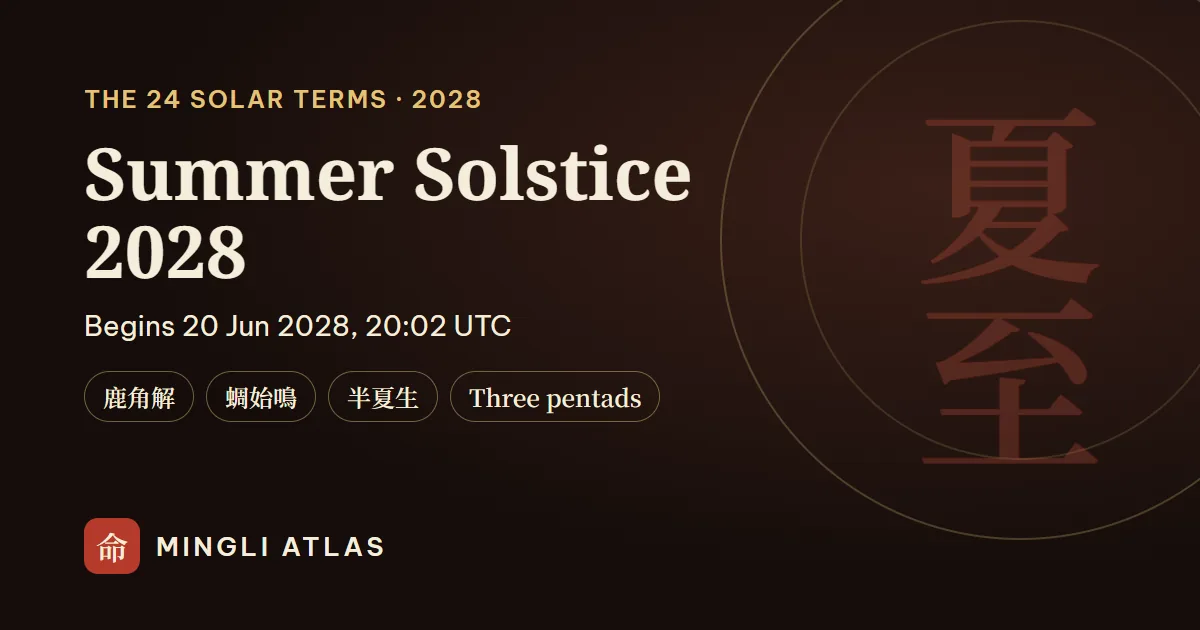
The Summer Solstice (夏至, Xiazhi) of 2028 falls on Tuesday 20 June 2028 at 20:02 UTC, which is already 04:02 on Wednesday 21 June in Beijing and 03:02 in Vietnam. It marks the longest day of the year in the Northern Hemisphere and lasts until Minor Heat on 6 July. It is a midpoint term (中氣), so it does not change the BaZi month pillar. This guide gives the 2028 pentad dates, explains why the date split between West and East returns this year, rereads the Book of Rites passage on the longest days, and suggests three habits drawn from it.
When is the Summer Solstice 2028?
The Summer Solstice 2028 falls on 20 June at 20:02 UTC, when the sun reaches 90° of ecliptic longitude. In London that is 21:02 (British Summer Time); in New York 16:02 the same afternoon. In China and Vietnam the date is already 21 June. The moment falls on a Ding Chou (丁丑) day, in a Wu Wu (戊午) month of a Wu Shen (戊申) year. The term lasts about fifteen and a half days, until Minor Heat (小暑) begins on 6 July 2028 at 13:30 UTC.
| Milestone | UTC | Beijing (UTC+8) |
|---|---|---|
| Grain in Ear (previous term) | 5 Jun 2028, 03:16 | 5 Jun, 11:16 |
| Summer Solstice | 20 Jun 2028, 20:02 | 21 Jun, 04:02 |
| Minor Heat (next term) | 6 Jul 2028, 13:30 | 6 Jul, 21:30 |
So Western almanacs list 20 June and Chinese calendars list 21 June. In East Asia the solstice instant arrives before dawn, so the whole of the long daylight of 21 June comes after it. The time comes from the same calendar function that drives the Mingli Atlas chart tools.
The three pentads of the Summer Solstice 2028
The solstice splits into three pentads (候), counted here by Vietnam calendar days; this year all three run five days.
| Pentad | Dates (2028) | Chinese | Meaning |
|---|---|---|---|
| First | 21 to 25 June | 鹿角解 | Deer shed their antlers |
| Second | 26 to 30 June | 蜩始鳴 | Cicadas begin to sing |
| Third | 1 to 5 July | 半夏生 | Crow-dipper sprouts |
The plant of the third pentad, banxia (半夏), literally means “half summer”, and the pentad places its sprouting exactly when summer is half over. For the second pentad the Book of Rites uses the general word for cicada, 蟬, instead of 蜩, and it adds a fourth sign that is not one of the 72 pentads, the rose of Sharon blooming (木堇榮).
How 2028 differs from 2027
In 2027 the solstice fell on 21 June at 14:10 UTC; in 2028 it falls on 20 June at 20:02 UTC. Adding exactly 365 days to last year’s moment reaches 20 June 2028 at 14:10 UTC, one date earlier because 2028 is a leap year with 29 February. The sun needs nearly six hours more than 365 days to return to the same point, and this year’s solstice comes 352 minutes after that mark, about 5 hours 52 minutes.
The result depends on your clock. In UTC and in Europe the date moves back from 21 to 20 June. In Vietnam the extra hours carry the moment past midnight, so it stays on 21 June, moving from the evening (21:10) to the small hours (03:02). Last year every major time zone shared one date; this year the split returns. The pillars at the start differ as well: in 2027 a Xin Wei (辛未) day, Bing Wu (丙午) month and Ding Wei (丁未) year; in 2028 a Ding Chou day, Wu Wu month and Wu Shen year. Last year’s guide is Summer Solstice 2027.
What do the classical texts say about the Summer Solstice?
「夏至,五月中。《韻會》曰:夏,假也;至,極也;萬物于此皆假大而至極也。」
Yueling Qishier Hou Jijie (月令七十二候集解), section 夏至
In plain words: the Summer Solstice is the midpoint of the fifth month. The Yunhui dictionary glosses “xia” as great and “zhi” as utmost: here all things reach the height of their growth. The “fifth month” is the Wu (午) month of the solar calendar, and the solstice sits in its middle.
「夏三月,此謂蕃秀。天地氣交,萬物華實。」
Huangdi Neijing, Suwen (素問), chapter 四氣調神大論
The three months of summer are called “lush and flowering”: the qi of heaven and earth mingle, and all things blossom and bear fruit. The solstice is the peak of that abundance.
The Book of Rites sets out how the noble person should live in the month of the longest day:
「是月也,日長至,陰陽争,死生分。君子齊戒,處必掩身,毋躁。止聲色,毋或進。薄滋味,毋致和。」
Book of Rites, Monthly Ordinances (禮記·月令), 仲夏之月
This month the day reaches its longest, yin and yang contend, and life and decline part ways. The noble person fasts and keeps restraint, stays covered and is not hasty; sets aside music and sensual pleasure and does not indulge; keeps food plain rather than richly seasoned.
What should you do at the Summer Solstice 2028?
Last year’s guide drew on the second half of that passage (stay covered, eat plainly, fewer distractions). This year, its opening lines suggest three different habits:
- Review the half year: what to keep, what to drop. “Yin and yang contend, life and decline part ways” (陰陽争,死生分). The solstice is the middle of the year; spend half an hour listing the plans you made in January, then choose one to put your energy into and one to stop for good.
- Have one simple day. “The noble person fasts and keeps restraint” (君子齊戒). There is no need to go without food; pick one day in solstice week for light meals, fewer appointments, no shopping, and phone notifications off after nine in the evening.
- Use the longest mornings. The passage opens with “the day reaches its longest” (日長至). Around the solstice, dawn in Vietnam usually comes between about five and half past five; move errands such as shopping, watering plants or a walk to the start of the day, before the sun is fierce.
These are lifestyle readings of a classical text, not medical advice. In strong sun drink enough water and rest in the shade; if you feel dizzy, nauseous or faint after time in the heat, move somewhere cool and seek medical help. Older people, small children and anyone with a heart or blood pressure condition should follow their doctor’s advice.
Does the Summer Solstice change the BaZi month?
No. The solstice is a midpoint term (中氣) inside the Wu (午) month, so everyone born from Grain in Ear (5 June 2028, 03:16 UTC) up to Minor Heat (6 July 2028, 13:30 UTC) has the month pillar Wu Wu (戊午). The year pillar stays Wu Shen (戊申).
The boundary to watch is Minor Heat, when the month turns to Ji Wei (己未). If a birth falls near it, enter the exact hour and minute in the BaZi chart calculator, which converts your local time zone for you.
Is the solstice the hottest time of year?
Usually not. It is the day with the most daylight in the Northern Hemisphere: roughly 13 hours 20 minutes in Hanoi and 12 hours 40 minutes in Ho Chi Minh City. But land and sea take time to store heat, so the hottest weeks in northern and central Vietnam, as in much of the Northern Hemisphere, tend to come after the solstice, around Minor Heat and Major Heat. In the Southern Hemisphere the same instant is the winter solstice.
Follow the Summer Solstice day by day
The Today page shows the solar term, pentad and day pillar of each day, and sets the day beside your own chart if you have made one. For the term itself, read what the Summer Solstice is in the solar terms section. The previous term is Grain in Ear 2028; the next is Minor Heat 2028.
Keep reading
From reading to your chart
See your own chart
Free BaZi and Zi Wei charts, read against the classical texts, with no email needed.