Frost’s Descent 2027: Start Time, Pentads and Habits
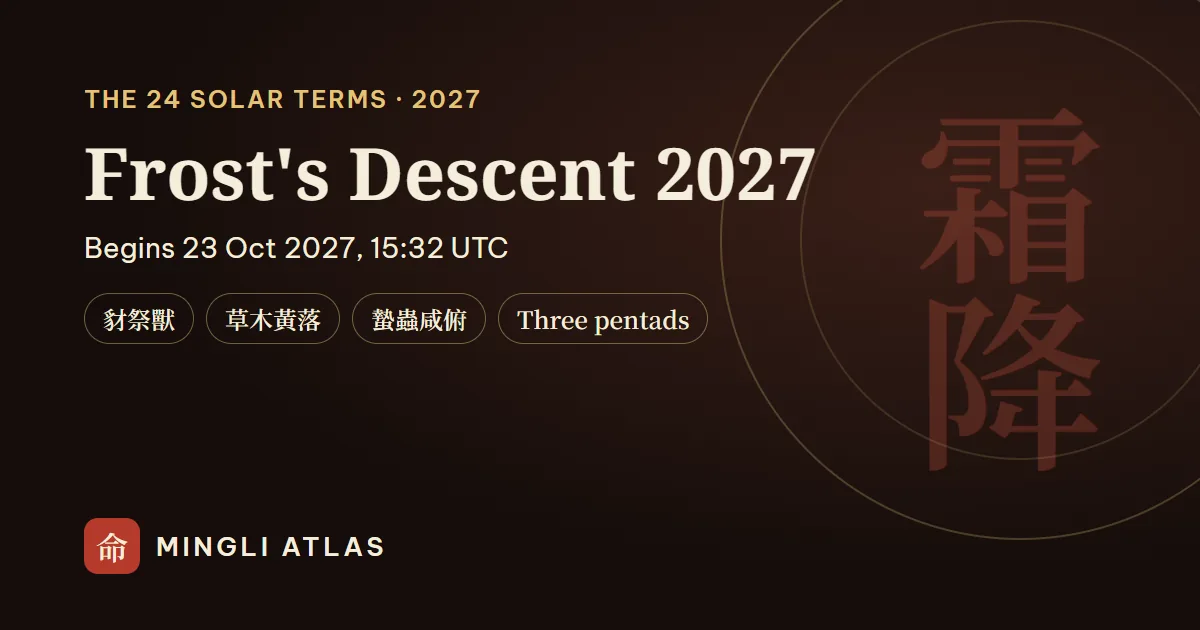
Frost’s Descent (霜降, Shuangjiang) begins on Saturday 23 October 2027 at 15:32 UTC, which is 23:32 in Beijing and 22:32 in Vietnam, and runs until Start of Winter on 7 November. It closes autumn in the Chinese solar calendar. Below you will find the 2027 pentad dates, how this year’s timing differs from 2026, and three small habits drawn from lines of the classical autumn advice that last year’s guide did not use.
When does Frost’s Descent 2027 begin and end?
The sun reaches 210° of ecliptic longitude on 23 October 2027 at 15:32 UTC. That instant is 11:32 on Saturday morning in New York (UTC-4) and 16:32 in London (UTC+1). The term ends fifteen days later, on 7 November 2027 at 15:38 UTC, when Start of Winter (立冬) begins.
In China the start falls less than half an hour before midnight, and most almanacs list only the date, so the minute matters more than usual this year. The time here comes from the same calendar function that drives the Mingli Atlas chart tools.
| Milestone | UTC | Beijing (UTC+8) |
|---|---|---|
| Cold Dew (previous term) | 8 Oct 2027, 12:17 | 8 Oct, 20:17 |
| Frost’s Descent | 23 Oct 2027, 15:32 | 23 Oct, 23:32 |
| Start of Winter (next term) | 7 Nov 2027, 15:38 | 7 Nov, 23:38 |
Frost’s Descent 2027: the three pentads
The fifteen days split into three pentads (候) of five days each. They are counted by Vietnam calendar days, so 23 October counts as the first day even though the term begins late that evening in Vietnam.
| Pentad | Dates (2027) | Chinese | Meaning |
|---|---|---|---|
| First | 23 to 27 October | 豺祭獸 | Jackals lay out their prey |
| Second | 28 October to 1 November | 草木黃落 | Leaves yellow and fall |
| Third | 2 to 6 November | 蟄蟲咸俯 | Insects lie still in hibernation |
The old texts do not agree word for word. The Yi Zhou Shu reads the first pentad as 豺乃祭獸 (“jackals then lay out their prey”), and the Book of Rites adds that they also kill birds (戮禽). The image is the same: animals stocking up before the cold.
What do the classical texts say about Frost’s Descent?
The commentary on the 72 pentads explains the name in one line:
「霜降,九月中。氣肅而凝露結為霜矣。」
Yueling Qishier Hou Jijie (月令七十二候集解), section 霜降
Frost’s Descent is the midpoint of the ninth month; the air turns austere and dew congeals into frost. The “ninth month” is the Xu (戌) month of the solar calendar, not the ninth lunar month.
「秋三月,此謂容平。天氣以急,地氣以明。」
Huangdi Neijing, Suwen (素問), chapter 四氣調神大論
The Neijing calls the three autumn months “form settled and level”: things have taken their shape, heaven’s qi turns brisk and earth’s qi turns clear. Frost’s Descent is the last stretch of that settling, just before winter starts to store.
What to do during Frost’s Descent 2027
The closest classical guidance is still the Neijing’s autumn passage:
「早臥早起,與雞俱興,使志安寧,以緩秋刑,收斂神氣,使秋氣平,無外其志,使肺氣清」
Huangdi Neijing, Suwen (素問), chapter 四氣調神大論
In plain words: go to bed early and rise early, with the rooster; keep the mind calm to soften autumn’s harshness; gather your spirit in; keep the breath of the lungs clear. This year, three different phrases from it:
- Keep one fixed wake time for the whole fortnight. “Rise with the rooster” (與雞俱興) means waking with the day, not with your mood. Pick a time, keep it on weekends too, and get a few minutes of daylight soon after you get up.
- Leave a quiet half hour before sleep. “Keep the mind calm” (使志安寧) is easier with a buffer. Switch off the news, write down the two or three things still on your mind, and leave them for the morning.
- Say hard things gently. “Soften autumn’s harshness” (以緩秋刑) fits the end of the working year, when reviews and feedback pile up. If you must deliver bad news, choose a calm moment and talk about the work, not the person.
These are lifestyle readings of a classical text, not medical advice. If you are being treated for insomnia, anxiety or a breathing condition, follow your doctor.
How does 2027 differ from 2026?
Same date, very different hour. Frost’s Descent 2026 began on Friday 23 October 2026 at 09:37 UTC; this year it begins on a Saturday at 15:32 UTC, 355 minutes later than the same clock time 365 days on. The solar year is close to six hours longer than a 365 day calendar year, so in ordinary years each term arrives about that much later; after the leap day of 29 February 2028, terms fall one calendar day earlier than they otherwise would.
The pillars change too. In 2026 the term began on a Geng Wu (庚午) day, in a Wu Xu (戊戌) month of a Bing Wu (丙午) year. In 2027 it begins on a Yi Hai (乙亥) day, in a Geng Xu (庚戌) month of a Ding Wei (丁未) year.
Does Frost’s Descent bring frost where you live?
Usually not unless your climate resembles northern China’s. The names describe the Yellow River basin. In the tropics there is no frost at this time, and in the Southern Hemisphere late October is mid spring. Treat the term as a position of the sun that starts at the same instant everywhere.
Does Frost’s Descent change the BaZi month pillar?
No. It is a midpoint term (中氣) inside the Xu month, so everyone born from Cold Dew (8 October 2027, 12:17 UTC) up to Start of Winter (7 November 2027, 15:38 UTC) has the month pillar Geng Xu (庚戌).
The boundary to watch is Start of Winter: from 15:38 UTC on 7 November 2027 the month pillar becomes Xin Hai (辛亥). In East Asia that moment falls late in the evening, so evening births that day need the exact minute. Enter it in the BaZi chart calculator, which converts your local time zone for you.
Follow Frost’s Descent 2027 day by day
The Today page shows each day’s solar term, pentad and day pillar, and places the day beside your own chart if you have made one. For the term itself, read what Frost’s Descent is in the solar terms section. The previous term is Cold Dew 2027; the next is Start of Winter 2027.
Keep reading
From reading to your chart
See your own chart
Free BaZi and Zi Wei charts, read against the classical texts, with no email needed.