Start of Winter 2027 (Lidong): Time, Pentads, Xin Hai Month
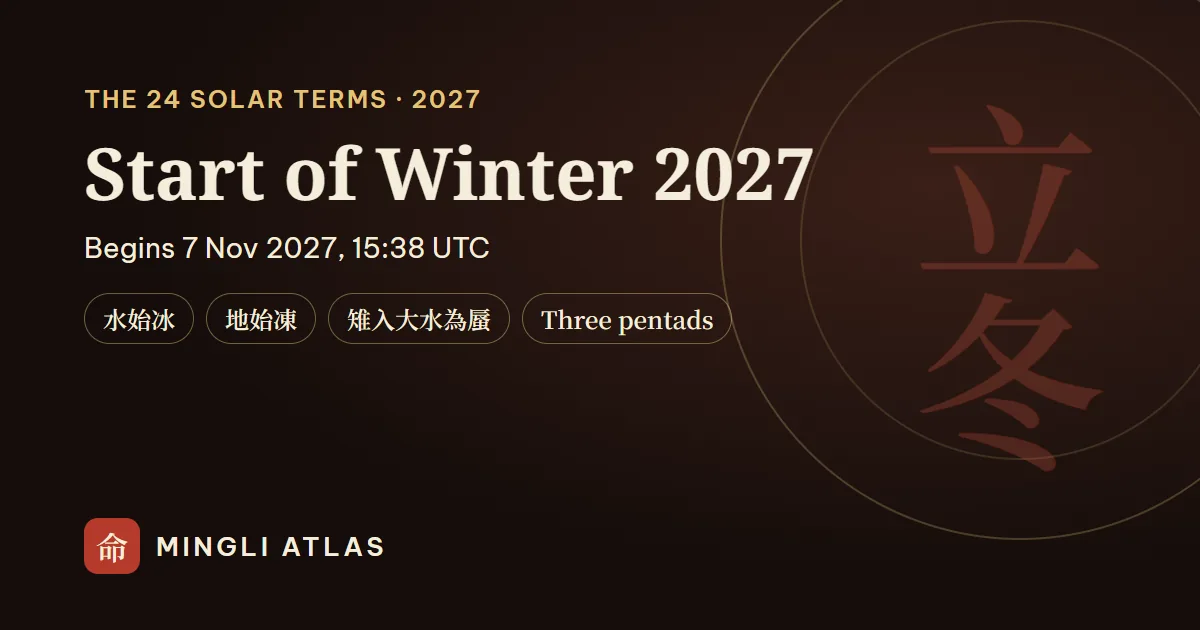
Start of Winter (立冬, Lidong) begins on Sunday 7 November 2027 at 15:38 UTC (23:38 in Beijing, 22:38 in Vietnam) and lasts until Minor Snow on 22 November. In the Chinese solar calendar it is the first day of winter, and in BaZi it is the minute the month pillar turns from Geng Xu to Xin Hai. This guide gives the 2027 pentad dates, compares the timing with 2026, and offers three preparations for the season of storing.
When is Start of Winter 2027?
The sun reaches 225° of ecliptic longitude on 7 November 2027 at 15:38 UTC. In London that is 15:38 GMT. In New York it is 10:38 EST, and that same Sunday is the morning the United States sets its clocks back an hour, so check which offset your calendar app is using. The moment falls on a Geng Yin (庚寅) day, in a Xin Hai (辛亥) month of a Ding Wei (丁未) year. The term lasts until Minor Snow (小雪) begins on 22 November 2027 at 13:16 UTC.
| Milestone | UTC | Beijing (UTC+8) |
|---|---|---|
| Frost’s Descent (previous term) | 23 Oct 2027, 15:32 | 23 Oct, 23:32 |
| Start of Winter | 7 Nov 2027, 15:38 | 7 Nov, 23:38 |
| Minor Snow (next term) | 22 Nov 2027, 13:16 | 22 Nov, 21:16 |
The time comes from the same calendar function that drives the Mingli Atlas chart tools. Popular almanacs list 7 November without an hour, which is fine for the season but not for a birth chart.
The three pentads of Start of Winter 2027
Counted by Vietnam calendar days, the three pentads (候) fall on the same dates as in 2026.
| Pentad | Dates (2027) | Chinese | Meaning |
|---|---|---|---|
| First | 7 to 11 November | 水始冰 | Water begins to freeze |
| Second | 12 to 16 November | 地始凍 | The ground begins to freeze |
| Third | 17 to 21 November | 雉入大水為蜃 | Pheasants enter the water and become giant clams |
The first two pentads move from water to soil: thin ice forms on still water before the ground hardens. The third records an old belief about pheasants vanishing in early winter; read it as a seasonal marker, not as biology.
What do the classical texts say about Start of Winter?
The commentary on the 72 pentads defines winter as an ending, when everything is brought in:
「立冬,十月節。……冬,終也,萬物收藏也。」
Yueling Qishier Hou Jijie (月令七十二候集解), section 立冬
The “tenth month” is the Hai (亥) month of the solar calendar, not the tenth lunar month. The Book of Rites records the court ritual before the day and names the season’s element:
「是月也,以立冬。……「某日立冬,盛德在水。」天子乃齊。」
Book of Rites, Monthly Ordinances (禮記·月令), 孟冬之月
This month holds Start of Winter. The Grand Historian announces, “On such a day winter begins; the flourishing virtue is in Water.” The Son of Heaven then fasts. The Hai branch is also Water, so the ritual text and the calendar agree on the element.
What should you do at Start of Winter 2027?
The Huangdi Neijing names the winter months “closing and storing”:
「冬三月,此謂閉藏。水冰地坼,無擾乎陽。」
Huangdi Neijing, Suwen (素問), chapter 四氣調神大論
Last year’s guide took its habits from the Neijing’s sleep advice. This year’s three come from the two texts quoted above:
- Switch your wardrobe in the first pentad. “All things are gathered in and stored” (萬物收藏) is literal here: wash and put away summer clothes, and air the winter ones before the first cold morning catches you digging through a cupboard.
- Keep a flask of warm water where you work. “The flourishing virtue is in Water” (盛德在水) makes a good reminder. In dry, cool weather many people drink less because they feel less thirsty; a warm drink within reach makes it easy.
- Keep one simple day. “The Son of Heaven then fasts” (天子乃齊) describes a day of restraint before the season’s rites. Pick one day in the first week for plain meals, no alcohol and no evening plans, and start winter with a clearer head.
These are lifestyle readings of a classical text, not medical advice. If you have a kidney, heart or blood sugar condition, or follow a prescribed diet, ask your doctor before changing how much you drink or eat.
How does Start of Winter 2027 differ from 2026?
Start of Winter 2026 began on Saturday 7 November 2026 at 09:52 UTC. This year it begins on a Sunday at 15:38 UTC, 346 minutes later than the same clock time 365 days on. The solar year runs close to six hours longer than 365 days, which is why each term drifts later through ordinary years; after the leap day of 29 February 2028, terms fall one calendar day earlier than they otherwise would.
The pillars at the start differ as well: a Yi You (乙酉) day, Ji Hai (己亥) month and Bing Wu (丙午) year in 2026, against a Geng Yin (庚寅) day, Xin Hai (辛亥) month and Ding Wei (丁未) year in 2027.
Start of Winter changes the BaZi month pillar
Start of Winter is a sectional term (節), so at 15:38 UTC on 7 November 2027 the month pillar changes from Geng Xu (庚戌) to Xin Hai (辛亥). A person born before that minute, even on the same day, keeps the Geng Xu month.
In East Asia this year’s boundary falls late at night, and in the Americas it falls on the morning of a clock change, so a birth time recorded loosely can land in the wrong month. Enter the exact hour, minute and place in the BaZi chart calculator; it uses each year’s exact term time and converts your local time zone.
Is it really winter in early November?
In the Chinese calendar, yes: its seasons begin at the four “starts”, midway between solstices and equinoxes. Western astronomical winter begins at the December solstice instead. Weather follows neither rule exactly, and in the Southern Hemisphere early November is late spring, so treat the term as a marker of shortening days rather than a forecast.
Follow Start of Winter 2027 day by day
The Today page shows each day’s solar term, pentad and day pillar, and places the day beside your own chart if you have made one. For the term itself, read what Start of Winter is in the solar terms section. The previous term is Frost’s Descent 2027; the next is Minor Snow 2027.
Keep reading
From reading to your chart
See your own chart
Free BaZi and Zi Wei charts, read against the classical texts, with no email needed.