Grain in Ear 2028 (Mangzhong): Time, Pentads, Wu Wu
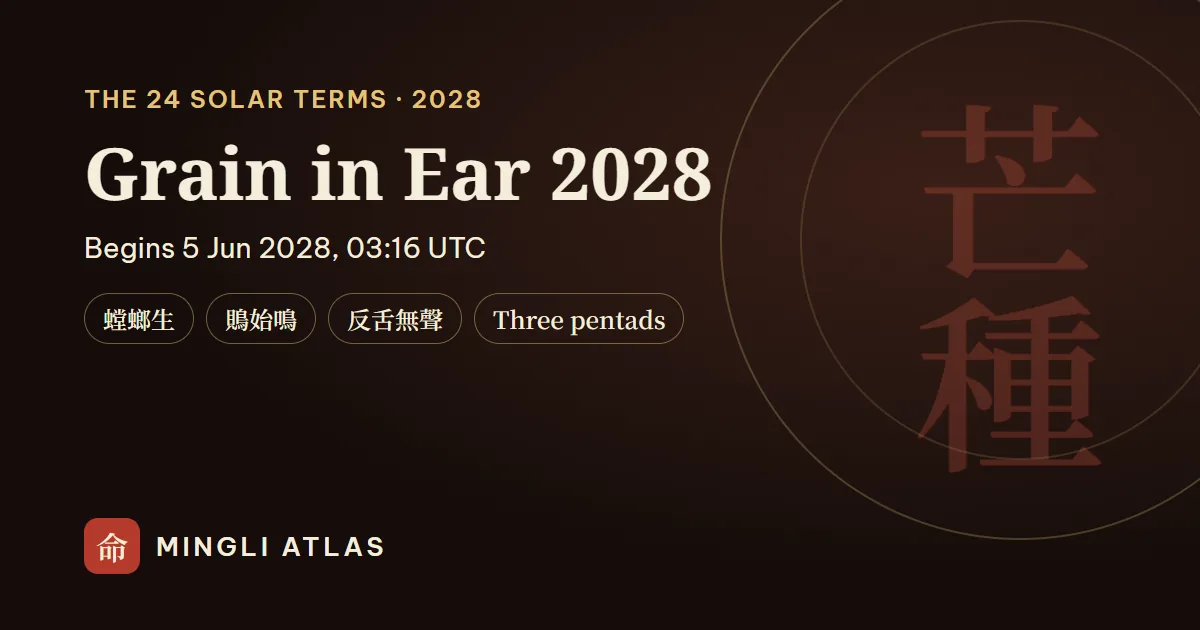
Grain in Ear (芒種, Mangzhong) begins on Monday 5 June 2028 at 03:16 UTC (11:16 in Beijing, 10:16 in Vietnam) and lasts until the Summer Solstice on the evening of 20 June in UTC. It is a sectional term (節), so at that minute the BaZi month pillar changes from Ding Si to Wu Wu. This guide gives the 2028 pentad dates, sets this year beside 2027, explains what the name means in the classical gloss, and suggests three habits for the middle of summer.
When is Grain in Ear 2028?
Grain in Ear 2028 begins on 5 June at 03:16 UTC, when the sun reaches 75° of ecliptic longitude. In London that is 04:16 on Monday morning; in New York it is still 23:16 on Sunday 4 June. The moment falls on a Xin You (辛酉) day, in a Wu Wu (戊午) month of a Wu Shen (戊申) year. The term lasts about fifteen and a half days, until the Summer Solstice (夏至) begins on 20 June 2028 at 20:02 UTC.
| Milestone | UTC | Beijing (UTC+8) |
|---|---|---|
| Grain Buds (previous term) | 20 May 2028, 12:09 | 20 May, 20:09 |
| Grain in Ear | 5 Jun 2028, 03:16 | 5 Jun, 11:16 |
| Summer Solstice (next term) | 20 Jun 2028, 20:02 | 21 Jun, 04:02 |
So Europe and Asia list 5 June this year, and only the Americas list 4 June. The time comes from the same calendar function that drives the Mingli Atlas chart tools.
The three pentads of Grain in Ear 2028
Each solar term splits into three pentads (候). Counted by Vietnam calendar days, the third runs six days, because the Summer Solstice arrives before dawn on 21 June in Vietnam.
| Pentad | Dates (2028) | Chinese | Meaning |
|---|---|---|---|
| First | 5 to 9 June | 螳螂生 | Mantises hatch |
| Second | 10 to 14 June | 鵙始鳴 | Shrikes begin to call |
| Third | 15 to 20 June | 反舌無聲 | Mockingbirds fall silent |
Young mantises leave their egg cases, the shrike starts calling, and the mimic songbird goes quiet. One way to read the three is as a handover: the voices of spring fall silent and the small hunters of summer appear. The Book of Rites writes the mantis as 螳蜋 and the shrike as 鶪, with the same meaning.
How 2028 differs from 2027
In 2027 Grain in Ear began on 5 June at 21:25 UTC; in 2028 it begins on 5 June at 03:16 UTC. The sun needs nearly six hours more than 365 days to return to the same point, so adding exactly 365 days to last year’s moment reaches 4 June 2028 at 21:25 UTC, and this year’s start comes 351 minutes later, about 5 hours 51 minutes. In UTC the two effects cancel out: the extra hours carry the start past midnight, while the leap day of 29 February pulls every term after February one calendar date earlier, so the UTC date stays 5 June. In Vietnam the date moves from 6 June to 5 June.
The clearest effect is on the date split. Last year Europe listed 5 June and Asia 6 June; this year Europe and Asia agree on 5 June and only the Americas show 4 June. The pillars at the start differ too: in 2027 a Bing Chen (丙辰) day, Bing Wu (丙午) month and Ding Wei (丁未) year; in 2028 a Xin You day, Wu Wu month and Wu Shen year. Last year’s guide is Grain in Ear 2027.
What does “Grain in Ear” mean?
「芒種,五月節。謂有芒之種穀可稼種矣。」
Yueling Qishier Hou Jijie (月令七十二候集解), section 芒種
In plain words: Grain in Ear is the sectional term of the fifth month; grains with awns can now be sown. “Mang” (芒) is the awn, the bristle on an ear of grain, and “zhong” (種) is both the seed and the sowing. The English name stresses ripe ears, but the classical gloss is about a season for sowing. The “fifth month” is the Wu (午) month of the solar calendar, not the fifth lunar month.
「夏三月,此謂蕃秀。天地氣交,萬物華實。」
Huangdi Neijing, Suwen (素問), chapter 四氣調神大論
The three months of summer are called “lush and flowering”: the qi of heaven and earth mingle, and all things blossom and bear fruit. Grain in Ear stands right in the middle of those three months.
What to do in midsummer 2028
The same chapter continues with advice for summer:
「夜臥早起,無厭於日,使志無怒,使華英成秀,使氣得泄,若所愛在外」
Huangdi Neijing, Suwen (素問), chapter 四氣調神大論
Go to bed a little later and rise early, do not resent the sun; keep the mind free of anger, let what is flowering come to full bloom, let the qi flow outward, as if what you love were outside. This year, three habits suit the fortnight:
- Show one nearly finished piece of work. “Let the flowers come into full bloom” (使華英成秀). Pick something close to done, an essay, a plan or something you have made, and show it to one trusted friend before the solstice on 21 June to get their feedback.
- Take someone you love outdoors on a cool evening. “As if what you love were outside” (若所愛在外). Arrange a walk in a park or by a lake, or a drink at a street cafe after five, when the sun has softened, instead of everyone sitting with their own screen.
- Keep one quiet hour a day. The third pentad is “mockingbirds fall silent” (反舌無聲). Follow the bird for one hour daily: no scrolling news, no forwarding messages, just one task that needs your attention.
These are lifestyle readings of a classical text, not medical advice. In hot weather drink enough water and limit long stretches outdoors at midday; if you feel dizzy, nauseous or faint after time in the sun, move somewhere cool and seek medical help. Anyone with a heart, blood pressure or other chronic condition should ask their doctor what level of activity suits them.
Grain in Ear changes the BaZi month pillar
At 03:16 UTC on 5 June 2028 the month pillar changes from Ding Si (丁巳) to Wu Wu (戊午). Anyone born before that minute has the Ding Si month; from then on it is Wu Wu. The year pillar stays Wu Shen (戊申).
The new month shares the stem Wu (戊) with the year; what that means can only be read in a whole chart, never from one pillar. In the Americas the change falls late on 4 June, so a late evening birth there on that date can already belong to the new month. Enter the full date, hour and minute in the BaZi chart calculator; it converts your local time zone for you.
Is it a sowing or a harvest season?
Both, depending on where you are. The name follows the Yellow River plain, where early June typically brought the wheat harvest and the sowing of awned grain together. In northern Vietnam the spring rice crop is usually being cut around now, while in the Mekong Delta many farmers have already sown the summer and autumn crop with the first rains. In the Southern Hemisphere the same instant falls in early winter. Read Grain in Ear as a reminder that this is a time both to sow and to gather, not as a planting date for your region.
Follow Grain in Ear day by day
The Today page shows the solar term, pentad and day pillar of each day, and sets the day beside your own chart if you have made one. For the term itself, read what Grain in Ear is in the solar terms section. The previous term is Grain Buds 2028; the next is Summer Solstice 2028.
Keep reading
From reading to your chart
See your own chart
Free BaZi and Zi Wei charts, read against the classical texts, with no email needed.