How to Place the 14 Main Stars in Zi Wei Dou Shu
To place the 14 main stars in a Zi Wei chart you only need the right palace for the two lead stars, Zi Wei and Tian Fu, and then count out the other twelve stars at fixed distances. The position of Zi Wei depends on exactly two numbers: the bureau number (2 to 6) and the lunar birth day (1 to 30). Tian Fu sits opposite Zi Wei across the Yin–Shen axis. This guide goes step by step on a sample chart, prints the full 150-cell table for every pairing of bureau and birth day, calculated by the Mingli Atlas calculator, and points out something few guides count: Zi Wei lands in the Chen palace most often (17 of the 150 cells) and in the Zi palace least (7 cells). If you still need to find the Life palace and the bureau, start with the guide to placing the Life and Body palaces; this guide covers how to place the stars, not which star is good or bad.
How do you place the Zi Wei star from the bureau and birth day?
Find the smallest k (0 or more) for which the lunar birth day plus k is divisible by the bureau number, then count the position from the quotient and k. Step by step:
- Take the lunar birth day (1 to 30) and the bureau number: Water Two Bureau is 2, Wood Three is 3, Metal Four is 4, Earth Five is 5, Fire Six is 6.
- Find the smallest k for which (day + k) is divisible by the bureau number, and take the quotient q of that division.
- Count q palaces from the Yin palace, with Yin as the 1st, going in the order Yin, Mao, Chen and wrapping around after Chou (if q is more than 12, drop the multiples of 12).
- From the palace you reached, if k is even go forward k more palaces; if k is odd go back k palaces. The final palace is where Zi Wei sits.
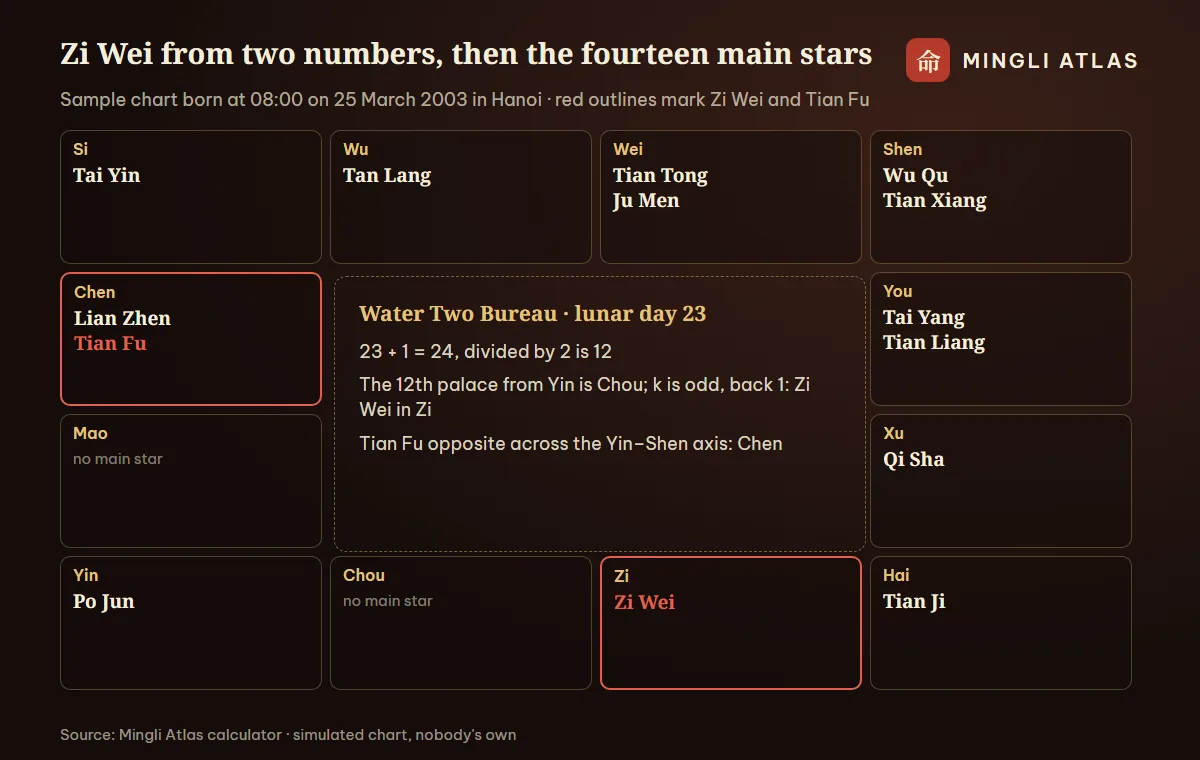
The sample chart, born at 08:00 on 25 March 2003 in Hanoi, has the Water Two Bureau and lunar birth day 23 (23rd of the second month). Day 23 is not divisible by 2, so k = 1: 23 + 1 = 24, and 24 divided by 2 gives q = 12. Counting 12 palaces from Yin lands on Chou; k is odd, so go back 1 palace, to Zi. Zi Wei sits in the Zi palace, the same as the calculator’s chart.
The table below gives the result for every pairing of bureau and birth day. Rows are lunar birth days, columns are bureaus, and each cell is the palace of Zi Wei. Day 23 with the Water Two Bureau gives Zi.
| Lunar day | Water Two | Wood Three | Metal Four | Earth Five | Fire Six |
|---|---|---|---|---|---|
| 1 | Chou | Chen | Hai | Wu | You |
| 2 | Yin | Chou | Chen | Hai | Wu |
| 3 | Yin | Yin | Chou | Chen | Hai |
| 4 | Mao | Si | Yin | Chou | Chen |
| 5 | Mao | Yin | Zi | Yin | Chou |
| 6 | Chen | Mao | Si | Wei | Yin |
| 7 | Chen | Wu | Yin | Zi | Xu |
| 8 | Si | Mao | Mao | Si | Wei |
| 9 | Si | Chen | Chou | Yin | Zi |
| 10 | Wu | Wei | Wu | Mao | Si |
| 11 | Wu | Chen | Mao | Shen | Yin |
| 12 | Wei | Si | Chen | Chou | Mao |
| 13 | Wei | Shen | Yin | Wu | Hai |
| 14 | Shen | Si | Wei | Mao | Shen |
| 15 | Shen | Wu | Chen | Chen | Chou |
| 16 | You | You | Si | You | Wu |
| 17 | You | Wu | Mao | Yin | Mao |
| 18 | Xu | Wei | Shen | Wei | Chen |
| 19 | Xu | Xu | Si | Chen | Zi |
| 20 | Hai | Wei | Wu | Si | You |
| 21 | Hai | Shen | Chen | Xu | Yin |
| 22 | Zi | Hai | You | Mao | Wei |
| 23 | Zi | Shen | Wu | Shen | Chen |
| 24 | Chou | You | Wei | Si | Si |
| 25 | Chou | Zi | Si | Wu | Chou |
| 26 | Yin | You | Xu | Hai | Xu |
| 27 | Yin | Xu | Wei | Chen | Mao |
| 28 | Mao | Chou | Shen | You | Shen |
| 29 | Mao | Xu | Wu | Wu | Si |
| 30 | Chen | Hai | Hai | Wei | Wu |
When the birth day divides evenly by the bureau number, k is 0 and Zi Wei sits exactly at the q-th palace: in 30 days that is 15 days for the Water Two Bureau, 10 for Wood Three, 7 for Metal Four, 6 for Earth Five and 5 for Fire Six. Over the whole 150-cell table Zi Wei falls in the Chen palace 17 times, Wu 16 times, Yin, Mao and Si 15 times each, Wei 13, Chou 12, Shen 11, You and Hai 10 each, Xu 9 and Zi 7. These are counts of cells in the table, not shares of people, because the number of people born on each day and bureau is not equal.
Where is Tian Fu relative to Zi Wei?
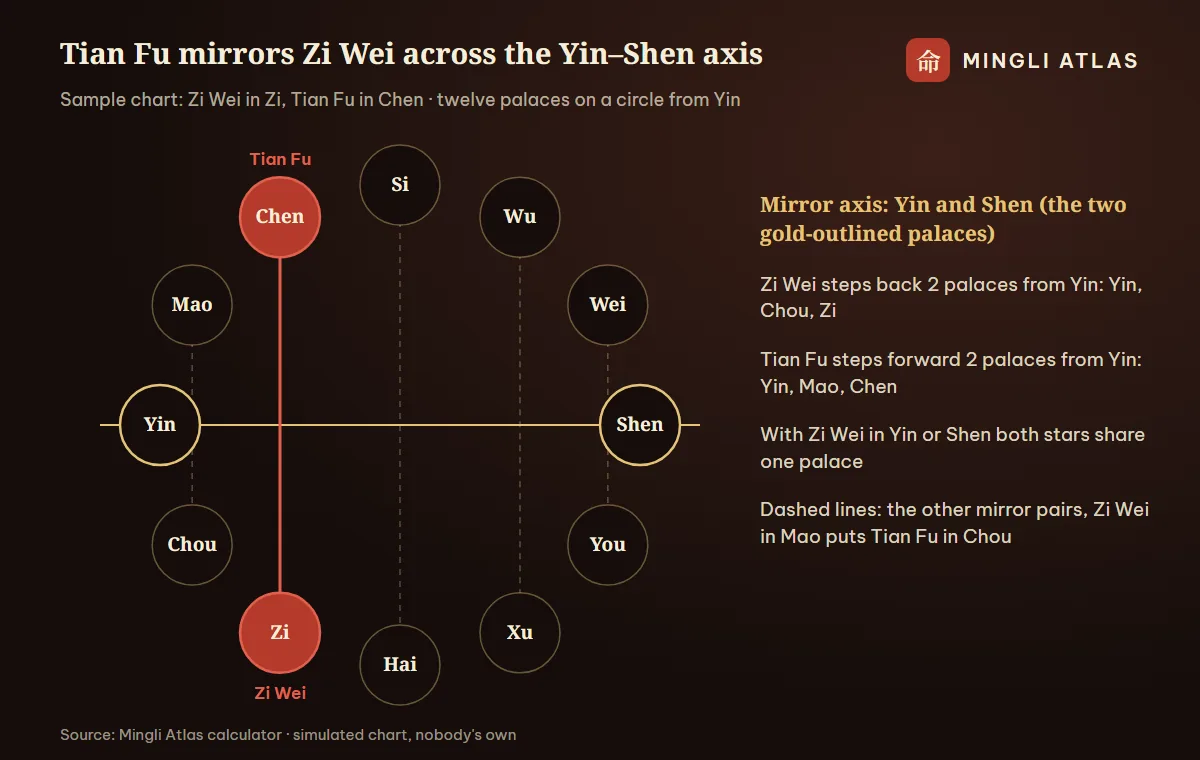
Tian Fu sits opposite Zi Wei across the Yin–Shen axis: if Zi Wei is n palaces back from Yin (towards Chou), Tian Fu is n palaces forward from Yin (towards Mao), and the other way round. The two stars share a palace when Zi Wei is in Yin or Shen; everywhere else they sit in two different palaces.
| Zi Wei sits in | Tian Fu sits in |
|---|---|
| Yin | Yin |
| Mao | Chou |
| Chen | Zi |
| Si | Hai |
| Wu | Xu |
| Wei | You |
| Shen | Shen |
| You | Wei |
| Xu | Wu |
| Hai | Si |
| Zi | Chen |
| Chou | Mao |
In the sample chart Zi Wei is in Zi, so Tian Fu is in Chen. The pair Zi and Chen is one line of the table above.
How are the other twelve stars placed?
Six stars follow Zi Wei backward and eight follow Tian Fu forward, each a fixed number of palaces from its lead star. Counting from Yin in the order Yin, Mao, Chen, “forward” means towards Chou and “backward” means towards Hai.
| Star | Lead star | Direction | Palaces from the lead star |
|---|---|---|---|
| Zi Wei | Itself | Backward | 0 |
| Tian Ji | Zi Wei | Backward | 1 |
| Tai Yang | Zi Wei | Backward | 3 |
| Wu Qu | Zi Wei | Backward | 4 |
| Tian Tong | Zi Wei | Backward | 5 |
| Lian Zhen | Zi Wei | Backward | 8 |
| Tian Fu | Itself | Forward | 0 |
| Tai Yin | Tian Fu | Forward | 1 |
| Tan Lang | Tian Fu | Forward | 2 |
| Ju Men | Tian Fu | Forward | 3 |
| Tian Xiang | Tian Fu | Forward | 4 |
| Tian Liang | Tian Fu | Forward | 5 |
| Qi Sha | Tian Fu | Forward | 6 |
| Po Jun | Tian Fu | Forward | 10 |
The distances 2, 6 and 7 are left empty in the Zi Wei group, and 7, 8 and 9 in the Tian Fu group; that is why many palaces hold two stars and some hold no main star at all. Applying the table to the sample chart, Zi Wei is in Zi, Tian Ji in Hai, Tai Yang in You, Wu Qu in Shen, Tian Tong in Wei, Lian Zhen in Chen; Tian Fu is in Chen, Tai Yin in Si, Tan Lang in Wu, Ju Men in Wei, Tian Xiang in Shen, Tian Liang in You, Qi Sha in Xu and Po Jun in Yin.
The result on the sample chart
Grouped by palace, the fourteen stars fall into ten of the twelve palaces; the Mao and Chou palaces hold no main star.
| Palace | Main stars |
|---|---|
| Yin | Po Jun |
| Mao | No main star |
| Chen | Lian Zhen, Tian Fu |
| Si | Tai Yin |
| Wu | Tan Lang |
| Wei | Tian Tong, Ju Men |
| Shen | Wu Qu, Tian Xiang |
| You | Tai Yang, Tian Liang |
| Xu | Qi Sha |
| Hai | Tian Ji |
| Zi | Zi Wei |
| Chou | No main star |
The Life palace of this chart is the Hai palace, so this person has Tian Ji in the Life palace. The table above matches the calculator’s chart, including the two palaces without a main star; for how to read such a palace see the guide to the Life palace with no main star, and for the brightness of each star the guide to star brightness.
How to place the 14 main stars step by step
- Settle the lunar birth day and the bureau number of the chart.
- Find the smallest k for which (day + k) is divisible by the bureau number, take the quotient q, count q palaces from Yin, then go forward k if k is even or back k if k is odd to get the Zi Wei palace.
- Take the palace opposite across the Yin–Shen axis to get the Tian Fu palace.
- Place the other five stars of the Zi Wei group by going back 1, 3, 4, 5 and 8 palaces from Zi Wei.
- Place the other seven stars of the Tian Fu group by going forward 1, 2, 3, 4, 5, 6 and 10 palaces from Tian Fu.
- Compare the result with a chart from a calculator; if it differs, check the lunar birth day first (was there a leap month?) and then the bureau number.
Common mistakes
- Using the calendar day instead of the lunar birth day.
- Forgetting to add k and taking only the nearest quotient, or reversing forward and back according to whether k is even or odd.
- Counting q from Zi instead of Yin, which shifts the whole ring of stars by two palaces.
- Placing Tian Fu opposite across the Zi–Wu axis instead of the Yin–Shen axis.
- Assuming each palace holds one star: in fact some hold two and some hold none.
A chart is a frame for reflecting on yourself, not a certain prediction. What each star stands for is on the fourteen main stars page, how the bureau number is found in the Five Element Bureau guide, and how Zi Wei differs from BaZi in the Zi Wei vs BaZi guide. For how this site calculates a chart, see the methodology, and for the main stars of your own chart, calculate your Zi Wei chart.
Keep reading
From reading to your chart
See your own chart
Free BaZi and Zi Wei charts, read against the classical texts, with no email needed.