Zi Wei vs BaZi: Differences Shown on One Birth Chart
Published , updated
Written by the Mingli Atlas team · Method and sources
Đọc bài này bằng tiếng Việt
Zi Wei and BaZi differ in what they build: BaZi builds four pillars from the solar terms and reads the Day Master and the Ten Gods, while Zi Wei builds twelve palaces from the lunar birth date and reads the main stars. Both start from the same birth data, but they are not two names for one chart, and neither is a corrected version of the other. This guide puts the two systems side by side on one sample chart, shows the dates on which they read two different years, and explains how to choose between them. We do not rank either system as more accurate: Mingli reports use both because they complement each other, and neither replaces the other.
What do Zi Wei and BaZi have in common?
Both systems start from the same data: the birth date, the birth hour and the birthplace, which fixes the time zone. Both use the Heavenly Stems and Earthly Branches, both divide life into ten-year stretches (luck pillars in BaZi, decade limits in Zi Wei), and both add a layer for each single year. Because the base is shared, a wrong birth hour spoils both charts, and the birth-time checklist serves both.
How do Zi Wei and BaZi differ?
The two systems differ in the base calendar, in what is built, in where reading starts and in how the ten-year stretches are counted. The table sets each point side by side.
| Point | BaZi | Zi Wei |
|---|---|---|
| Base calendar | Solar terms; months change at the terms, the year changes at the Start of Spring | The lunar calendar; the year changes at lunar New Year |
| What is built | Four pillars: Year, Month, Day, Hour | Twelve palaces holding fourteen main stars |
| Where reading starts | The Day Master, the stem of the Day pillar | The Life palace |
| Role of the Five Elements | Counted across the four pillars to judge strength | Fix the Bureau, which places the Zi Wei star and sets the starting age of the decade limits |
| Ten-year stretches | Luck pillars, started from the Month pillar; the starting age is counted from the birth date to a solar term, three days to a year | Decade limits, moving through the palaces; the starting age comes from the Bureau number |
For each system in depth, see how to read a BaZi chart and how to read a Zi Wei chart.
One person through two charts
The synthetic sample chart used throughout this series was born at 08:00 on 25 March 2003 in Hanoi, male. The table below shows the two charts of that one person, taken from the two chart calculators.
| Point | BaZi | Zi Wei |
|---|---|---|
| Year | Gui Wei (changes at the Start of Spring) | Gui Wei (lunar year, 23rd day of the second month) |
| What is built | Gui Wei, Yi Mao, Ding You, Jia Chen | Life at Hai, Body at Wei, Water 2 Bureau |
| Where reading starts | Day Master Ding (Fire, Yin) | Life palace with Tian Ji, brightness Neutral |
| First ten-year stretch | Luck pillar Jia Yin, starting after 6 years 4 months 4 days, running backwards, shown as ages 7 to 16 | Decade limit in the Life palace (Hai), ages 2 to 11, then the palace at Xu, ages 12 to 21 |
| What the Gui stem of the year does | It is the stem of the Year pillar | It looks up the Four Transformations: Po Jun Hua Lu, Ju Men Hua Quan, Tai Yin Hua Ke, Tan Lang Hua Ji |
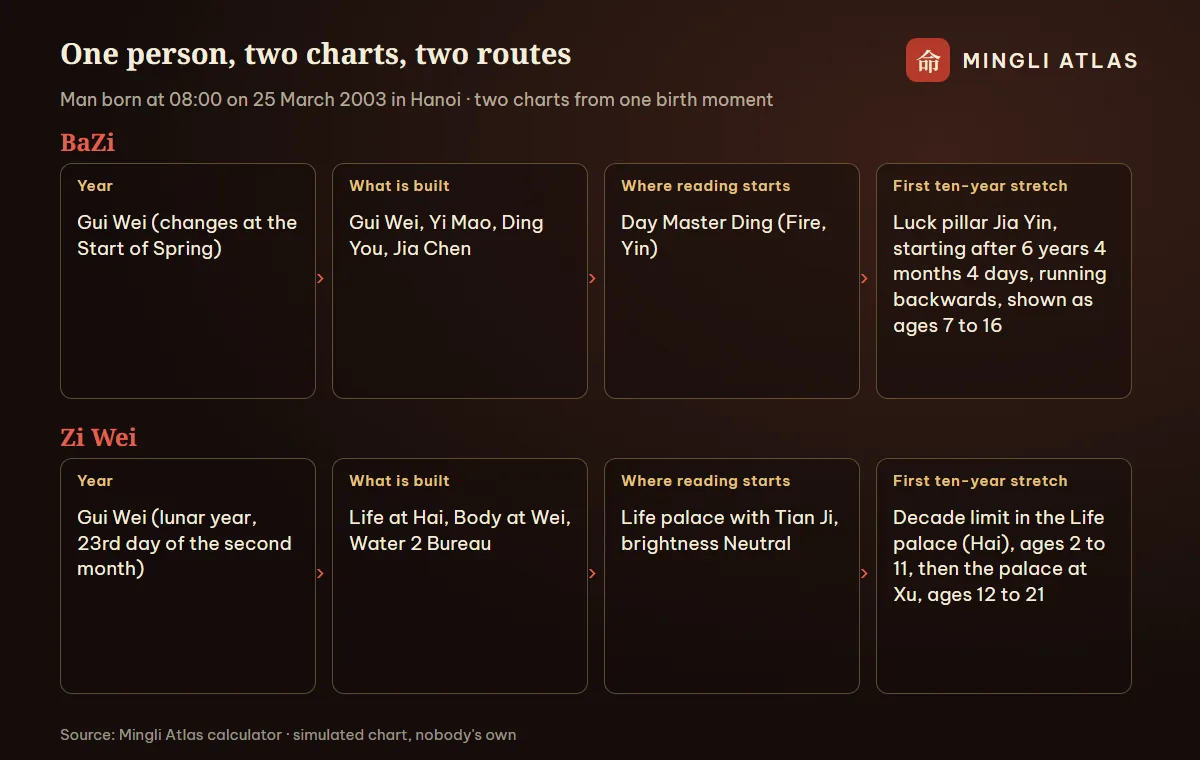
The first ten-year stretches both last ten years but start at different ages, 6 years 4 months in BaZi and age 2 in Zi Wei, by two different rules. So the two sequences are not laid over each other as if they were one. The same Gui stem also does two different jobs: in BaZi it is one pillar of the chart, in Zi Wei it is the key that looks up the four Transformations.
The two systems change year on different days
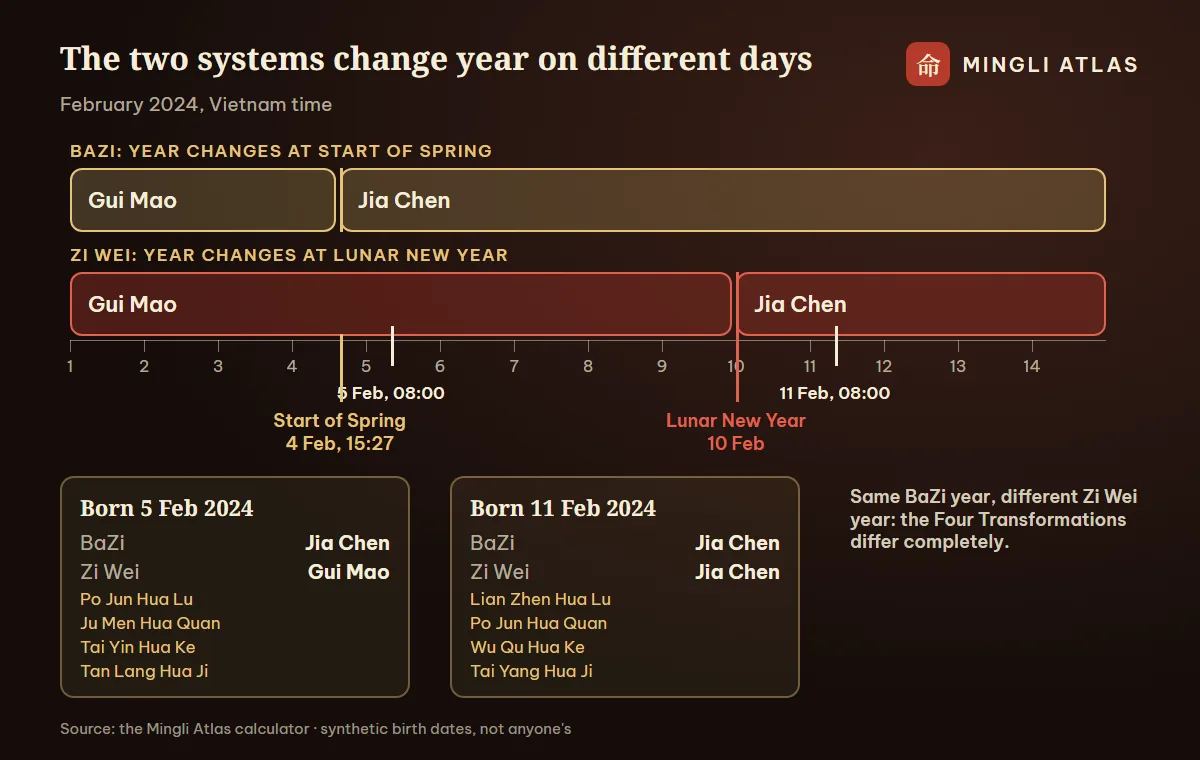
BaZi changes the year at the Start of Spring (立春), while Zi Wei changes it at lunar New Year, so between those two dates the systems read two different years. In 2024 the Start of Spring fell at 15:27 on 4 February (Vietnam time) and lunar New Year was on 10 February. Take two people born at 08:00 in Hanoi, one on 5 February and one on 11 February. Both are after the Start of Spring, so both are in the Jia Chen year in BaZi; but in Zi Wei the person born on the 5th still belongs to the Gui Mao year.
| Birth date (08:00, Hanoi, male) | BaZi year | Lunar year (Zi Wei) | Four Transformations on the Zi Wei chart |
|---|---|---|---|
| 5 February 2024 (26th day of the twelfth month) | Jia Chen | Gui Mao | Po Jun Hua Lu, Ju Men Hua Quan, Tai Yin Hua Ke, Tan Lang Hua Ji |
| 11 February 2024 (2nd day of the first month) | Jia Chen | Jia Chen | Lian Zhen Hua Lu, Po Jun Hua Quan, Wu Qu Hua Ke, Tai Yang Hua Ji |
The gap is not only after the Start of Spring. Lunar New Year can come before it: in 2020 lunar New Year was on 25 January and the Start of Spring on 4 February, so a person born on 30 January 2020 is already in the Geng Zi year in Zi Wei but still in the Ji Hai year in BaZi. If you were born in the days around lunar New Year and the Start of Spring, check which year each chart used before comparing the two results. The guide to solar terms and the Month pillar explains why BaZi divides time by the terms.
Should you read Zi Wei or BaZi?
Choose by the question you are asking, and if you can, read both. BaZi gives a picture of the balance of the Five Elements around the Day Master and of the luck pillars; Zi Wei gives a picture palace by palace, such as Life, Wealth or Career, with the stars that sit there. This is the division of work our two page groups follow, not a rule for every reader.
- Read each system separately, in that system’s own order of steps, and keep two separate notes.
- Compare only after you are sure both charts used the same birth date and time and the same year-change rule.
- Phrase each conclusion with “tends to”, and leave alone any place where the two systems do not say the same thing instead of forcing them to agree.
To get your own charts, calculate your BaZi chart and calculate your Zi Wei chart from the same birth date and time.
Common mistakes
- Treating BaZi and Zi Wei as two names for one chart. They build two different things from the same data.
- Asking which system is more accurate instead of which one answers your question.
- Using the Start-of-Spring year for a Zi Wei chart, or the lunar year for a BaZi chart.
- Mixing up luck pillars and decade limits: the two ten-year stretches start at different ages and follow different rules.
- Forcing the two systems to one conclusion when they do not say the same thing.
A chart is a frame for reflecting on yourself, not a certain prediction. For how this site calculates and reads a chart, see the methodology.
From reading to your chart
See your own chart
Free BaZi and Zi Wei charts, read against the classical texts, with no email needed.