Hua Ji in Zi Wei: Is the Transformation Really Bad?
Published , updated
Written by the Mingli Atlas team · Method and sources
Đọc bài này bằng tiếng Việt
Hua Ji (化忌) is the fourth of the Four Transformations of Zi Wei Dou Shu, and its name does not say by itself whether anything is good or bad: it only says that one particular star in the chart carries the Ji mark. The traditional reading links Ji with obstacles and entanglements, but the same Hua Ji can sit on a bright star or a dim one, in one palace or another, and that changes how it is read. This guide answers three questions: which star takes Hua Ji for each birth-year stem, what the old books say about it, and whether the Hua Lu and Hua Ji of the same year ever meet on a chart, with counts taken from the chart calculator. We do not call a chart good or bad because it has Hua Ji.
What is Hua Ji and where does it sit on the chart?
Hua Ji is the fourth mark of the Four Transformations, attached to a main star or a minor star according to the Heavenly Stem of the birth year. Each birth-year stem gives exactly one star the Ji mark, so a natal chart always has exactly one Hua Ji. The decade limit and the annual chart also have their own Four Transformations, taken from the stem of the stretch or of the year, but this guide covers only the birth-year layer. The full set of four is explained in the guide to the Four Transformations.
Which star takes Hua Ji for each birth-year stem?
The ten stems give ten different stars the Ji mark: eight main stars and two minor stars, Wen Qu and Wen Chang. The table below comes from the Four Transformations table of the chart calculator.
| Birth-year stem | Star with Hua Ji | Type of star |
|---|---|---|
| Jia | Tai Yang | Main star |
| Yi | Tai Yin | Main star |
| Bing | Lian Zhen | Main star |
| Ding | Ju Men | Main star |
| Wu | Tian Ji | Main star |
| Ji | Wen Qu | Minor star |
| Geng | Tian Tong | Main star |
| Xin | Wen Chang | Minor star |
| Ren | Wu Qu | Main star |
| Gui | Tan Lang | Main star |
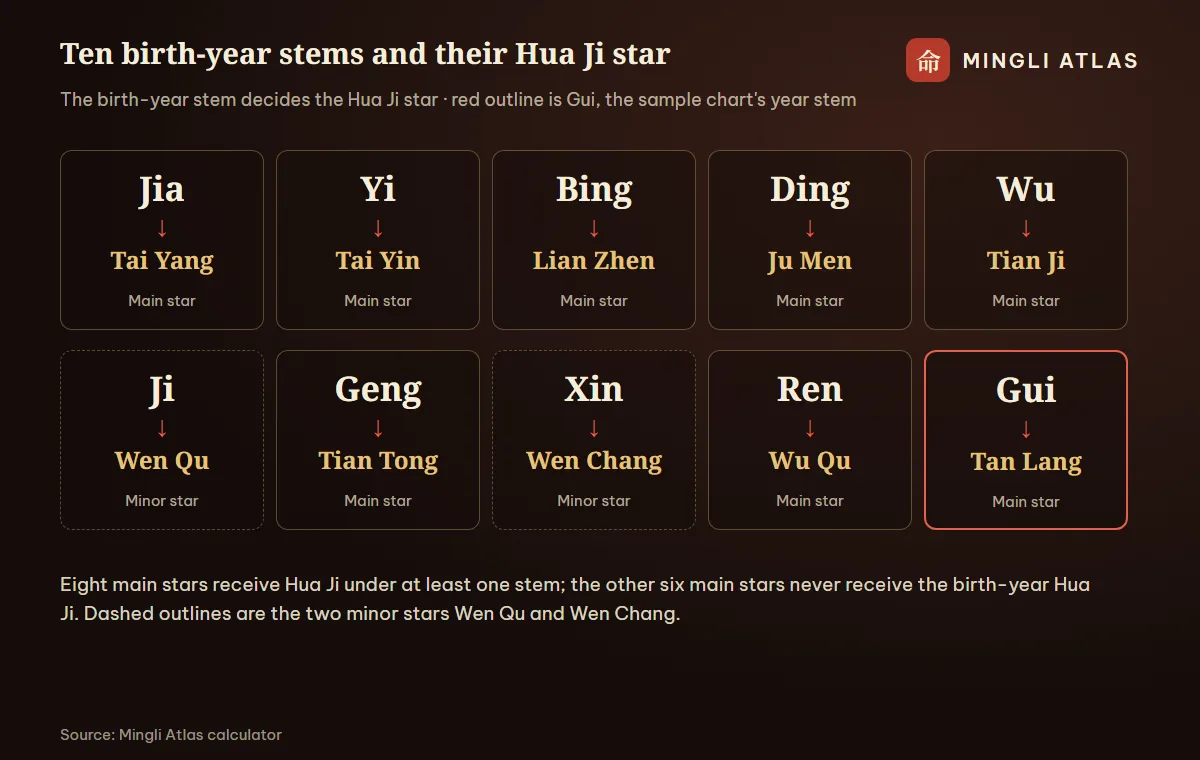
Two things can be counted from the table. First, six of the fourteen main stars never receive the birth-year Hua Ji: Zi Wei, Tian Fu, Tian Xiang, Tian Liang, Qi Sha and Po Jun. Second, the Ji column is identical to the Transformations song in the Quanshu; the two places where our table differs from the song are in the Hua Ke column for the stems Wu and Geng, not in Ji. So when you compare charts between two sites, Hua Ji is rarely where they disagree.
What do the old books say about Hua Ji?
The Complete Book of Zi Wei Dou Shu (紫微斗數全書, the Quanshu) gives Hua Ji an element and a role:
化忌星水,為多管之神。
Complete Book of Zi Wei Dou Shu (紫微斗數全書), vol. 2, section on Hua Lu, Hua Quan, Hua Ke and Hua Ji
The line says that Hua Ji belongs to Water and is the “spirit that meddles in many things”. That names a role; it is not an event. The passage goes on with a conclusion about a whole life; we do not copy that part, because it is a statement about outcomes and not a fact of the chart.
Is Hua Ji always bad?
It cannot be decided from the name, because the same Hua Ji can fall under very different conditions. The two sample charts below have Hua Ji from two different stems, in two different palaces and at two different brightness levels.
| Sample chart | Birth-year stem | Star with Hua Ji | Palace and branch | Brightness |
|---|---|---|---|---|
| A (08:00, 25 March 2003, Hanoi, male) | Gui | Tan Lang | Health, Wu | Prosperous |
| B (22:00, 15 January 1995, Hanoi, female) | Jia | Tai Yang | Wealth, Xu | Unfavourable |
In chart A, the star with Hua Ji, Tan Lang, stands at Prosperous; in chart B, the star with Hua Ji, Tai Yang, stands at Unfavourable. The label “Hua Ji” is the same, but the stars that carry it differ in nature, in brightness and in palace, so it cannot be read as one general statement. The guide to star brightness has the table for all fourteen main stars.
Do the Hua Lu and Hua Ji of one year ever meet?
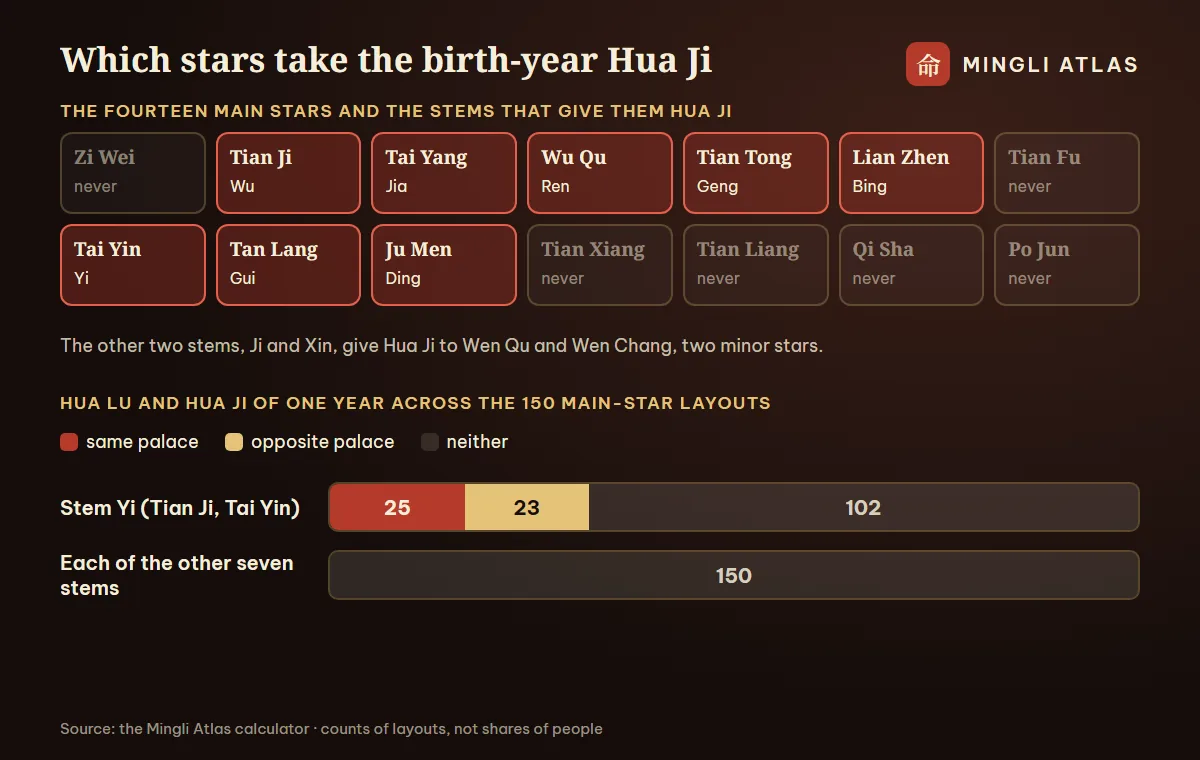
Almost never: in the birth-year layer, only the stem Yi ever puts Hua Lu and Hua Ji in the same palace or in opposite palaces. The method is to take each of the 150 layouts of the main stars (five Bureaus times thirty lunar days) and see where the Hua Lu star and the Hua Ji star of each stem stand. For the seven stems where both stars are main stars (Jia, Bing, Ding, Wu, Geng, Ren and Gui), none of the 150 layouts puts the two stars in one palace or in opposite palaces. For Yi alone, Hua Lu is on Tian Ji and Hua Ji on Tai Yin, and those two stars share a palace in 25 layouts, face each other in 23 and do neither in 102.
| Birth-year stem | Same palace | Opposite palace | Neither |
|---|---|---|---|
| Yi | 25 | 23 | 102 |
| Each of the other seven stems | 0 | 0 | 150 |
These are counts of layouts, not shares of people, because the real position also depends on the birth month and hour. The two stems Ji and Xin are left out, because their Hua Ji falls on Wen Qu and Wen Chang, two stars that follow the birth hour and not the main-star table. So when a page says that “Lu and Ji in one palace” is common in the birth-year layer, ask which stem and which stars it means.
How to read a Hua Ji on a chart
- Find the star with Hua Ji and note the birth-year stem that produced it, then check the Four Transformations table the chart uses.
- Note the star’s brightness on the branch where it stands.
- Look at the palace it sits in, then at that palace’s opposite and trine palaces by san fang si zheng.
- Decide whether this is the birth-year Ji, the Ji of the decade limit or the Ji of the annual chart, because the three layers are read differently.
- Phrase the conclusion with “tends to” or “is worth a second look”, and name one concrete thing you could do, instead of a verdict.
If the palace with Hua Ji speaks of health, as the Health palace does in chart A, remember that a chart is only a frame for reflection and does not replace a medical check; if you are worried about your health, ask a doctor.
Common mistakes
- Treating Hua Ji as a curse. It is a mark attached to one particular star.
- Ignoring brightness and palace and reading only the word Ji.
- Mixing the birth-year Ji with the Ji of a decade limit or an annual chart.
- Assuming some stem always gives Lu and Ji in one palace, when the count shows that only the stem Yi has such layouts.
- Copying a lifelong prediction from a book or a page without saying whose words they are.
A chart is a frame for reflecting on yourself, not a certain prediction. For how this site calculates and reads a chart, see the methodology, and to see the Hua Ji on your own chart, calculate your Zi Wei chart.
Keep reading
From reading to your chart
See your own chart
Free BaZi and Zi Wei charts, read against the classical texts, with no email needed.