Hidden Stems in BaZi: Table for All 12 Branches
Published , updated
Written by the Mingli Atlas team · Method and sources
Đọc bài này bằng tiếng Việt
Hidden stems (藏干) are the heavenly stems tucked inside each earthly branch: some branches hide one stem, others two or three. The eight characters you can see on a BaZi chart are only the surface, because each of the four branches carries these stems, and they are named as Ten Gods and counted as roots for the Day Master just as the visible stems are. This guide has the hidden stems of all twelve branches, checked against a classical verse and against this site’s calculator, shows where the two differ, and shows how hidden stems change the Ten Gods picture of the sample chart.
What are hidden stems?
Every earthly branch holds one to three heavenly stems inside it, and those stems are the hidden stems. Two branches of the same element still differ inside: Zi holds only Gui, while Hai holds Ren and Jia. So do not infer a chart’s elements from the zodiac animals alone.
Hidden stems come into play when you compare each stem with the Day Master. For a visible stem you read the character on the pillar. For a hidden one you look up the branch to see which stems it holds, then name the Ten God of each hidden stem as usual. The guide to the twelve earthly branches places each branch in its month and season.
Hidden stems of the twelve earthly branches
The middle column is what this site’s calculator gives, in the order it lists them. The right column is the classical verse from the Shenfeng Tongkao, quoted in the next section.
| Earthly branch | Hidden stems (this site’s calculator) | Classical verse |
|---|---|---|
| Zi (子) | Gui (Water) | Gui |
| Chou (丑) | Ji (Earth), Gui (Water), Xin (Metal) | Ji, Xin, Gui |
| Yin (寅) | Jia (Wood), Bing (Fire), Wu (Earth) | Jia, Bing, Wu |
| Mao (卯) | Yi (Wood) | The verse does not mention Mao |
| Chen (辰) | Wu (Earth), Yi (Wood), Gui (Water) | Wu, Yi, Gui |
| Si (巳) | Bing (Fire), Geng (Metal), Wu (Earth) | Bing, Wu, Geng |
| Wu (午) | Ding (Fire), Ji (Earth) | Ding, Ji |
| Wei (未) | Ji (Earth), Ding (Fire), Yi (Wood) | Ding, Yi, Ji |
| Shen (申) | Geng (Metal), Ren (Water), Wu (Earth) | Geng, Ren, Wu |
| You (酉) | Xin (Metal) | Xin |
| Xu (戌) | Wu (Earth), Xin (Metal), Ding (Fire) | Ding, Xin, Wu |
| Hai (亥) | Ren (Water), Jia (Wood) | Ren, Jia |
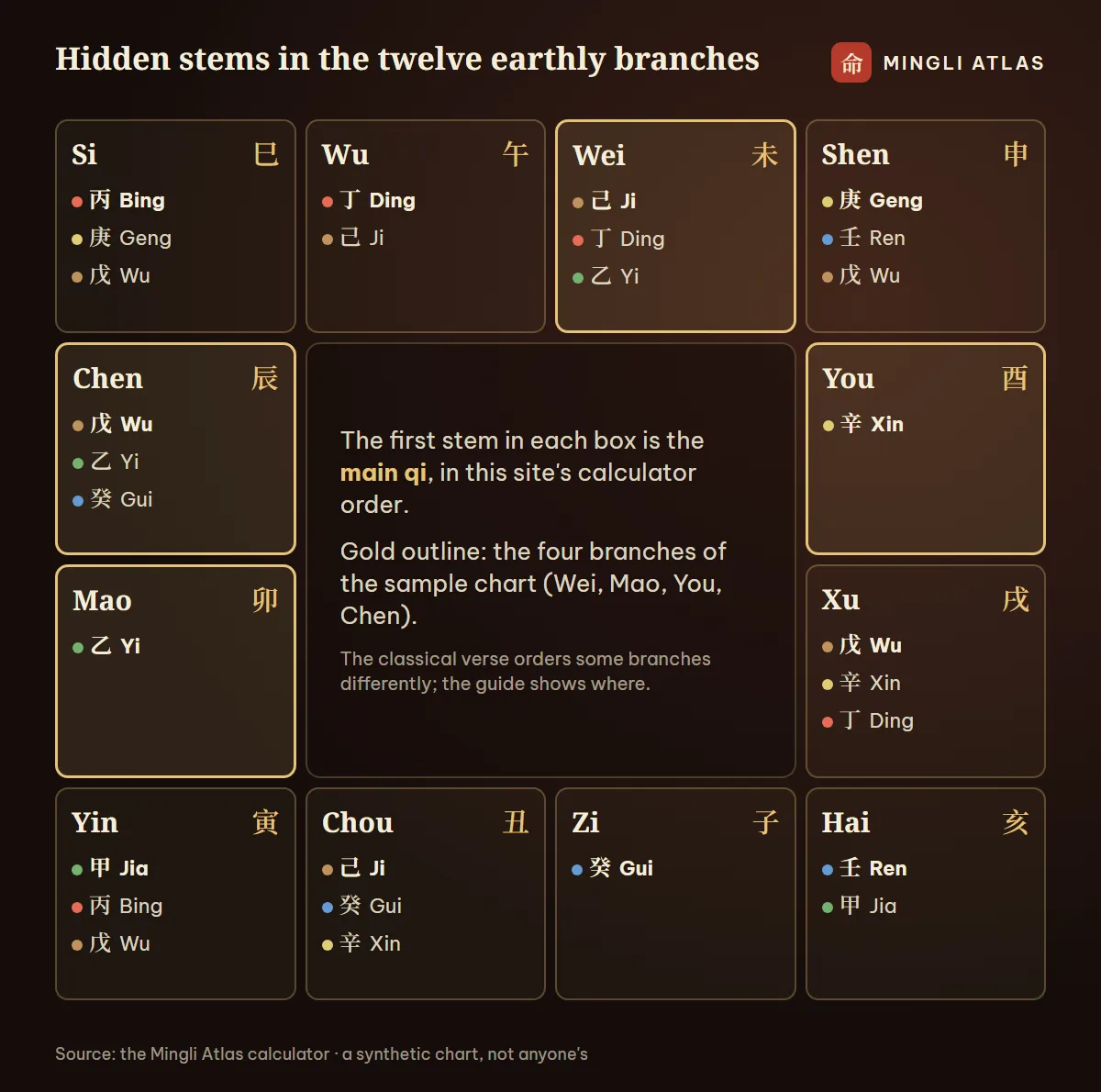
For the eleven branches the verse names, the set of stems matches the calculator. Two differences are worth knowing: the verse leaves out Mao, and the order of the stems differs in four branches, Chou, Si, Wei and Xu.
What the classical verse says, and what the order means
The Shenfeng Tongkao, a Ming-dynasty book, has a verse in volume 4 meant for memorising, listing the stems hidden in each branch.
子藏癸水是禄位,丑己三分辛及癸。寅藏甲丙戊木火,辰有戊兮乙与癸。巳藏丙戊及庚金,午宫却有丁火己。未宫丁乙己同临,申宫庚金壬水戊。酉宫辛金一位美,戌有丁辛戊土至。亥藏壬甲二天干,十二宫中须记取。
Shenfeng Tongkao (神峰通考), vol. 4, On what is hidden in the twelve branches (十二支中所藏法)
In plain terms: Zi hides Gui Water; Chou holds Ji, Xin and Gui; Yin hides Jia, Bing and Wu; Chen holds Wu, Yi and Gui; Si hides Bing, Wu and Geng; Wu holds Ding and Ji; Wei has Ding, Yi and Ji together; Shen has Geng, Ren and Wu; You has a single Xin; Xu holds Ding, Xin and Wu; Hai hides Ren and Jia. The last line says these twelve palaces must be memorised.
On order, many books and websites call the first stem the principal qi (本氣), the next the middle qi and the last the residual qi, then give each kind a weight. This site does not. The verse gives no rank to the order it writes, and that order does not match the calculator’s list in four branches, so the site treats the table above as a membership list only: which branch hides which stem. We do not use the order to score strength.
The verse does not mention Mao either. The calculator gives Mao one stem, Yi, and the site uses that label; but you should know that this one row has no support from the verse above.
How hidden stems change the way you read a chart
- Ten Gods. Each hidden stem is named against the Day Master like a visible one. A chart can hold Ten Gods that its four visible stems do not show.
- Elements. Count the elements from the visible and the hidden stems together; counting only the eight visible characters misses the elements tucked inside the branches.
- Roots. When weighing the Day Master, this site counts a root only when the Day Master’s own stem is hidden in a branch of the chart. See strong or weak Day Master.
- Season. The month branch gives the season, called the Month Command. The old books also divide a month into duty-day spells; that is a separate layer from this hidden-stem table.
Example: the hidden stems in the sample chart
The synthetic chart used across these guides was born at 08:00 on 25 March 2003 in Hanoi, male. The Day Master is Ding (丁), Yin Fire. The four branches hide the stems below, each named against Ding.
| Pillar | Branch | Hidden stems and Ten Gods |
|---|---|---|
| Year | Wei (未) | Ji Eating God, Ding Friend, Yi Indirect Resource |
| Month | Mao (卯) | Yi Indirect Resource |
| Day | You (酉) | Xin Indirect Wealth |
| Hour | Chen (辰) | Wu Hurting Officer, Yi Indirect Resource, Gui Seven Killings |
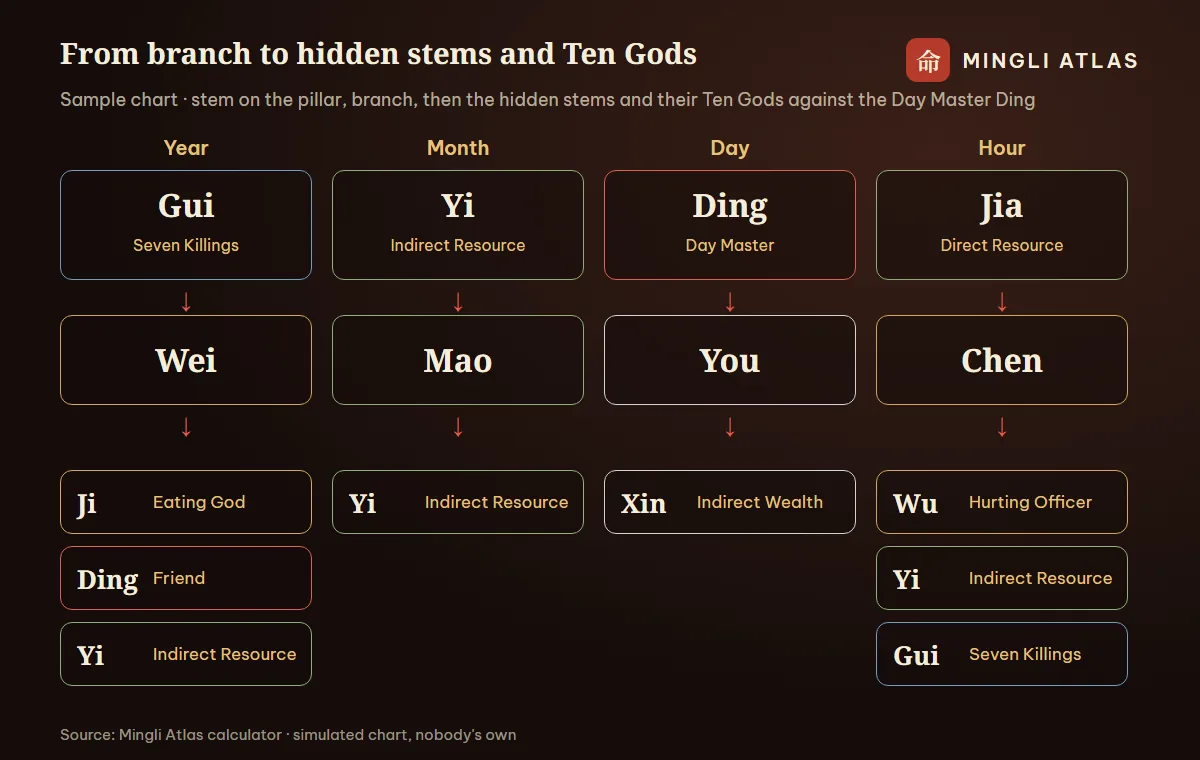
The four visible stems of this chart, Gui, Yi, Ding and Jia, give three Ten Gods: Seven Killings, Indirect Resource and Direct Resource (Ding is the Day Master and is not counted). Add the hidden stems and the picture widens: Eating God, Friend, Indirect Wealth and Hurting Officer are present too, seven Ten Gods in all. Ding hidden in Wei is where the Day Master has a root in this chart. This is a synthetic chart for learning, not anyone’s real chart.
To see the hidden stems of your own chart, calculate your BaZi chart; it lists them under each pillar. See also how to read a BaZi chart in seven steps for where they come in, and the Day Master guide for what everything is measured from. A chart is a frame for reflecting on yourself, not a certain prediction. For how this site calculates, see the methodology.
Keep reading
From reading to your chart
See your own chart
Free BaZi and Zi Wei charts, read against the classical texts, with no email needed.