Day Master in BaZi: What It Is and How to Find Yours
Published , updated
Written by the Mingli Atlas team · Method and sources
Đọc bài này bằng tiếng Việt
Your Day Master (日主) is the heavenly stem of your day pillar, the top character of the day column in a BaZi chart. It stands for you, the person the chart is about, and every other stem in the chart is read against it. There are ten possible Day Masters, one for each stem from Jia to Gui, and the same stem returns every ten days, so it cannot be guessed from your birth year or month. This page shows how to find it, the one birth-time case that changes it, and what a Day Master can and cannot tell you.
What is the Day Master in BaZi?
The Day Master is the day pillar’s heavenly stem, and BaZi uses it as the reference point of the whole chart. A chart has four pillars (year, month, day and hour) and eight characters; of these, the top character of the day pillar is the one the classics call the master of the chart.
凡看命專以日干為主,取提綱所用之物為命,譬月令以金木水火土為用,但有一件取其節氣先後輕重淺深成局破衝細加考究……
San Ming Tong Hui (三命通會), vol. 10, Rules for Reading a Chart
In plain words: read a chart with the day stem as its master, take what the month brings as the material to work with, and then look closely at where in the solar term the birth fell, how heavy that element is, and whether anything clashes or breaks it. That is why the Day Master comes first, and the month second, in every reading on this site.
Two things are easy to confuse with it. The element people mean when they ask “what element am I by birth year” is the nayin of the year pillar, a different thing. And in Zi Wei Dou Shu the Life palace is a palace of the chart, not a stem. Neither is the Day Master.
How to find your Day Master
- Use the right birth data. Enter the time on the birth certificate as the clock showed it, with the time zone of the place of birth. The birth time checklist covers summer time, true solar time and births near an edge.
- Cast the chart. Calculate your BaZi chart and find the day pillar. Its top character, the stem, is your Day Master, and the chart also shows it on its own Day Master card.
- Check it by hand. The day stem moves one step every day through the ten stems: Jia, Yi, Bing, Ding, Wu, Ji, Geng, Xin, Ren, Gui, then Jia again. 10 January 2000 is a Ding day (the day pillar is Ding Mao 丁卯), so 11 January is Wu, 12 January is Ji, and 20 January is a Ding day again. If your chart and the neighbouring dates agree, the stem is right.
The year and month do not decide it. Two people born in the same month usually have different Day Masters, and the Day Master of a given date is fixed by the calendar day alone.
When the Day Master changes: births between 23:00 and midnight
A birth between 23:00 and midnight can have two different Day Masters, depending on which rule the chart follows. The chart on this site changes the day at midnight. Some schools start the next day at 23:00, when the Zi hour begins.
Take 23:30 on 10 January 2000. On this site the day pillar is Ding Mao (丁卯), so the Day Master is Ding, Yin Fire. Under the 23:00 rule the day pillar is Wu Chen (戊辰), and the Day Master is Wu, Yang Earth. The element and the polarity both change, and so does every Ten God in the chart, because the Ten Gods are measured from the Day Master.
True solar time, when you switch it on, can also move a birth across midnight, because it shifts the clock by up to about twenty minutes in Hanoi. If two charts for the same birth disagree about the Day Master, check these two things first; the page on true solar time explains the shift.
The ten Day Masters
| Day Master | Element | Polarity | Read the stem |
|---|---|---|---|
| Jia (甲) | Wood | Yang | Jia stem |
| Yi (乙) | Wood | Yin | Yi stem |
| Bing (丙) | Fire | Yang | Bing stem |
| Ding (丁) | Fire | Yin | Ding stem |
| Wu (戊) | Earth | Yang | Wu stem |
| Ji (己) | Earth | Yin | Ji stem |
| Geng (庚) | Metal | Yang | Geng stem |
| Xin (辛) | Metal | Yin | Xin stem |
| Ren (壬) | Water | Yang | Ren stem |
| Gui (癸) | Water | Yin | Gui stem |
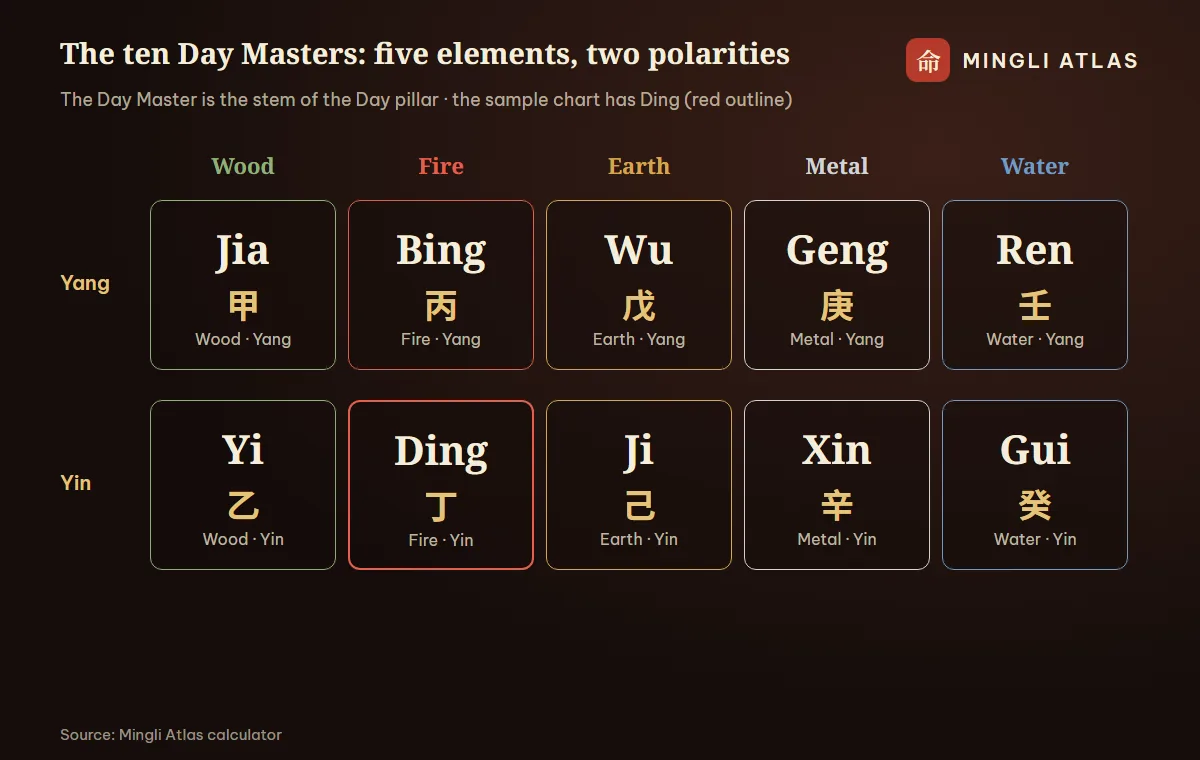
The pairing of each stem with an element and a polarity is old and stable: the San Ming Tong Hui lists Jia and Yi as Wood, Bing and Ding as Fire, and so on, with the odd stems Yang and the even stems Yin. The page on the ten heavenly stems gives the sources.
What the Day Master tells you, and what it does not
The Day Master tells you which element the chart is measured from. Everything else is a relationship to it: the Ten Gods are the ten ways any other stem relates to the Day Master, and the Five Elements cycle of producing and controlling is read from its element.
It does not tell you how strong the Day Master is, and it is not a verdict on character or luck. Strength depends on the season of birth and on the support and pressure around it; read the Month Command for the season, then how to judge a strong or weak Day Master. Two charts with the same Day Master can read very differently, because the month, the other stems and the luck pillars differ. For a full path through a chart, see how to read a BaZi chart step by step.
Example: one Day Master in a sample chart
Across these guides we use one synthetic chart, made up for teaching: born 25 March 2003 at 08:00 in Hanoi. Its four pillars are Gui Wei (癸未) for the year, Yi Mao (乙卯) for the month, Ding You (丁酉) for the day and Jia Chen (甲辰) for the hour. The day pillar is Ding You, so the Day Master is Ding, Yin Fire. Every other stem in the chart, Gui, Yi and Jia, is then named by its relationship to Ding: Gui is the Seven Killings, Yi the Indirect Resource, and Jia the Direct Resource.
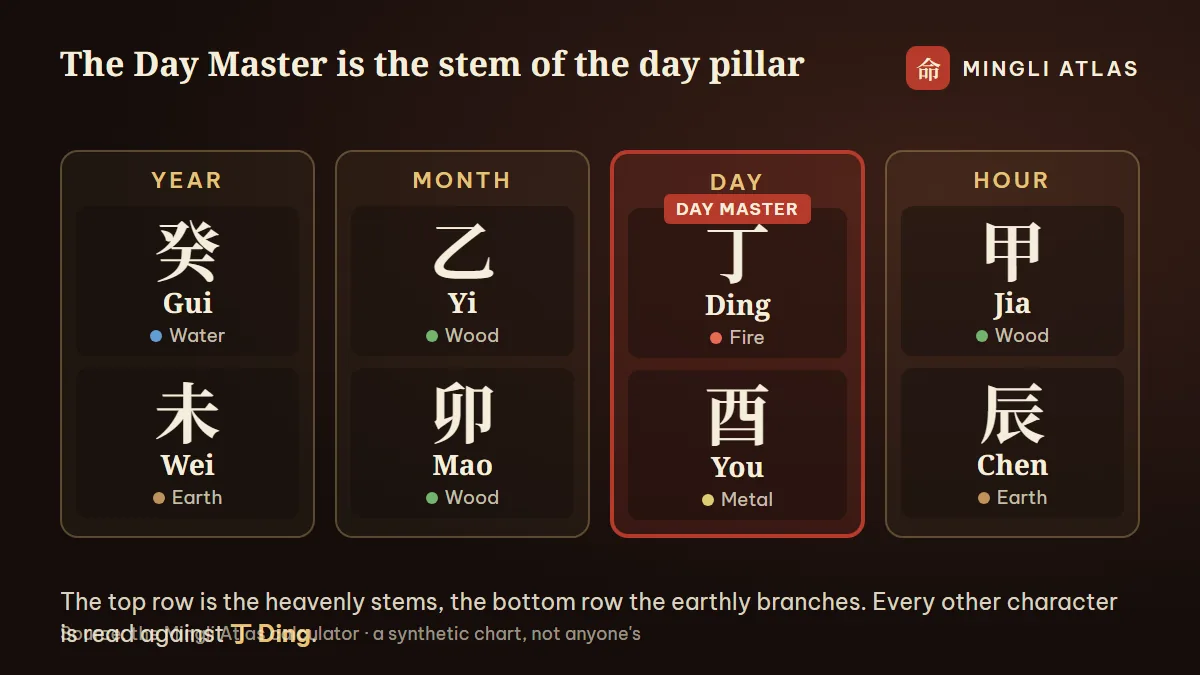
This is a sample for learning, not anyone’s real chart. See a full worked reading, or calculate your own chart and find the stem of your day pillar. A chart is a frame for reflecting on yourself, not a certain prediction.
Keep reading
From reading to your chart
See your own chart
Free BaZi and Zi Wei charts, read against the classical texts, with no email needed.