Month Command in BaZi: Why the Birth Month Comes First
Published , updated
Written by the Mingli Atlas team · Method and sources
Đọc bài này bằng tiếng Việt
The Month Command (月令) is the Earthly Branch of your month pillar, read as the season that was in command when you were born. BaZi reads it straight after the Day Master because it says which of the Five Elements were in season and which were out of it. The month does not follow the lunar calendar: it changes at the twelve sectional solar terms, so a birth a few hours either side of one can belong to a different month. This page covers how the month is set, how each element stands in each season, and the older way of dividing a month into spells of duty.
What is the Month Command in BaZi?
The Month Command is the month pillar’s branch, and it is where the classics tell you to start on the rest of the chart. They call it the headrope (提綱), the cord that holds the net together.
月令者,提綱也。看命先看提綱,方看其餘。
Yuan Hai Zi Ping (淵海子平), vol. 1, On the Direct Officer
In plain words: the Month Command is the headrope; when you read a chart, look at the headrope first and the rest after. That is why the Day Master guide sends you here next.
The Month Command is a narrower thing than the whole teaching that carries its name. The branch and its season are facts you read off the chart. The wider doctrine, which also covers chart patterns and the useful god, builds on those facts and is covered on separate pages.
How the month is set: the twelve sectional terms
The BaZi month starts at a sectional solar term (節, jie) and ends at the next one, so each month branch has a fixed opening term. The terms are spaced 15 degrees apart along the sun’s yearly path, and only the twelve jie open a month; the other twelve terms fall inside one.
| Month branch | Opens at | Sun’s longitude | Season | Place in the season |
|---|---|---|---|---|
| Yin (寅) | Start of Spring | 315° | Spring | Early |
| Mao (卯) | Awakening of Insects | 345° | Spring | Middle |
| Chen (辰) | Clear and Bright | 15° | Spring | Late |
| Si (巳) | Start of Summer | 45° | Summer | Early |
| Wu (午) | Grain in Ear | 75° | Summer | Middle |
| Wei (未) | Minor Heat | 105° | Summer | Late |
| Shen (申) | Start of Autumn | 135° | Autumn | Early |
| You (酉) | White Dew | 165° | Autumn | Middle |
| Xu (戌) | Cold Dew | 195° | Autumn | Late |
| Hai (亥) | Start of Winter | 225° | Winter | Early |
| Zi (子) | Major Snow | 255° | Winter | Middle |
| Chou (丑) | Minor Cold | 285° | Winter | Late |
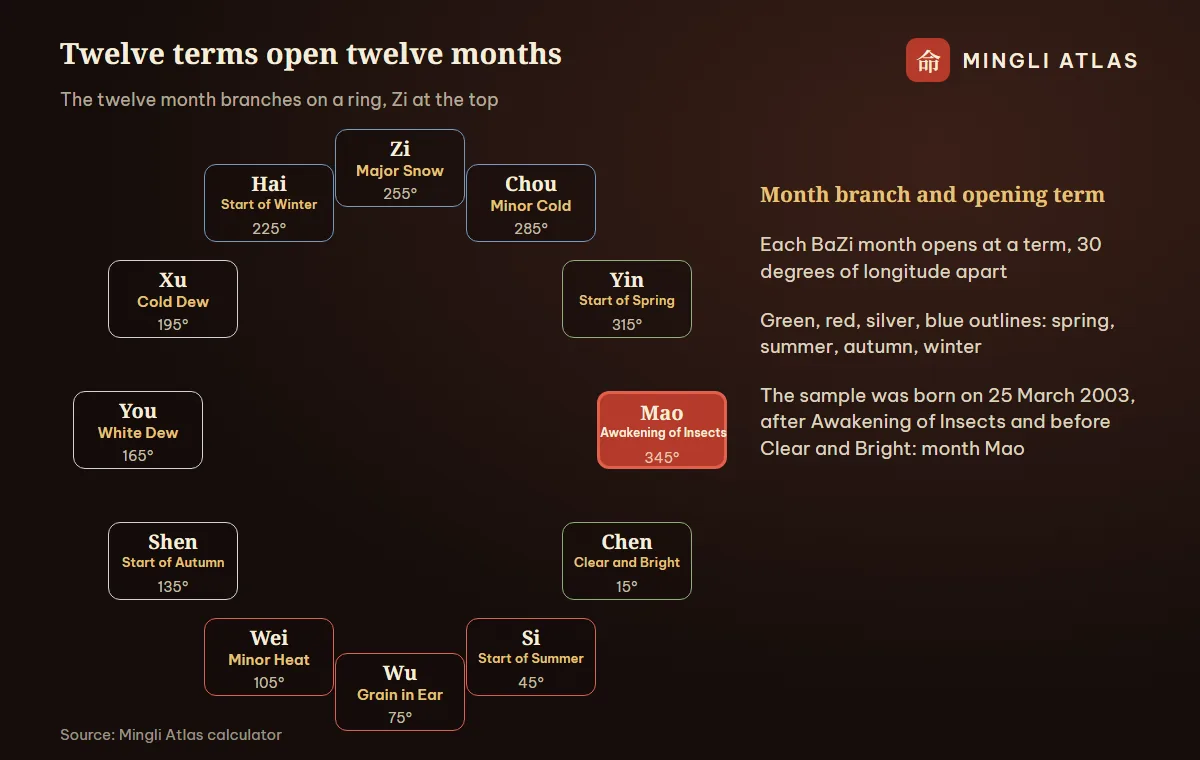
The classics name the season of each branch directly; the early, middle and late place is this site’s own way of labelling them, taken from the order of the three months in each season.
Here is why the exact time matters. Awakening of Insects fell at 07:04 Vietnam time on 6 March 2003. A birth at 06:30 that morning has the month pillar Jia Yin (甲寅); a birth at 07:30 the same morning has Yi Mao (乙卯), a different stem and a different branch. When a birth is too close to a boundary to settle, the chart says so rather than guessing, and the birth time checklist tells you what to check.
The five seasonal states: Prosperous, Assisted, Retired, Confined, Weakest
In each season the Month Command gives every element one of five states, and the first is the element that governs the season. The San Ming Tong Hui sets out the rule with spring as its first example.
盛德乘时曰旺。如春木旺,旺则生火,火乃木之子,子乘父业,故火相;木用水生,生我者父母,今子嗣得时,登高明显赫之地,而生我者当知退矣,故水休。
San Ming Tong Hui (三命通會), vol. 2, On the Prosperity, Assistance, Retirement, Confinement and Death of the Five Elements, with Their Lodging in the Twelve Palaces
In plain words: the element with abundant virtue in its time is Prosperous. In spring that is Wood. Wood produces Fire, a child carrying on the parent’s work, so Fire is Assisted. Water produces Wood; now that its child is in season, the parent steps back, so Water is Retired. The same passage goes on to say that Metal, which Fire would restrain, is Confined, and that Earth, which Wood restrains, is the Weakest.
That gives one rule for any season: the governing element is Prosperous (旺); the element it produces is Assisted (相); the element that produces it is Retired (休); the element that controls it is Confined (囚); and the element it controls is Weakest (死). Applied to the four seasons, and to the sixth month, which the same book treats on its own, it gives this table.
| Season | Wood | Fire | Earth | Metal | Water |
|---|---|---|---|---|---|
| Spring | Prosperous | Assisted | Weakest | Confined | Retired |
| Summer | Retired | Prosperous | Assisted | Weakest | Confined |
| Autumn | Weakest | Confined | Retired | Prosperous | Assisted |
| Winter | Assisted | Weakest | Confined | Retired | Prosperous |
| Wei month (6th month) | Confined | Retired | Prosperous | Assisted | Weakest |
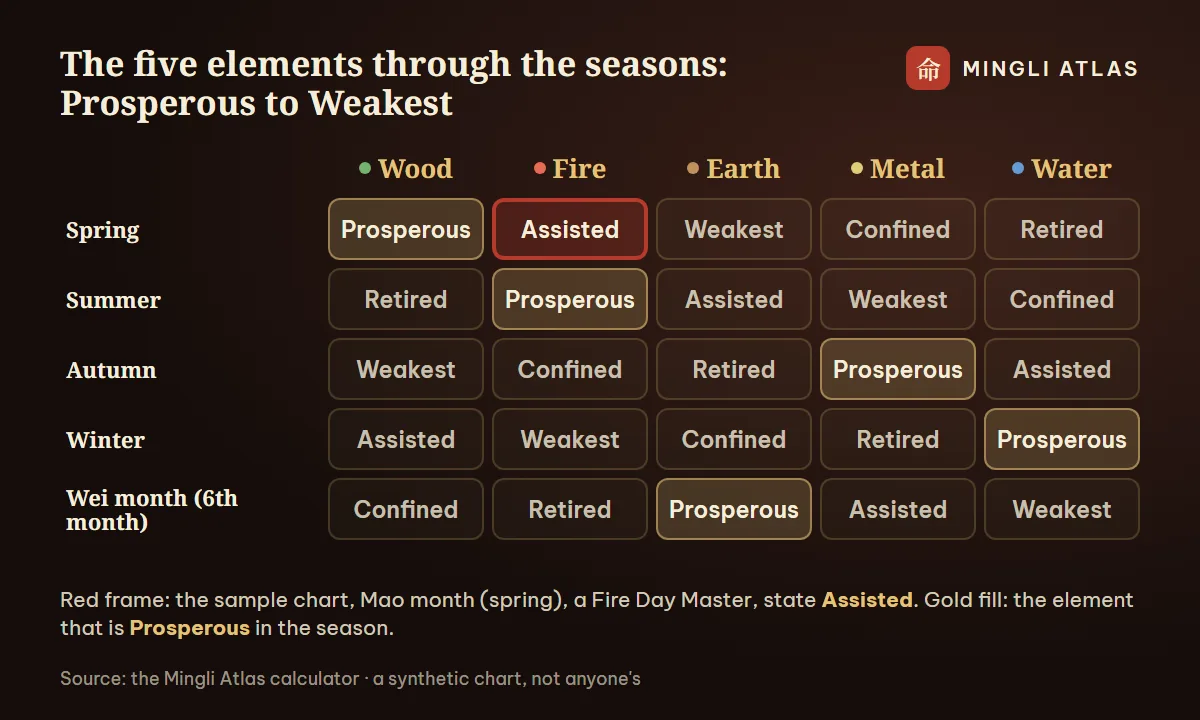
These are the states of the elements in a season. They are not the strength of your Day Master. A Day Master that is Prosperous in its season can still be pressed hard by the rest of the chart, and one that is Confined can be held up by roots and Resource; the guide to a strong or weak Day Master shows how the season is weighed against the rest.
Earth months and the duty days
The same book that gives the table above also splits each month into spells, called duty days (人元司事, the hidden stem on duty). This matters most in the four months that end a season, Chen, Wei, Xu and Chou, where Earth takes part of the month.
| Month branch | First spell | Second spell | Third spell |
|---|---|---|---|
| Yin (寅) | Earth 5 | Bing Fire (Growth) 5 | Jia Wood 20 |
| Mao (卯) | Jia Wood 7 | Yi Wood 23 | none |
| Chen (辰) | Yi Wood 7 | Ren Water (Tomb) 5 | Wu Earth 18 |
| Si (巳) | Wu Earth 7 | Geng Metal (Growth) 5 | Bing Fire 18 |
| Wu (午) | Bing Fire 7 | Ding Fire 23 | none |
| Wei (未) | Ding Fire 7 | Jia Wood (Tomb) 5 | Ji Earth 18 |
| Shen (申) | Earth 5 | Ren Water (Growth) 5 | Geng Metal 20 |
| You (酉) | Geng Metal 7 | Xin Metal 23 | none |
| Xu (戌) | Xin Metal 7 | Bing Fire (Tomb) 5 | Wu Earth 18 |
| Hai (亥) | Wu Earth 5 | Jia Wood (Growth) 5 | Ren Water 20 |
| Zi (子) | Ren Water 7 | Gui Water 23 | none |
| Chou (丑) | Gui Water 7 | Geng Metal (Tomb) 5 | Ji Earth 18 |
Each row adds up to 30 days. Two details of the book are kept as written: for Yin and Shen it names only “Earth” (艮土 and 坤土) without a stem, and the list is a separate layer from the hidden stems of the branch. In Wu, for example, the spells are Bing and Ding, while the hidden stems of the branch are Ding and Ji.
A real month is 29 to 32 days long, not 30, so the chart does not count calendar days. It places a birth by the share of the month already gone between the two sectional terms and maps that share onto the 30-day frame. For three of the earth months, Chen, Xu and Chou, the book gives both the season table and these spells and does not say how to join them, so this site does not name a single seasonal state for them; the Month Command and the spell are facts, and the state is left open. For the other months the state follows the table above.
What the Month Command does not mean
It is not a percentage. Some sites say the month accounts for a fixed share of a chart, but none of the classical passages cited here gives a number, so this site does not either. It is not a verdict on strength, which also needs roots and the elements around the Day Master. And it is not the chart’s pattern or useful god, which come after it and are argued differently by different schools.
Example: the Month Command in a sample chart
In the synthetic chart used across these guides (born 25 March 2003 at 08:00 in Hanoi), the month pillar is Yi Mao (乙卯). The Month Command is Mao, a spring branch in the middle of the season, with Wood as its element. Wood is Prosperous and Fire is Assisted, so the Day Master Ding (Yin Fire) is in a supported season. The birth is 19 days after Awakening of Insects, and the duty spell for that part of the month is Yi Wood, the second spell of Mao.
That is one input only. Calculate your chart to see your own Month Command, then read how to read a BaZi chart to see where it fits. A chart is a frame for reflecting on yourself, not a certain prediction.
Keep reading
From reading to your chart
See your own chart
Free BaZi and Zi Wei charts, read against the classical texts, with no email needed.