Strong or Weak Day Master in BaZi: How to Judge It
Published , updated
Written by the Mingli Atlas team · Method and sources
Đọc bài này bằng tiếng Việt
A strong or weak Day Master describes how well the chart supports the Day Master (日主), the heavenly stem of the day pillar, compared with how much it drains or presses on it. Classical readers judge it by quality rather than by count: the season first, then the Day Master’s roots, then the help and the pressure around it. Strong is not good and weak is not bad; it is a description of balance. This guide gives the order of the judgement, the classical lines behind it, and the cases where the honest answer is that the chart cannot be settled by a rule.
What does a strong or weak Day Master mean?
A strong Day Master is well supported by its season, its roots and the stems that help it, and a weak one is not. The classics ask for a Day Master that is sound, and they tie the judgement to the birth month and to strength.
取用憑於生月,當推究於淺深;發覺在於日時,要消詳於強弱。
Yuan Hai Zi Ping (淵海子平), Ji Shan Pian (繼善篇)
In plain words: choosing what a chart needs rests on the birth month, so study how deep the season runs; and what shows itself in the day and hour has to be weighed for strength. That is the order this page follows: month first, then the Day Master’s own strength.
The two words are about support, not luck. The same tradition says a weak Day Master welcomes Resource and a strong one suits an Officer, which already tells you that neither state is simply good or bad.
The order of the judgement
- Season. Take the state of the Day Master’s element from the Month Command: Prosperous, Assisted, Retired, Confined or Weakest. It is the frame, and it never settles the question by itself.
- Roots. Look for the Day Master’s own stem hidden in the branches, the hidden stems. This site treats a root as present only when that very stem is hidden in a branch of the chart.
- Support. Look for the elements that help the Day Master: the Friend and Rob Wealth, and the Direct and Indirect Resource.
- Drain and pressure. Look for what takes from it or presses on it: Output, Wealth and Officer.
- Interactions. Check whether a clash, combination, harm or punishment touches any of the points above, because that can change what a placement can do.
| Group | Ten Gods | Relation to the Day Master |
|---|---|---|
| Peer | Friend, Rob Wealth | Same element: support |
| Resource | Direct Resource, Indirect Resource | Produces the Day Master: support |
| Output | Eating God, Hurting Officer | The Day Master produces it: drain |
| Wealth | Direct Wealth, Indirect Wealth | The Day Master controls it: drain |
| Officer | Direct Officer, Seven Killings | Controls the Day Master: pressure |
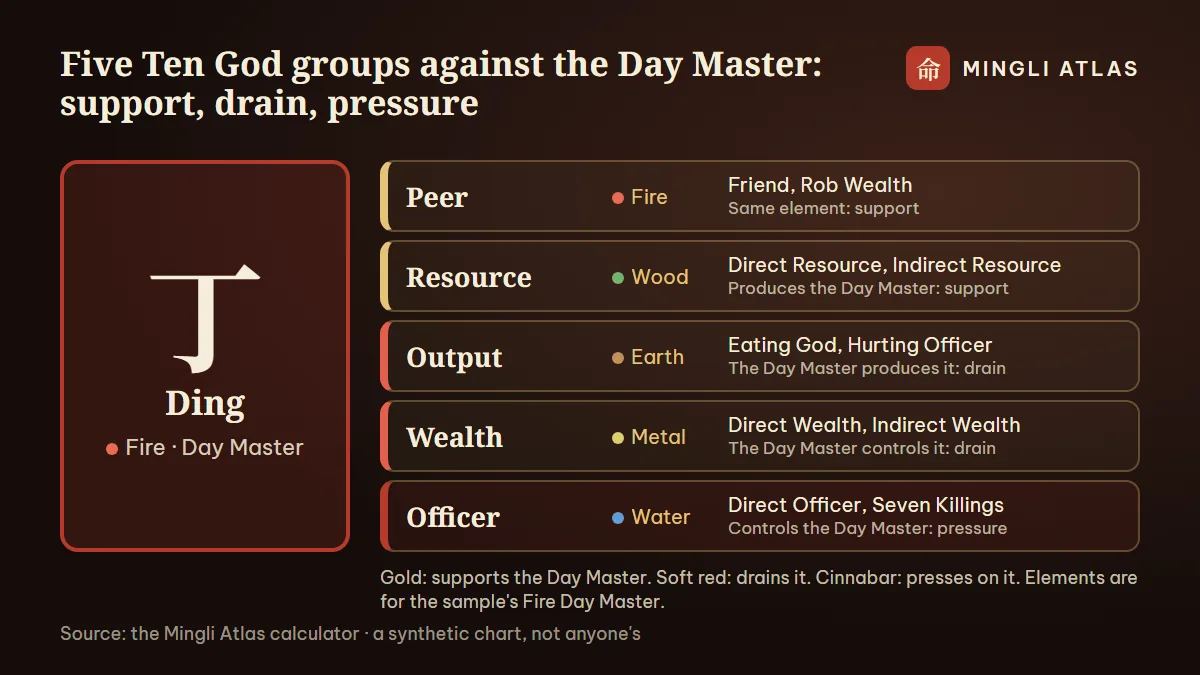
The Ten Gods page explains each one, and how to find the Ten Gods shows how they are found from the Day Master.
What the classics say about season and roots
The Xuan Ji Fu, quoted in the Yuan Hai Zi Ping, packs the whole method into a few lines.
得時俱為旺論。失令便作衰看。四柱無根,得時為旺。日干無氣,遇劫為強。身弱喜印。主旺宜官。
Yuan Hai Zi Ping (淵海子平), Xuan Ji Fu (玄機賦)
In plain words: in season, everything counts as prosperous; out of season, it counts as declining. With no root in the four pillars, being in season is what makes you prosperous. A Day Master with no breath that meets Rob Wealth becomes strong. A weak body is glad of Resource; a strong master suits an Officer. The fourth line matters most: a Day Master out of season is not weak by default, because a peer can lift it. That is why season alone cannot give the verdict.
On roots, the Di Tian Sui Chan Wei, a Qing commentary on the Di Tian Sui, ranks them against companions among the stems.
天干得一比肩,不如地支得一墓庫;得二比肩,不如得一餘氣;得三比肩,不如得一長生祿旺。
Di Tian Sui Chan Wei (滴天髓闡微), Qing commentary, vol. 1, Rooting (通根)
In plain words: one companion among the stems is worth less than a single Tomb in the branches; two companions are worth less than one residual qi; three are worth less than one Growth, Prosperity or Emolument root. A root in a branch counts for more than a friend on top.
Why this guide uses no points
Many online methods give each character a score or a percentage and add them up. The passages cited here weigh qualities and give no scale, so this site does not give scores, does not vote by counting more support characters than drain characters, and says when a chart cannot be settled.
When “cannot be settled” is the honest answer
- An unsettled interaction on a decisive point. A clash, combination, harm or punishment that touches the month branch, the day branch, the root or a placement you rely on, and whose effect is not settled by a source.
- A birth near a solar-term boundary. The Month Command itself is unsure.
- An unknown birth hour. A verdict is given only when all twelve possible hours lead to the same one.
- A season against the Day Master with help available. The Xuan Ji Fu line above blocks the shortcut to “weak” when a peer or Resource is on hand.
This is the method this site follows when it writes about strength (see also the methodology). It is a way of reasoning from the classics, not a verdict on you.
Example: the sample chart
The synthetic chart used across these guides (born 25 March 2003 at 08:00 in Hanoi) has the pillars Gui Wei, Yi Mao, Ding You and Jia Chen, and a Day Master of Ding, Yin Fire.
- Season: the Month Command is Mao, spring, so Fire is Assisted.
- Root: Ding is hidden in Wei, the year branch, so the Day Master has a root.
- Support: Jia (Direct Resource) at the hour stem, Yi (Indirect Resource) at the month stem, and a hidden Yi in Mao, Wei and Chen.
- Drain and pressure: Gui (Seven Killings) at the year stem, Xin (Indirect Wealth) hidden in You, Ji (Eating God) hidden in Wei and Wu (Hurting Officer) hidden in Chen.
- Interactions: Mao and You clash, which touches both the Month Command and the day branch, and You and Chen combine, which touches the day branch.
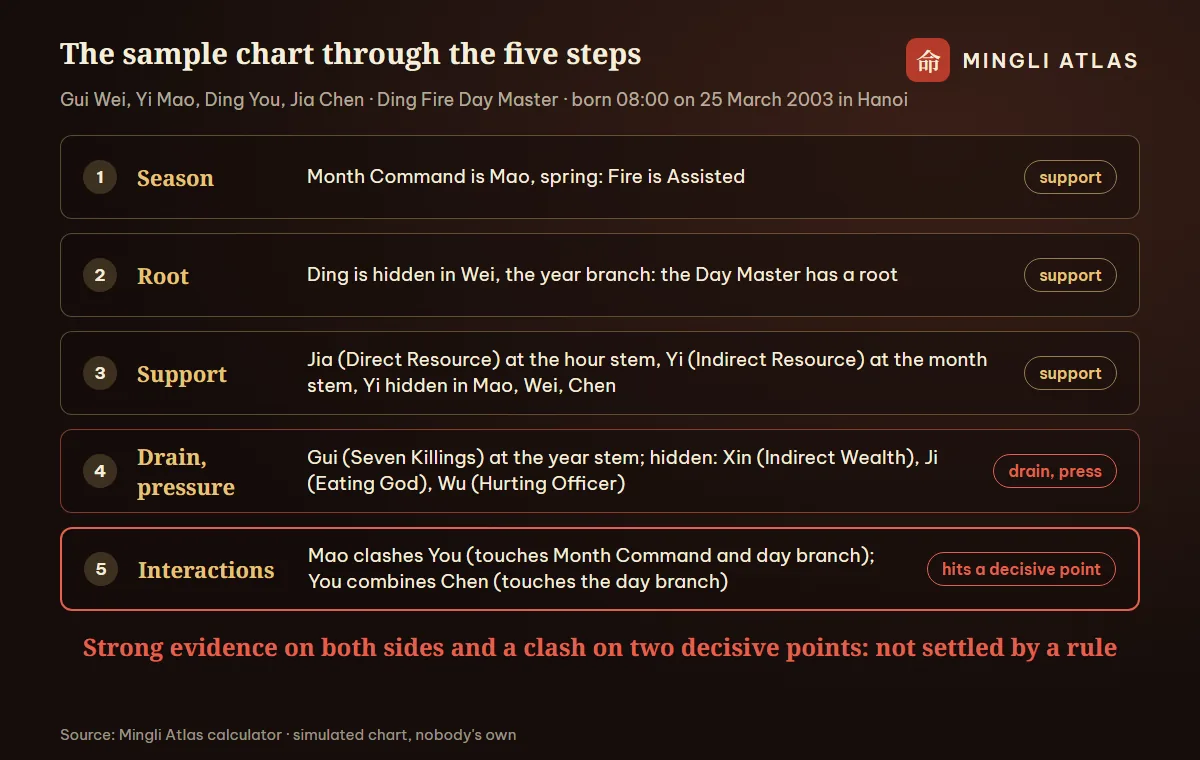
The evidence is strong on both sides, and a clash sits on two decisive points. By the order above this chart cannot be settled by a rule, and a teacher could argue either way, so the honest next step is to look at the luck pillars and at what the person is asking, not to force a label. Calculate your chart to see the elements in your own, and see how to read a BaZi chart for where strength fits in the whole reading.
Which element a chart needs (see what the Useful God is) is a further step with real differences between schools, and it is not covered here. A chart is a frame for reflecting on yourself, not a certain prediction.
Keep reading
From reading to your chart
See your own chart
Free BaZi and Zi Wei charts, read against the classical texts, with no email needed.