How to Read a BaZi Chart: A Step-by-Step Guide
Published , updated
Written by the Mingli Atlas team · Method and sources
Đọc bài này bằng tiếng Việt
To read a BaZi chart, work in a fixed order: confirm the birth data, read the four pillars, find the Day Master, read the season, name the Ten Gods and count the elements, weigh the Day Master’s strength, check the interactions, and only then add the luck pillars. Each step uses the one before it, so a beginner who starts from the Ten Gods or from the luck pillars is reading without a reference point. This guide gives the seven steps, what to write down at each, and the page that explains it in full. We run one synthetic sample chart through all of them.
Before you start: check the birth data
A chart is only as good as the time it is built from. Use the time on the birth certificate with the time zone of the birthplace, and check the cases that move a pillar: summer time, true solar time, a birth near an edge of a double hour, and a birth between 23:00 and midnight. The birth time checklist goes through them. Then calculate your BaZi chart, which gives you the pillars to read.
Step 1. Read the four pillars
A BaZi chart has four pillars, year, month, day and hour, and each pillar is a heavenly stem on top of an earthly branch, eight characters in all. Write them down in that order, and note the element and the yin or yang of each. The ten heavenly stems and the twelve earthly branches are the alphabet of the chart. Readers associate the pillars with different stages and areas of life, but those associations vary by school, so this guide does not lean on them.
Step 2. Find the Day Master
The Day Master is the stem of the day pillar, and it stands for the person the chart is about. Circle it, because every later step is measured from it. The Day Master guide shows how to find it, the 23:00 case that can change it, and what it does not tell you.
Step 3. Read the season
The branch of the month pillar is the Month Command, and it gives each element a state in the season you were born in: Prosperous, Assisted, Retired, Confined or Weakest. Look up your Day Master’s element in that table and write the state down. It is a frame for the next steps, not a verdict. The Month Command guide has the table, the twelve solar terms that open each month, and the duty-day spells.
Step 4. Name the Ten Gods and count the elements
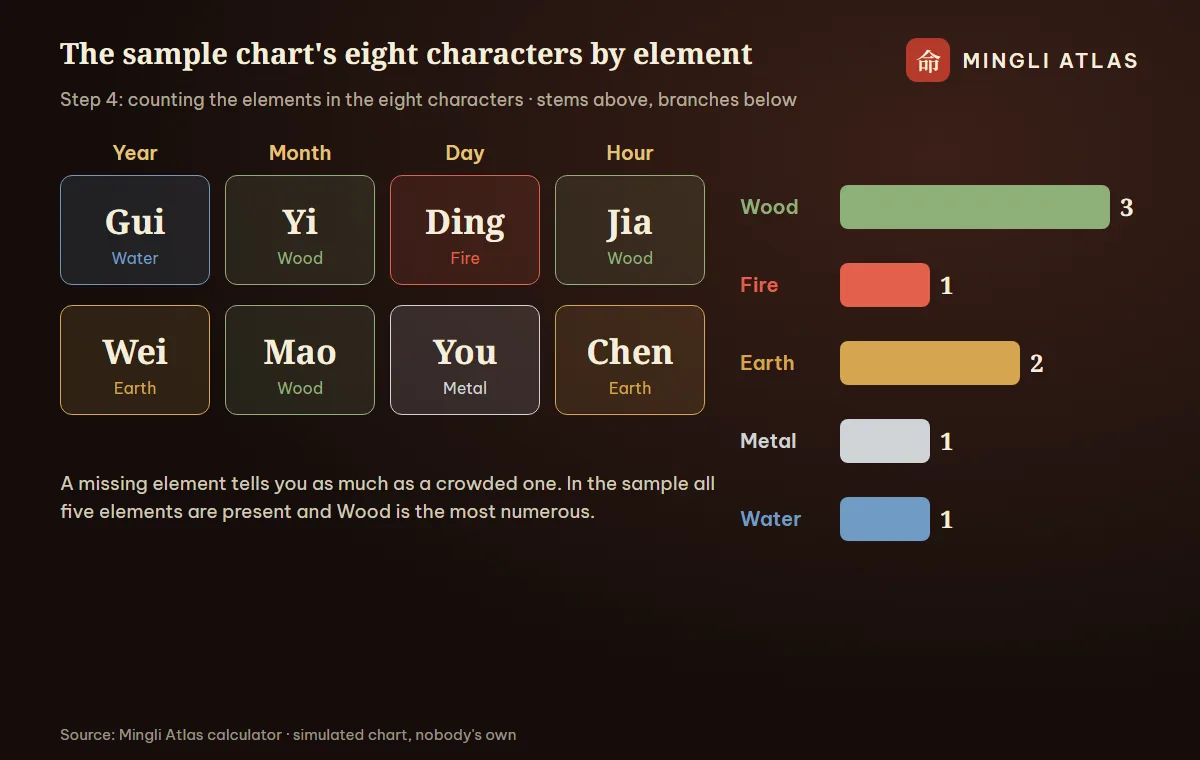
Compare every stem, and every hidden stem inside the branches, with the Day Master to name its Ten God. Then count how many of the eight visible characters fall in each of the Five Elements; a missing element is as informative as a heavy one. Write both lists down. Do not read a Ten God by its name alone: the same one means different things in different pillars and different charts.
Step 5. Weigh the Day Master’s strength
Put the season, the roots, the support and the pressure together to see how well the Day Master is held up. Do it by quality, not by score, and be ready to write “cannot be settled” when the evidence is mixed or an interaction sits on a decisive point. The guide to a strong or weak Day Master gives the order and the cases to stop at.
Step 6. Check the interactions
Look for branches that combine or clash with one another, and note which pillars they touch. A clash between the month and the day branch can weigh more than one between the year and the hour, because it touches the Month Command and the day branch itself. The earthly branches page lists the combinations and clashes, and void branches covers the empty pair.
Step 7. Add the luck pillars and the year
The natal chart is fixed; time moves through it. Find where the ten-year luck pillars start and which direction they run, then add the annual pillar of the year you are reading and see how its stem and branch meet your chart. Do this last, because a luck pillar is read against the natal chart you have already understood.
The sample chart through the seven steps
The synthetic chart used across these guides was born on 25 March 2003 at 08:00 in Hanoi, male.
| Step | What the sample chart shows |
|---|---|
| 1. Pillars | Year Gui Wei (癸未), month Yi Mao (乙卯), day Ding You (丁酉), hour Jia Chen (甲辰) |
| 2. Day Master | Ding (丁), Yin Fire |
| 3. Season | Month Command Mao, spring: Wood Prosperous, Fire Assisted |
| 4. Ten Gods and elements | Stems: Gui Seven Killings, Yi Indirect Resource, Jia Direct Resource. Of the eight visible characters: Wood 3, Earth 2, Fire 1, Metal 1, Water 1 |
| 5. Strength | Cannot be settled by a rule: evidence on both sides and a clash on two decisive points |
| 6. Interactions | Mao and You clash; You and Chen combine |
| 7. Luck pillars | Start at 6 years 4 months 4 days, running backwards: Jia Yin (ages 7 to 16, 2009 to 2018), Gui Chou (17 to 26, 2019 to 2028), Ren Zi (27 to 36), Xin Hai (37 to 46) |
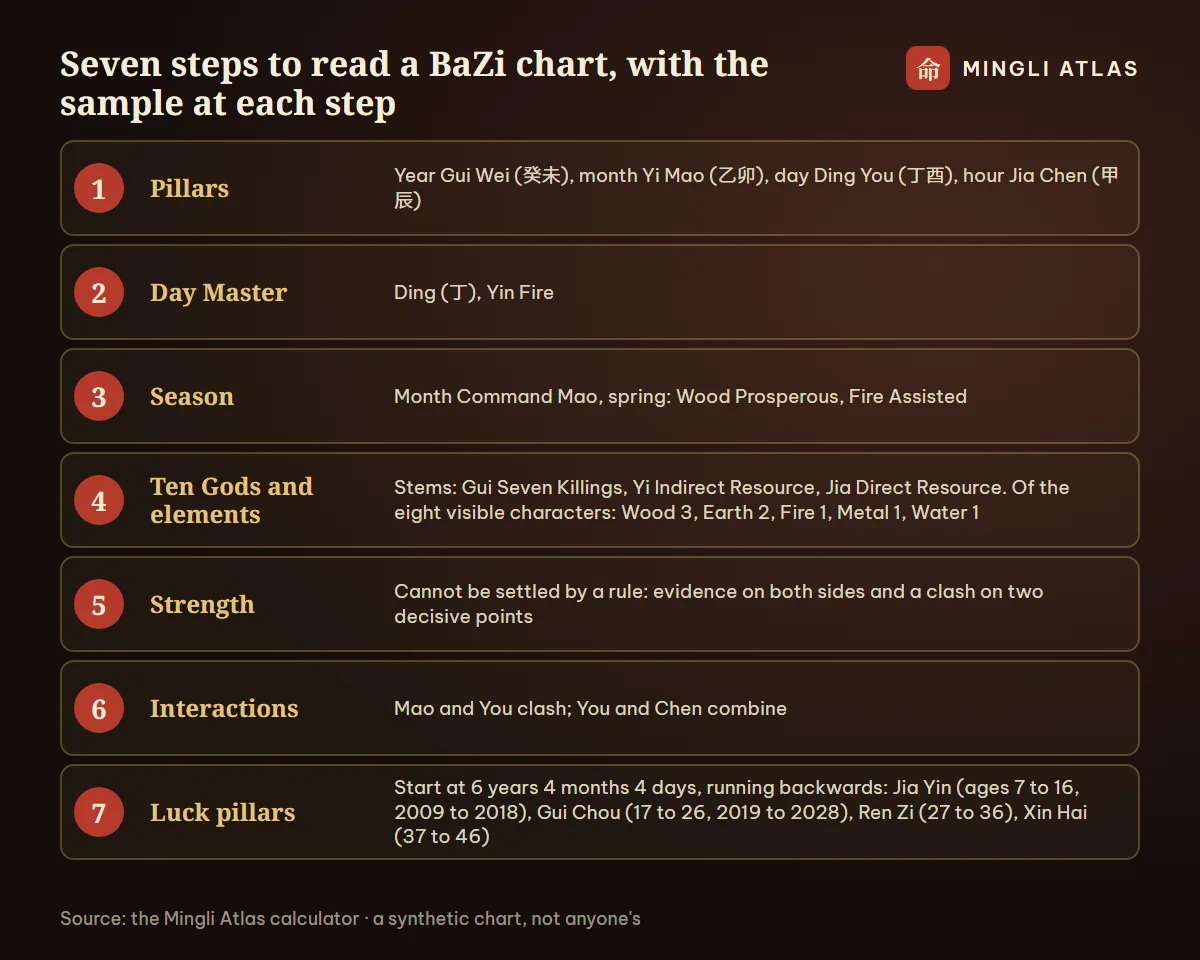
Read the sample as a learner would. The Day Master is in a supported season and has a root and a lot of Resource, yet Seven Killings, Wealth and Output are also present and the month and day branches clash, so a careful reader would hold the judgement open and look at how the luck pillars arrive. See a full worked reading for how the pages of a report put this together.
Common mistakes
- Naming the Ten Gods before fixing the Day Master.
- Counting elements from the stems only and ignoring the hidden stems.
- Skipping the season and judging strength from the number of friendly characters.
- Forcing a strong or weak label when the chart does not support one.
- Treating one clash or one hard luck pillar as a verdict.
A chart is a frame for reflecting on yourself, not a certain prediction. For how this site calculates and reads a chart, see the methodology.
Keep reading
From reading to your chart
See your own chart
Free BaZi and Zi Wei charts, read against the classical texts, with no email needed.