How to Place the Zi Wei Annual Chart (Liu Nian)
To place the annual chart (Liu Nian, 流年) on a Zi Wei Dou Shu chart you do three things: take the year’s palace from the year’s Earthly Branch, take the year’s Four Transformations from the year’s Heavenly Stem, and lay both over the natal chart and the decade limit that is running. The annual chart never changes the natal chart; it only shows which palaces and stars are activated that year. This guide runs all three steps on a sample chart (a man born at 08:00 on 25 March 2003 in Hanoi), prints twelve years from 2024 to 2035, and works 2026 (Bing Wu) in full so you can see the layers stack. What the annual chart means and how to read it is on the annual chart page; this guide only covers placement, not which year is good or bad.
How many steps does it take to place the annual chart?
Three steps, on top of three layers of time. The natal chart is the lifelong base, the decade limit is the ten-year stretch now running, and the annual chart is the layer for one single year. Each layer answers a different question.
| Layer | Length | Comes from |
|---|---|---|
| Natal chart | A lifetime | Birth date and time |
| Decade limit | Ten years | Bureau number, gender and birth-year stem |
| Annual chart | One year | Stem and branch of the year being read |
How to calculate the middle layer is in the guide to calculating Zi Wei decade limits; this guide starts there and adds the outer layer.
Step 1: the annual palace comes from the year’s branch
The palace whose Earthly Branch matches the year’s branch is the annual palace. A Wu year sits on the Wu palace, a Wei year on the Wei palace, and so on through the twelve branches. The palace name (Life, Wealth, Health and so on) comes from the natal chart itself, so the same year gives two different charts two annual palaces with different names.
For the sample chart, the table below places twelve years in a row. Age is the traditional count (a newborn is already 1, and the year turns at Lunar New Year), and the last column shows the decade limit that is running so you see two layers at once.
| Year | Stem and branch | Age | Annual palace | Decade limit running |
|---|---|---|---|---|
| 2024 | Jia Chen | 22 | Friends (Chen) | Spouse (You) |
| 2025 | Yi Si | 23 | Travel (Si) | Spouse (You) |
| 2026 | Bing Wu | 24 | Health (Wu) | Spouse (You) |
| 2027 | Ding Wei | 25 | Wealth (Wei) | Spouse (You) |
| 2028 | Wu Shen | 26 | Children (Shen) | Spouse (You) |
| 2029 | Ji You | 27 | Spouse (You) | Spouse (You) |
| 2030 | Geng Xu | 28 | Siblings (Xu) | Spouse (You) |
| 2031 | Xin Hai | 29 | Life (Hai) | Spouse (You) |
| 2032 | Ren Zi | 30 | Parents (Zi) | Spouse (You) |
| 2033 | Gui Chou | 31 | Fortune (Chou) | Spouse (You) |
| 2034 | Jia Yin | 32 | Property (Yin) | Children (Shen) |
| 2035 | Yi Mao | 33 | Career (Mao) | Children (Shen) |
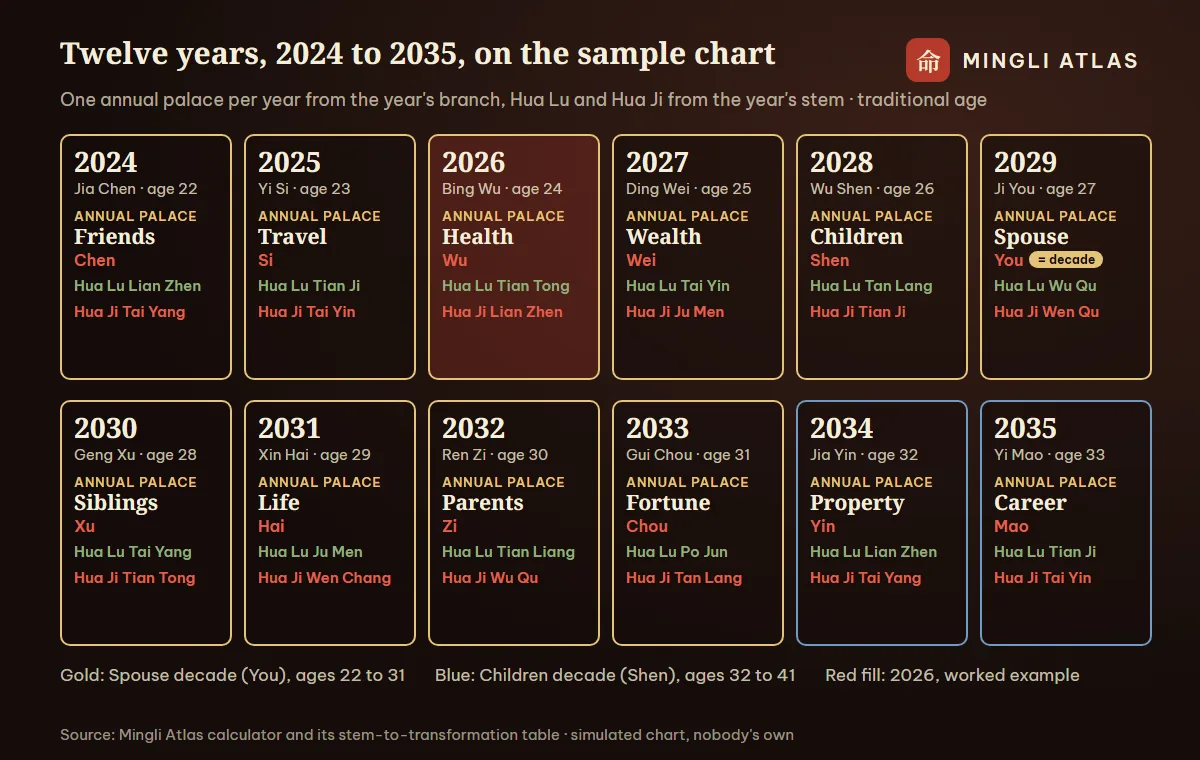
Two things show straight away. The annual palace does not follow the order of the palaces on the chart but the order of the Earthly Branches, so the palace names jump around (Friends, Travel, Health, Wealth and so on). And the decade limit sits still on the Spouse palace (You) from 2024 to 2033, moving to Children (Shen) only when the man turns 32 in 2034. In 2029 the annual palace is also Spouse (You): that is a year where the year’s palace and the decade palace coincide.
Step 2: the year’s Four Transformations come from the year’s stem
The year’s stem decides the four transforming stars of that year: Hua Lu, Hua Quan, Hua Ke and Hua Ji. Each of the ten stems picks a fixed set of four stars, and whichever palace of the natal chart each star sits in is the palace that gets activated. How the stem gives the four, and why schools assign a few stems differently, is in the four transformations guide; this page follows the Mingli Atlas assignment table.
2026 is a Bing Wu year. The stem Bing gives the four stars in the table below; the last column looks each star up on the sample chart.
| Transformation | Star | Palace on the natal chart |
|---|---|---|
| Hua Lu | Tian Tong | Wealth (Wei) |
| Hua Quan | Tian Ji | Life (Hai) |
| Hua Ke | Wen Chang | Health (Wu) |
| Hua Ji | Lian Zhen | Friends (Chen) |
Beyond the lookup, one relation with the natal layer is worth noting. The year’s Hua Ke (Wen Chang) lands exactly on the annual palace, Health, and the sample chart already has a natal Hua Ji, Tan Lang, in the same Health palace. One palace can receive several layers at once, which is the reason to stack the layers instead of reading each alone.
Step 3: stack the three layers
Place the annual palace, then the year’s four transforming stars, then compare with the decade palace that is running. For the sample chart in 2026, the man aged 24, the layers sit like this:
- Natal chart: Life at Hai, Water Two Bureau, with Hua Lu on Po Jun, Hua Quan on Ju Men, Hua Ke on Tai Yin and Hua Ji on Tan Lang.
- Decade limit: the Spouse palace (You), ages 22 to 31.
- Annual chart: the Health palace (Wu), because 2026 is a Wu year.
- Bing-year transformations: Hua Lu on Tian Tong (Wealth), Hua Quan on Tian Ji (Life), Hua Ke on Wen Chang (Health), Hua Ji on Lian Zhen (Friends).
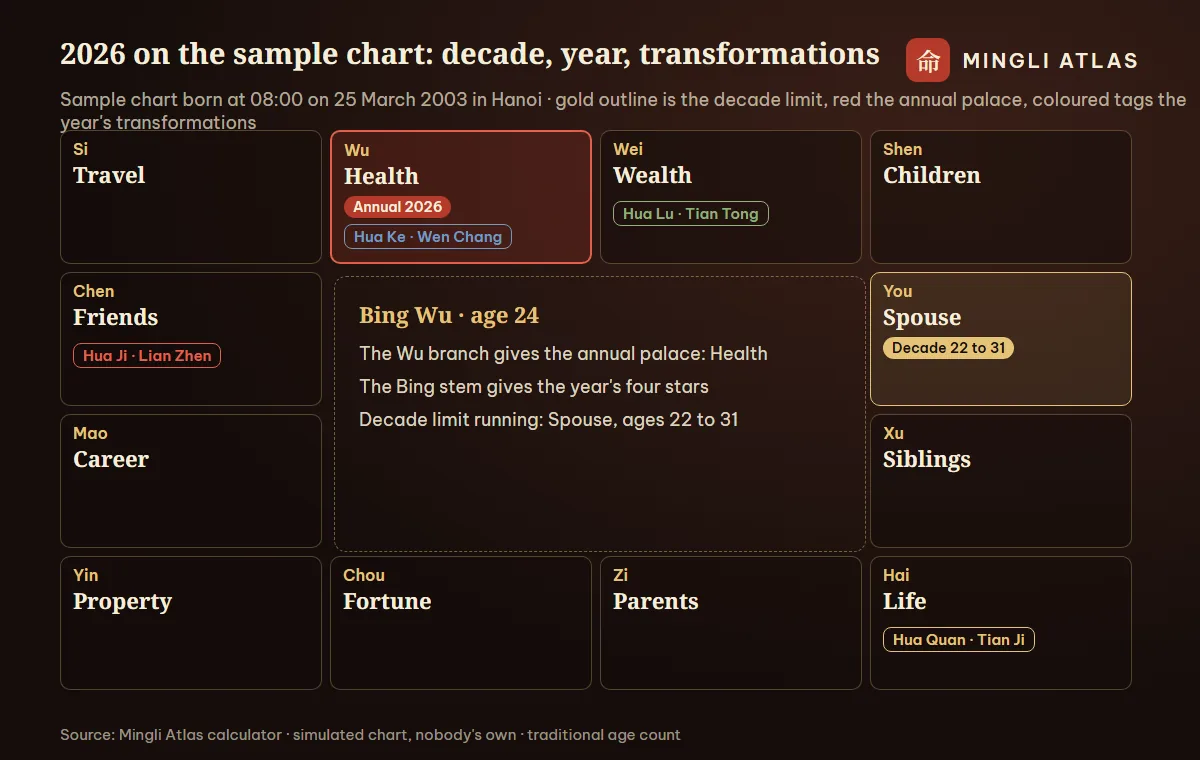
Reading the result is the last step and belongs to how to read a Zi Wei chart: which main stars each palace holds (see how to place the 14 main stars), what part of life each palace speaks of (see the twelve palaces), and how the decade limit is running. This guide stops at placing correctly, because a misplaced layer makes any reading crooked.
The year turns at Lunar New Year, not Start of Spring
The annual chart’s year changes on the first day of the Lunar New Year, not at the solar term Start of Spring. People used to BaZi easily take the wrong stem and branch for days between the two dates. In 2026 Start of Spring falls on 4 February, but the Bing Wu Lunar New Year arrives on 17 February; the table below takes the lunar date from the Mingli Atlas calendar converter.
| Solar date | Lunar date | Annual chart year | BaZi year |
|---|---|---|---|
| 3/2/2026 | 16/12/2025 | Yi Si | Yi Si |
| 4/2/2026 | 17/12/2025 | Yi Si | Bing Wu |
| 16/2/2026 | 29/12/2025 | Yi Si | Bing Wu |
| 17/2/2026 | 1/1/2026 | Bing Wu | Bing Wu |
From 4 to 16 February 2026 BaZi has already moved to Bing Wu while the annual chart is still Yi Si, so the annual palace is at Si (Travel) and the transformations follow the stem Yi. It is the same cause as the direction trap in the previous guide; the two systems are compared in Zi Wei versus BaZi, and BaZi’s own year layer is the annual pillars.
How does the annual chart differ from the minor limit?
The annual chart takes its palace from the year’s branch, while the minor limit is a separate ring that starts from the birth-year branch and moves one palace a year, forwards for men and backwards for women. They are not the same thing, and this guide places only the annual chart. If a source says “this year’s limit is in such a palace”, check whether it uses the annual chart or the minor limit before comparing it with the table above.
How to place the annual chart step by step
- Fix the natal chart and the decade limit that is running (see the previous guide for the decade limit).
- Decide the year by Lunar New Year, not Start of Spring, and take that year’s stem and branch.
- Find the palace whose branch matches the year’s branch: that is the annual palace.
- From the year’s stem, take the four stars Hua Lu, Hua Quan, Hua Ke and Hua Ji.
- Look each transforming star up on the natal chart to see which palace it falls in.
- Compare the annual palace, the palaces holding transformations and the decade palace, and only then move to reading.
Common mistakes
- Taking the year by Start of Spring when the date being read is before Lunar New Year.
- Confusing the annual chart with the minor limit, or using the decade palace as the annual palace.
- Taking the Four Transformations from the birth-year stem instead of the stem of the year being read. The birth-year stem gives the natal transformations; the stem of the year gives the year’s.
- Assuming the annual palace follows the order of palaces on the chart, when it follows the Earthly Branches.
- Calling a year good or bad from a palace name alone, without the stars, the decade limit and the stacked layers.
A chart is a frame for self-reflection, not a fixed prediction, and the signs of a year are material for reflection only. How Mingli Atlas places and reads charts is on the methodology page; to see these layers on your own chart, build a Zi Wei chart.
Keep reading
From reading to your chart
See your own chart
Free BaZi and Zi Wei charts, read against the classical texts, with no email needed.