BaZi Branch Clashes and Combinations Explained
Published , updated
Written by the Mingli Atlas team · Method and sources
Đọc bài này bằng tiếng Việt
The relations between earthly branches in a chart are the combinations, clashes, punishments, harms and breaks. The old books name two kinds plainly: the Six Harmonies, six pairs of branches that combine, and the Six Clashes, six pairs that face each other seven places apart. The other kinds, the Three Harmonies, the directional groups, punishments and harms, are in this site’s calculator table but have no pinned source here, so the site records them only as relations of position and does not read an effect into them. The calculator does not mark breaks at all. This guide has every table, the old books on combining and clashing, the three relations the calculator finds in the sample chart, and how to read them so that a clash is not mistaken for a verdict.
What are the Six Harmonies?
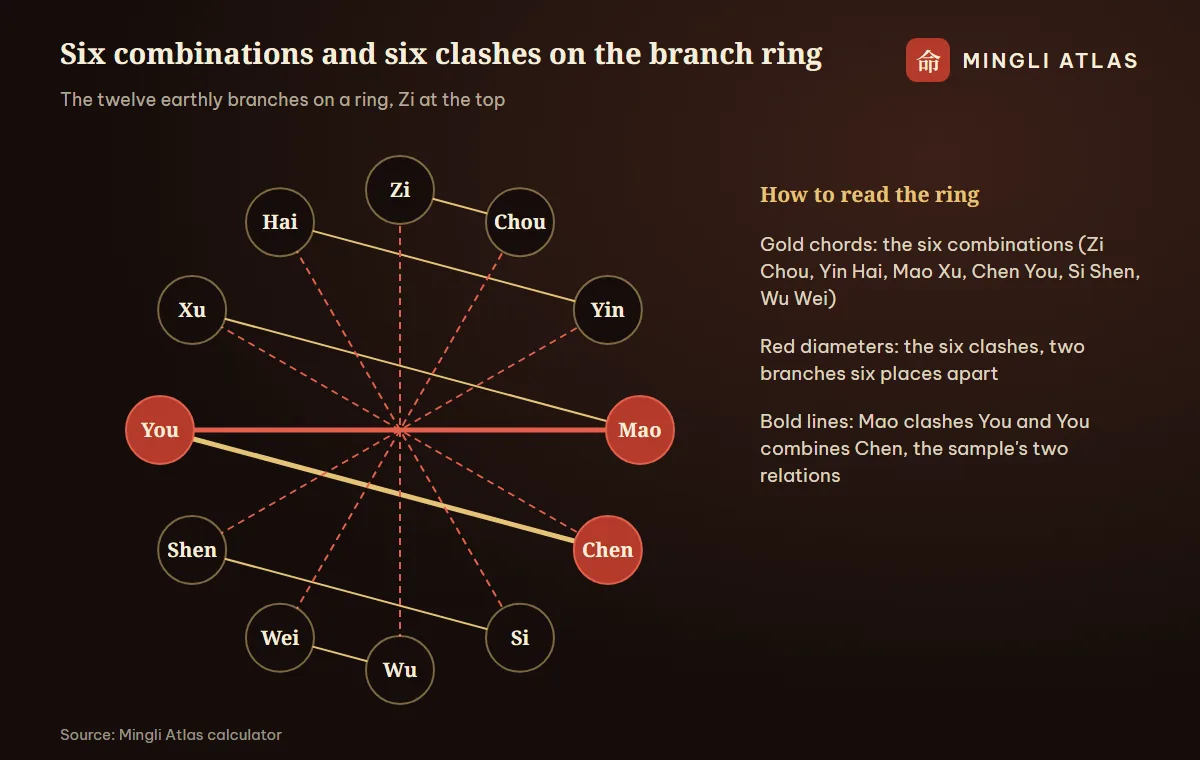
The Six Harmonies (六合) are six pairs of earthly branches that combine. The old book lists all six.
子合丑,寅合亥。卯合戌,辰合酉,巳合申,午合未。
Sanming Tonghui (三命通會), vol. 2, On the six harmonies of the branches (論支元六合)
In plain terms: Zi combines with Chou, Yin with Hai, Mao with Xu, Chen with You, Si with Shen, Wu with Wei. When both branches of a pair are present in a chart the calculator marks a six harmony; what that pair does depends on circumstances, and this site does not give mere presence a good or bad meaning.
| Pair | The two branches |
|---|---|
| Zi Chou | Zi (子), Chou (丑) |
| Yin Hai | Yin (寅), Hai (亥) |
| Mao Xu | Mao (卯), Xu (戌) |
| Chen You | Chen (辰), You (酉) |
| Si Shen | Si (巳), Shen (申) |
| Wu Wei | Wu (午), Wei (未) |
What are the Six Clashes, and why seven places?
The Six Clashes (六沖) are six pairs of branches that face each other. The word clash has a countable definition, and the old book states it as a count.
地支取七位為沖,猶天干取七位為煞之義。如子午對沖,子至午七數。…可見衝破有吉有凶,不可概論。
Sanming Tonghui (三命通會), vol. 2, On clashing and striking (論衝擊)
In plain terms: for the branches, the seventh place makes a clash, just as for the heavenly stems the seventh place makes a killing; take Zi and Wu facing each other, counting from Zi to Wu gives seven. The end of the passage concludes that clashing and breaking can be lucky or unlucky and cannot be discussed in one way. These two ideas underlie this guide: a clash is a countable relation of position, and whether it is good or bad cannot be read from its name alone.
The Shenfeng Tongkao lists the six clashing pairs separately, independently of the passage above.
子午相冲,寅申相冲,卯酉相冲,辰戌相冲,巳亥相冲,丑未相冲。
Shenfeng Tongkao (神峰通考), vol. 4, Branches clash with one another (地支相冲)
In plain terms: Zi and Wu, Yin and Shen, Mao and You, Chen and Xu, Si and Hai, Chou and Wei clash. The two books name the same six pairs, and these are also the six pairs the calculator marks.
| Pair | The two branches |
|---|---|
| Zi Wu | Zi (子), Wu (午) |
| Chou Wei | Chou (丑), Wei (未) |
| Yin Shen | Yin (寅), Shen (申) |
| Mao You | Mao (卯), You (酉) |
| Chen Xu | Chen (辰), Xu (戌) |
| Si Hai | Si (巳), Hai (亥) |
Three Harmonies, directional groups, punishments and harms
The calculator marks four more kinds of relation. For these the site has not pinned a passage to quote, so the table below is only the list of sets the calculator recognises, and their presence together is recorded as a relation of position and nothing more.
| Kind | Sets the calculator recognises |
|---|---|
| Three Harmonies (三合) | Shen, Zi, Chen; Yin, Wu, Xu; Si, You, Chou; Hai, Mao, Wei |
| Directional groups (三會) | Yin, Mao, Chen; Si, Wu, Wei; Shen, You, Xu; Hai, Zi, Chou |
| Punishments (刑) | Yin, Si, Shen; Chou, Xu, Wei; Zi and Mao |
| Self-punishment (自刑) | Chen, Wu, You, Hai, when the same branch appears twice |
| Harms (害) | Zi Wei, Chou Wu, Yin Si, Mao Chen, Shen Hai, You Xu |
Breaks (破) the calculator does not mark, and the site has no source from which to list the pairs. Schools also differ over which kinds count and how heavily, so do not treat this table as a common standard.
How to read these relations in a chart
- List first, read second. Write down every pair or set present, with the two pillars it touches. The guide to the twelve earthly branches gives more context on each branch.
- See where they land. A clash between the month and the day branch can weigh more than one between the year and the hour, because it touches the Month Command and the day branch itself.
- Do not label from the name. As the old book concludes, a clash can be lucky or unlucky; so can a combination. A relation is a signal about structure, not a verdict.
- Put it in its step. In how to read a BaZi chart in seven steps, the relations between branches are step 6, after the Ten Gods are named and the Day Master’s strength is weighed. But if a pair touches a decisive point in the weighing, it can change the result of step 5.
Heavenly stems also combine with each other; the guide to the ten heavenly stems gives the five pairs of stems that combine.
Example: the relations in the sample chart
The synthetic chart used across these guides was born at 08:00 on 25 March 2003 in Hanoi, male, with the four branches Wei (year), Mao (month), You (day) and Chen (hour). The calculator finds three relations.
| Relation | The two branches | Pillars touched |
|---|---|---|
| Six harmony | Chen, You | Hour and Day |
| Six clash | Mao, You | Month and Day |
| Six harm | Mao, Chen | Month and Hour |
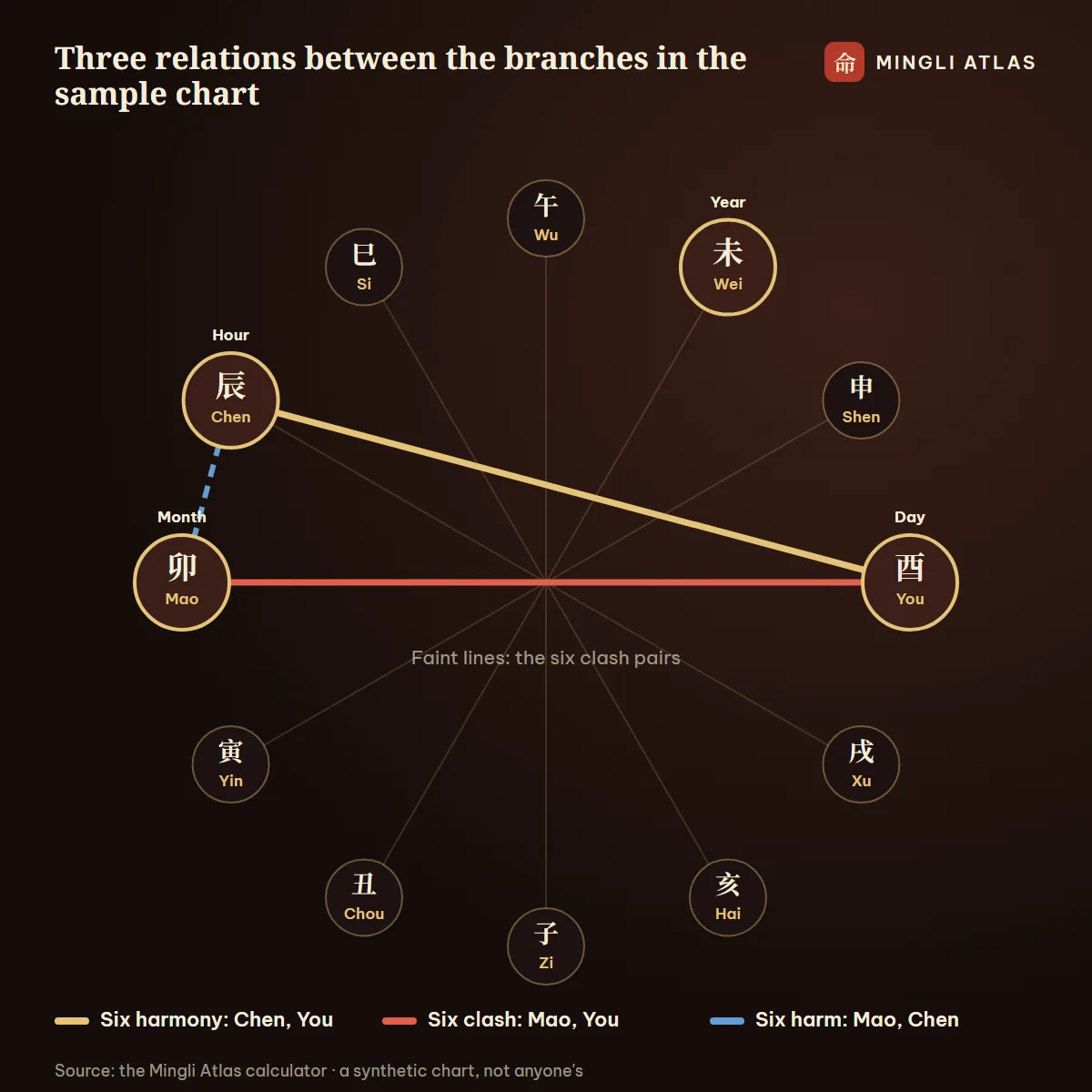
The day branch, You, sits in both the harmony and the clash, and the month branch, Mao, sits in both the clash and the harm. The clash touches both the Month Command and the day branch, the very point the guide to a strong or weak Day Master uses to say that this chart cannot be settled by a rule. The site records the pairs only as relations of position; there is no Three Harmony, directional group, punishment or self-punishment in this chart. This is a sample for learning, not anyone’s real chart.
To see the relations in your own chart, calculate your BaZi chart; it lists the combining and clashing pairs of the chart. A chart is a frame for reflecting on yourself, not a certain prediction. For how this site calculates and reads a chart, see the methodology.
Keep reading
From reading to your chart
See your own chart
Free BaZi and Zi Wei charts, read against the classical texts, with no email needed.