Why the BaZi Month Follows Solar Terms, Not the Lunar Month
Published , updated
Written by the Mingli Atlas team · Method and sources
Đọc bài này bằng tiếng Việt
The month in BaZi changes with the twelve solar terms of the year, the twelve moments when the Sun reaches a set longitude, not with the first of the lunar month or the first of a calendar month. So the month pillar changes at one exact minute: someone born before that minute belongs to the old month and someone born after belongs to the new one, even when they are two minutes apart. This guide gives the mechanism, the times of the twelve terms for 2026, 2027 and 2028 in Vietnam time, and two births near a term run through this site’s calculator to show which pillar changes.
Why does the month pillar follow solar terms, not the lunar calendar?
The month pillar stands for the season, and the season is set by where the Sun is, not by the phase of the Moon. A year has twenty-four solar terms, in two kinds that alternate: a jie (節) opens a month, and a zhongqi (中氣) sits in the middle of it. BaZi changes the month only at a jie. The Yueling Qishier Hou Jijie defines the first jie like this.
立春,正月節。立,建始也。五行之氣往者過來者續于此。而春木之氣始至,故謂之立也。
Yueling Qishier Hou Jijie (月令七十二候集解), entry Start of Spring (立春)
In plain terms: Start of Spring is the jie of the first month. Li means to set up, to begin: the qi of the old season passes and the qi of the new one carries on from here, and the Wood qi of spring begins to arrive. This definition ties the month to the qi of the season, which is what BaZi needs. The first month here is the Yin month, not the first month of the lunar calendar.
The result is that the month of a chart may not match the lunar month of the same birth date. Start of Spring usually falls around 4 February, while the lunar new year falls anywhere from 21 January to 20 February, so in some years it comes before Start of Spring and in others after. BaZi always changes the year at Start of Spring, whenever the lunar new year falls. The Month Command guide has the table of the twelve month branches and their seasons.
The twelve month-opening terms, 2026 to 2028
The table gives the start date and time of each term in Vietnam time (UTC+7), to the minute, taken from this site’s solar term table. Calendars printed in China usually give Beijing time, one hour ahead of Vietnam time, so the same term can show two different clock readings in two sources.
| Term | Opens month | 2026 | 2027 | 2028 |
|---|---|---|---|---|
| Start of Spring | Yin (寅) | 4 Feb 03:02 | 4 Feb 08:46 | 4 Feb 14:31 |
| Awakening of Insects | Mao (卯) | 5 Mar 20:59 | 6 Mar 02:39 | 5 Mar 08:24 |
| Clear and Bright | Chen (辰) | 5 Apr 01:40 | 5 Apr 07:17 | 4 Apr 13:03 |
| Start of Summer | Si (巳) | 5 May 18:48 | 6 May 00:25 | 5 May 06:12 |
| Grain in Ear | Wu (午) | 5 Jun 22:48 | 6 Jun 04:25 | 5 Jun 10:16 |
| Minor Heat | Wei (未) | 7 Jul 08:56 | 7 Jul 14:37 | 6 Jul 20:30 |
| Start of Autumn | Shen (申) | 7 Aug 18:42 | 8 Aug 00:26 | 7 Aug 06:21 |
| White Dew | You (酉) | 7 Sep 21:41 | 8 Sep 03:28 | 7 Sep 09:22 |
| Cold Dew | Xu (戌) | 8 Oct 13:29 | 8 Oct 19:17 | 8 Oct 01:08 |
| Start of Winter | Hai (亥) | 7 Nov 16:52 | 7 Nov 22:38 | 7 Nov 04:27 |
| Major Snow | Zi (子) | 7 Dec 09:52 | 7 Dec 15:37 | 6 Dec 21:24 |
| Minor Cold | Chou (丑) | 5 Jan 15:23 | 5 Jan 21:09 | 6 Jan 02:54 |
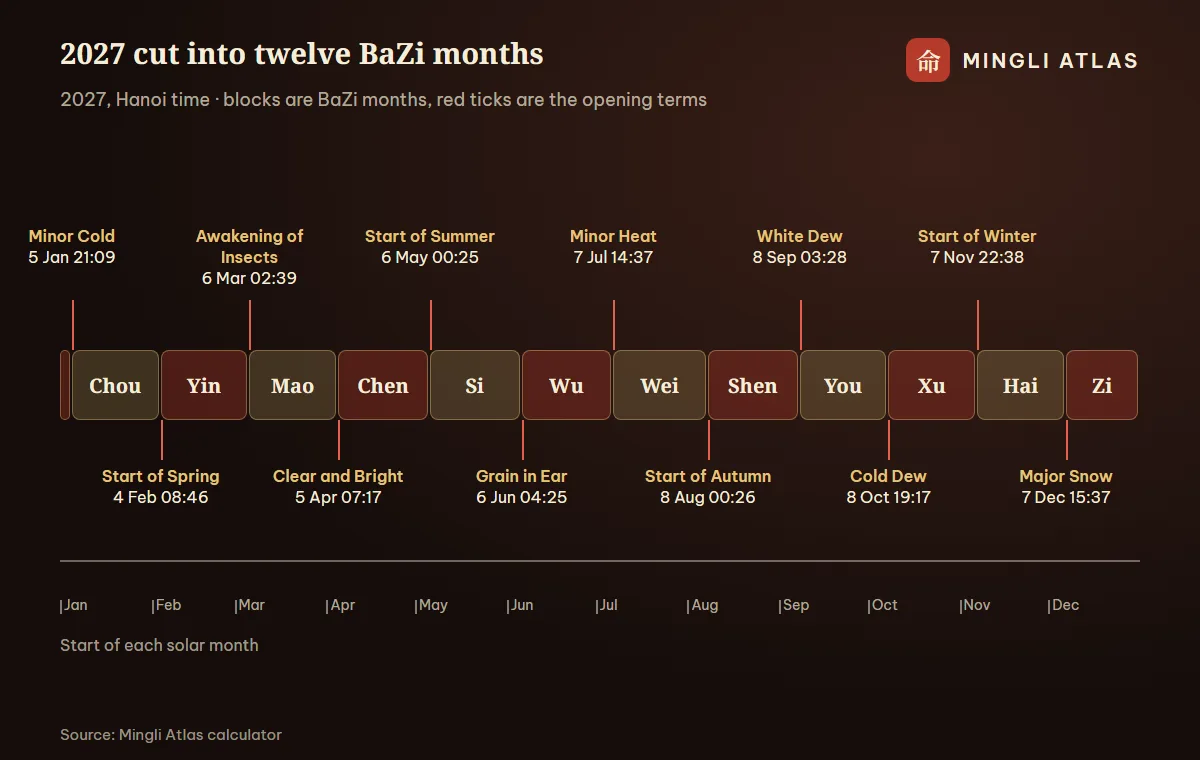
Two things follow from the table. The date of a term shifts by a day between years, so there is no fixed calendar date for the start of a BaZi month. And the clock time moves by about six hours from one year to the next, so someone born on the day of a term has to know the birth time to know which month they belong to.
Born near a term: two cases through the calculator
The cases below use the clock time in Hanoi, male, with true solar time off.
| Birth time (Hanoi) | Year pillar | Month pillar |
|---|---|---|
| 6 Mar 2027, 02:38 (before Awakening of Insects) | Ding Wei | Ren Yin |
| 6 Mar 2027, 02:40 (after Awakening of Insects) | Ding Wei | Gui Mao |
| 4 Feb 2027, 08:44 (before Start of Spring) | Bing Wu | Xin Chou |
| 4 Feb 2027, 08:48 (after Start of Spring) | Ding Wei | Ren Yin |
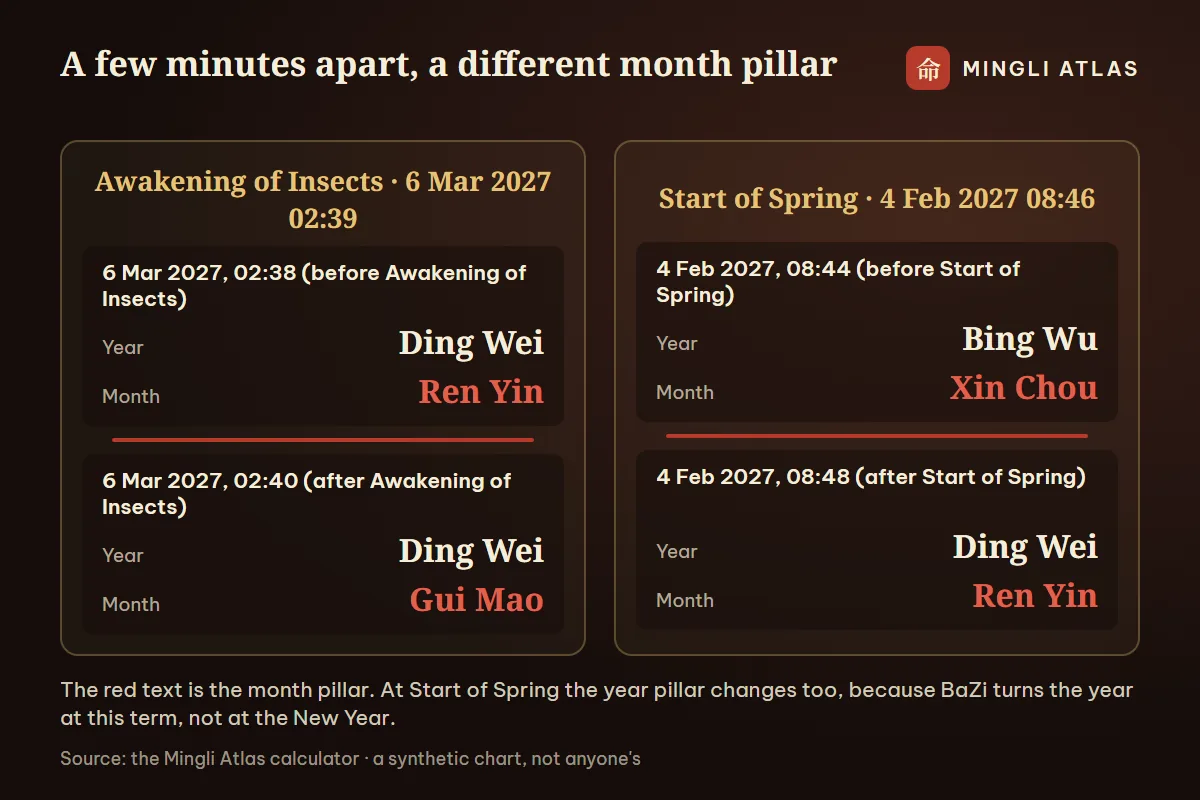
The first two births are two minutes apart and the month pillar changes from Ren Yin to Gui Mao, because Awakening of Insects begins at 02:39. The last two are four minutes apart at Start of Spring, and here both the year pillar and the month pillar change, because Start of Spring opens the Yin month and also opens the new BaZi year.
Start of Spring also shows the gap with the lunar calendar. At noon on 5 February 2027 the Vietnamese lunar calendar gives the 29th day of the twelfth month of the Bing Wu year, so the lunar calendar is still in the old year, yet the year pillar of the chart is already Ding Wei because Start of Spring passed the morning before. Someone born that day carries the Sheep year in BaZi, even if their papers show the Horse year by lunar reckoning.
What to do if you were born near a term
- Check whether your birth date is the date of a term. Look in the table above or on the page of that term.
- Confirm the birth time to the minute. If you were born within a few hours of the moment, a rounded birth time can put the chart in a different month. The birth time checklist covers time zones, summer time and true solar time.
- Cast both sides if you are unsure. Calculate your BaZi chart twice with the two doubtful times and see whether the month pillar changes; if it does, treat the seasonal reading of the chart as uncertain until the birth time is confirmed.
The month pillar does more than name a month. It sets the Month Command for the whole chart, and the seasonal state of the Day Master follows from it in the strong or weak Day Master step. See how to read a BaZi chart in seven steps for where it sits.
Common misunderstandings
- Taking the BaZi month to be the lunar month. The two only coincide by chance.
- Believing the BaZi year changes at the lunar new year. It changes at Start of Spring.
- Using one fixed calendar date, such as 4 February, for every year. The time of a term moves each year.
- Forgetting to convert the time when reading a Chinese calendar: Beijing time is one hour ahead of Vietnam time.
A chart is a frame for reflecting on yourself, not a certain prediction. For how this site calculates solar terms and charts, see the methodology.
Keep reading
From reading to your chart
See your own chart
Free BaZi and Zi Wei charts, read against the classical texts, with no email needed.