How to Calculate the Day and Hour Pillars in BaZi

The BaZi Day pillar is a cycle of sixty days that repeats without a break, independent of lunar months and solar terms, so it can be found with one division: turn the calendar date into a Julian day number, add 49, divide by 60 and keep the remainder, then divide that remainder by 10 and by 12 to get the stem and the branch. The Hour pillar has a fixed branch for each double-hour, and its stem follows from the stem of the Day pillar through a table of five groups. This guide does both on the sample chart born at 08:00 on 25 March 2003, checks the formula against the Mingli Atlas calculator on 1,985 days between 1900 and 2100, prints the full hour table for the five groups of day stems, and points out the one place people most often go wrong, the Zi hour. The Day pillar gives the Day Master, so this is the first step of every chart; the guide covers how to calculate, not which pillar is good or bad.
How do you calculate the Day pillar from a calendar date?
The Day pillar walks through the sixty stem-and-branch pairs and starts again, one step per day, never interrupted at the start of a month or at New Year. All you need is a number that counts days continuously, and the Julian day number (JDN) is exactly that. The procedure has four steps:
- For day d, month m, year y: let a be the whole part of (14 minus m) divided by 12, y’ = y + 4800 − a, and m’ = m + 12a − 3.
- JDN = d + the whole part of (153m’ + 2) divided by 5 + 365y’ + the whole part of y’ divided by 4 − the whole part of y’ divided by 100 + the whole part of y’ divided by 400 − 32045.
- Take (JDN + 49) divided by 60 and note the remainder r, from 0 to 59.
- The stem is the remainder of r divided by 10 and the branch is the remainder of r divided by 12, counted in the order Jia, Yi, Bing, Ding, Wu, Ji, Geng, Xin, Ren, Gui and Zi, Chou, Yin, Mao, Chen, Si, Wu, Wei, Shen, You, Xu, Hai, starting from 0.
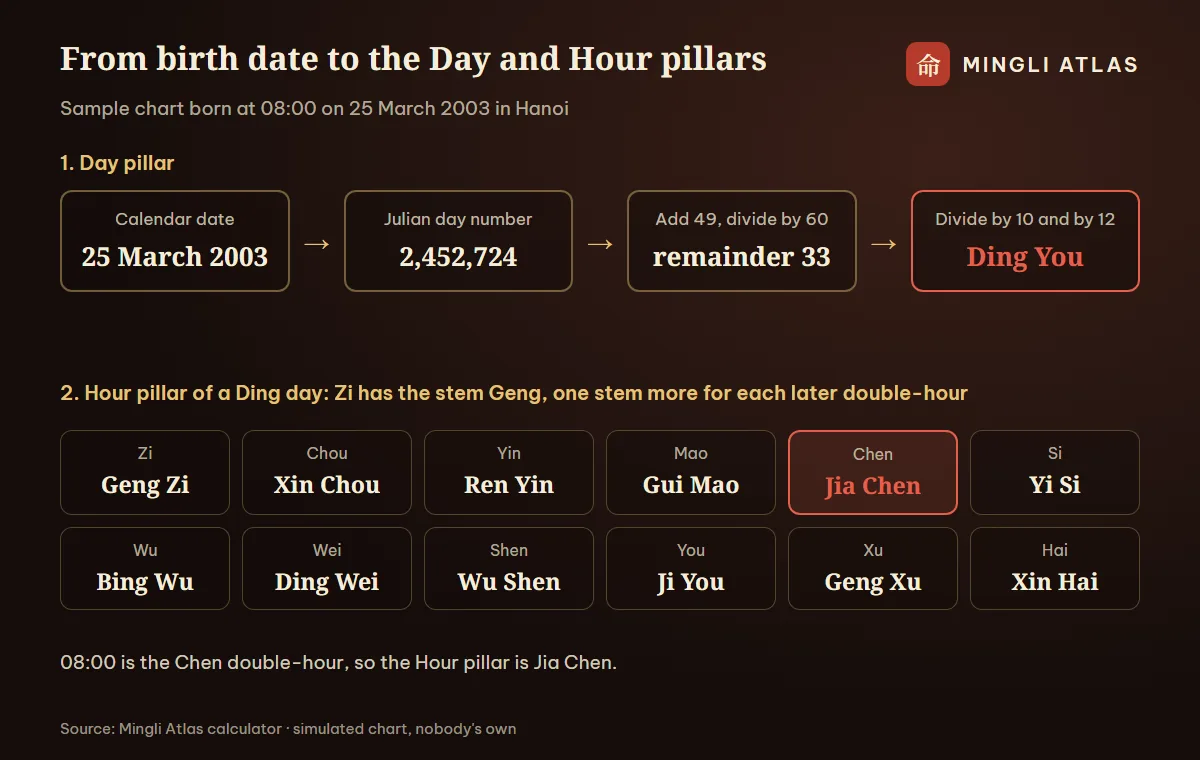
For 25 March 2003: a = 0, y’ = 6803, m’ = 0, so JDN = 25 + 0 + 2,483,095 + 1,700 − 68 + 17 − 32,045 = 2,452,724. Adding 49 gives 2,452,773, which leaves 33 when divided by 60. Dividing 33 by 10 leaves 3, which is Ding; dividing it by 12 leaves 9, which is You. The Day pillar is Ding You, the same as the calculator gives, and the Day Master is Ding (see what a Day Master is). The order of the ten stems and twelve branches used in step 4 is in the heavenly stems guide and the earthly branches guide.
Five more dates to try yourself. The last column comes from the Mingli Atlas calculator; the column “r” is the remainder of the formula.
| Calendar date | JDN | r | Day pillar by the formula | Day pillar by the calculator |
|---|---|---|---|---|
| 1 January 2000 | 2,451,545 | 54 | Wu Wu | Wu Wu |
| 29 February 2000 | 2,451,604 | 53 | Ding Si | Ding Si |
| 25 March 2003 | 2,452,724 | 33 | Ding You | Ding You |
| 10 February 2024 | 2,460,351 | 40 | Jia Chen | Jia Chen |
| 28 October 2026 | 2,461,342 | 11 | Yi Hai | Yi Hai |
The formula is not right for these five dates alone. Mingli Atlas took one date in every 37 from 1 January 1900 to the end of 2100, 1,985 days in all, worked each out by the formula and compared it with the calculator: not one date differed. Because the Day pillar depends only on the calendar date, two people born on the same date in the same time zone, with the same Zi-hour convention, always share the Day pillar.
Where does the Hour pillar get its stem?
The stem of the Hour pillar comes from the stem of the Day pillar: find the stem of the Zi hour in the table below, then add one stem for each later double-hour. The branch is fixed by the twelve double-hours, from Zi to Hai, counted in the standard time of the birthplace (the time ranges and the conversion are in the birth time guide).
| Stem of the Day pillar | Stem of the Zi hour | Zi-hour pillar |
|---|---|---|
| Jia or Ji | Jia | Jia Zi |
| Yi or Geng | Bing | Bing Zi |
| Bing or Xin | Wu | Wu Zi |
| Ding or Ren | Geng | Geng Zi |
| Wu or Gui | Ren | Ren Zi |
A quick way to remember it: number the stems from 0 (Jia 0, Yi 1, and so on up to Gui 9); the stem of the Zi hour is twice the number of the day stem, taken modulo 10. Ding is 3, twice that is 6, which is Geng. On a Ding day, for example, the Zi hour is Geng Zi, Chou is Xin Chou, Yin is Ren Yin, Mao is Gui Mao and Chen is Jia Chen. Someone born at 8 a.m. falls in the Chen double-hour, so the Hour pillar of the sample chart is Jia Chen. The full twelve double-hours for the five groups of day stems:
| Day stem | Zi | Chou | Yin | Mao | Chen | Si | Wu | Wei | Shen | You | Xu | Hai |
|---|---|---|---|---|---|---|---|---|---|---|---|---|
| Jia, Ji | Jia | Yi | Bing | Ding | Wu | Ji | Geng | Xin | Ren | Gui | Jia | Yi |
| Yi, Geng | Bing | Ding | Wu | Ji | Geng | Xin | Ren | Gui | Jia | Yi | Bing | Ding |
| Bing, Xin | Wu | Ji | Geng | Xin | Ren | Gui | Jia | Yi | Bing | Ding | Wu | Ji |
| Ding, Ren | Geng | Xin | Ren | Gui | Jia | Yi | Bing | Ding | Wu | Ji | Geng | Xin |
| Wu, Gui | Ren | Gui | Jia | Yi | Bing | Ding | Wu | Ji | Geng | Xin | Ren | Gui |
Two stems five steps apart (Jia and Ji, Yi and Geng, Bing and Xin, Ding and Ren, Wu and Gui) share a row, so ten day stems need only five rows. Each row runs through all ten stems and then repeats: the Xu and Hai hours repeat the stems of Zi and Chou.
When does the day change at the Zi hour?
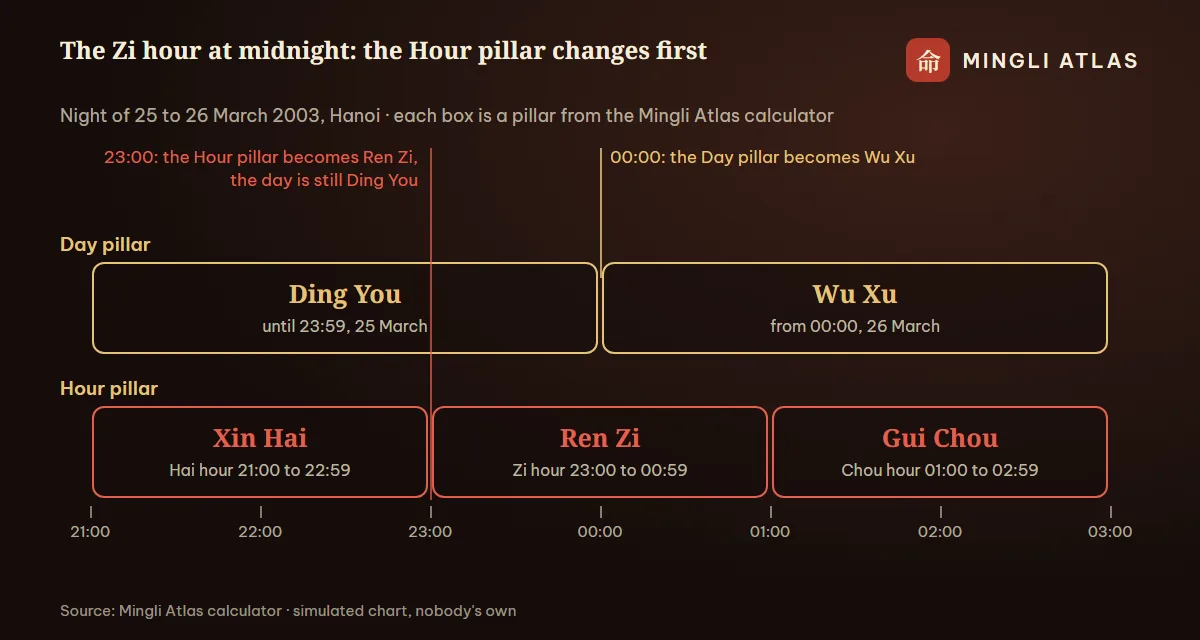
The Mingli Atlas chart changes the day at 00:00, but the Zi-hour pillar from 23:00 already carries the stem of the next day. Two schools differ here, which is why someone moving to another tool is likely to think a chart is “wrong”. For the sample birth:
| Birth time | Day pillar | Hour pillar |
|---|---|---|
| 25 March at 22:59 | Ding You | Xin Hai |
| 25 March at 23:00 | Ding You | Ren Zi |
| 25 March at 23:59 | Ding You | Ren Zi |
| 26 March at 00:00 | Wu Xu | Ren Zi |
| 26 March at 01:00 | Wu Xu | Gui Chou |
The Ren Zi at 23:00 is the Zi hour of a Wu day (the Wu or Gui row of the table above), although the Day pillar is still Ding. If your teacher changes the day at 23:00, someone born at 23:30 on 25 March has the Day pillar Wu Xu, a different Day Master. So for any birth between 23:00 and 00:59, write down which convention you used; the details are in the birth time guide.
How to calculate the Day and Hour pillars step by step
- Convert the birth time to the standard time of the birthplace; if the birth falls between 23:00 and 00:59, note the day-change convention.
- Work out the JDN of the calendar date, add 49, divide by 60 and keep the remainder.
- Read the stem and branch of the Day pillar from the remainder (divide by 10 and by 12).
- Find the double-hour of the birth time to get the branch of the Hour pillar.
- Look up the stem of the Hour pillar in the five-row table by day stem.
- Compare the result with a chart from a calculator; if it differs, check the standard time and the Zi-hour convention first.
Common mistakes
- Using the lunar date instead of the calendar date to work out the Julian day number.
- Forgetting to add 49, or dividing by 12 before dividing by 60.
- Counting the remainder from 1 instead of 0, which is off by one pillar.
- Taking the stem of the Hour pillar from the year or month stem instead of the day stem.
- Using clock time instead of standard time at the birthplace, or overlooking the Zi-hour convention.
With the Day Master found, the next step is to name the other stems relative to it: see how to find the Ten Gods.
A chart is a frame for reflecting on yourself, not a certain prediction. To see why the Year and Month pillars change with solar terms rather than with ordinary days, read the guide to solar terms and the Month pillar. For how this site calculates a chart, see the methodology, and for your own Day and Hour pillars, calculate your BaZi chart.
Keep reading
From reading to your chart
See your own chart
Free BaZi and Zi Wei charts, read against the classical texts, with no email needed.