Useful God (Yong Shen) in BaZi: What the Old Books Say
Published , updated
Written by the Mingli Atlas team · Method and sources
Đọc bài này bằng tiếng Việt
The Useful God (用神, yong shen) is the term for the thing a reading picks as the chart’s point of support, the thing the chart “needs to use”. The old books do not teach one single way to choose it, and the schools choose on different bases: the strength of the Day Master, the season of birth, or where the chart is “sick”. So the same chart can have more than one answer, and this site does not choose a Useful God for you. This guide says what the old books state firmly and what they leave open, the three common bases for choosing, a table showing one book changing its choice month by month for the same Day Master, and why the sample chart has no answer yet.
What is the Useful God?
The Useful God is the thing chosen for the chart to lean on, and readings place it in different kinds of thing: some treat it as an element, some as a heavenly stem, some as a Ten God. In the passages this site has pinned, the books do not settle which kind it is, so this guide gives no more general definition than the sentence above.
Two things are easy to confuse with it. The Useful God is not the Day Master: the Day Master is the stem of the day pillar and the point everything is measured from, while the Useful God is something chosen after the measuring. And “use” (用) in the old books often just means “to use” in the ordinary sense, not always this term.
What do the old books state firmly about the Useful God?
The three points below have a sentence in the books. First: the Useful God must not be damaged, and the Day Master should be healthy.
用神不可損傷,日主最宜健旺。
Yuanhai Ziping (淵海子平), Verses on continuing the good (繼善篇)
In plain terms: the Useful God must not be damaged; the Day Master is best when it is strong and flourishing. The book states a condition, but this passage does not say what counts as damage, so this guide does not list mechanisms.
Second: the choice rests on the birth month, and the weighing rests on strength.
取用憑於生月,當推究於淺深;發覺在於日時,要消詳於強弱。
Yuanhai Ziping (淵海子平), Verses on continuing the good (繼善篇)
In plain terms: take the useful thing from the birth month, and examine how deep or shallow it is; what shows in the day and hour must be weighed for strong and weak. Two points stand out: “birth month” here is the context of the month, and the book does not say that it is exactly the month branch; and “deep or shallow” is not said to be the depth of a root. The third point is about position.
月上有用神得祖宗之力,時上有用神得子孫之力,反此則否。
Sanming Tonghui (三命通會), vol. 10, Verses for reading a chart (看命口訣)
In plain terms: a Useful God on the month gets the strength of the ancestors, one on the hour gets the strength of the descendants, and the reverse if not. This is a remark about position, and it assumes the Useful God has already been chosen.
What do the old books leave open?
- How to choose. The passages above give no algorithm, for example the formula “if strong, drain; if weak, support”.
- The kind of thing it is. Whether it is an element, a stem or a Ten God depends on the reading.
- What counts as damage. Clash, combination, transformation or loss of root: the books do not settle it in these passages.
- What to do when the birth hour is unknown. The books say the day and hour matter, but not whether a chart without the hour can be settled.
This is why the site has no tool that picks a Useful God: these links have no source from which to build a rule.
Three common bases for choosing
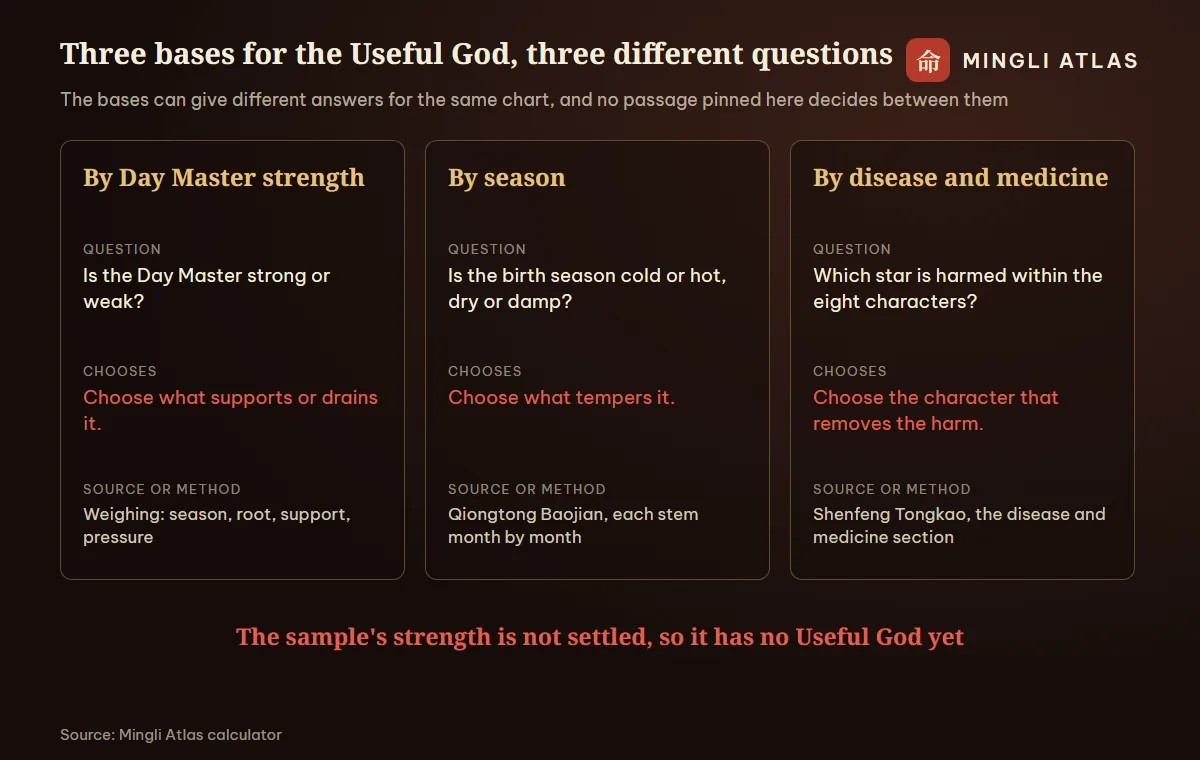
- By the strength of the Day Master. This asks whether the Day Master is strong or weak, then chooses what supports or drains it. The pinned sentences above support weighing the Day Master’s strength, but they do not prove a fixed formula. The guide to a strong or weak Day Master gives the method of weighing and the cases that must be written down as “cannot be settled”.
- By season. This looks at the cold and heat, dryness and damp of the birth season and chooses what tempers them. This is the approach of the Qiongtong Baojian, which takes each stem month by month; see the example below. The Month Command guide gives the season of each month.
- By disease and medicine. The Shenfeng Tongkao, in its section on disease and medicine, calls the “disease” a star that is harmed within the eight characters and the “medicine” a character that removes it. This is a separate framework; the passages pinned here do not say it is the same as the Useful God.
Beyond these three, the books use other ways of naming, such as the six methods Officer, Resource, Wealth, Killings, Eating God and Hurting Officer that the Sanming Tonghui uses to weigh a chart. The bases can give different answers for the same chart, and no passage pinned here decides between them.
Example: one book changing its choice by month
The Qiongtong Baojian takes each stem month by month. The table below uses the months pinned for the Day Master Jia (Wood), giving the book’s own words for what it chooses; the months are named as the book names them, and the site does not convert them to earthly branches. The words are the book’s choice, not this site’s rule.
| Month as the book calls it | The book chooses | Original text |
|---|---|---|
| First month | Bing (Fire) and Gui (Water) | 得丙癸逢 |
| Third month | Geng (Metal) first, Ren (Water) next | 先取庚金,次用壬水 |
| Fifth month | Gui (Water) first, then Ding (Fire) and Geng (Metal) | 五月先癸后丁庚金次之 |
| Sixth month | Ding (Fire) first, Geng (Metal) next | 先丁后庚 |
| Seventh month | Ding (Fire) first, Geng (Metal) next | 丁火为尊,庚金次之 |
| Eleventh month | Ding (Fire) first, Geng (Metal) next, Bing (Fire) assisting | 丁先庚后,丙火佐之 |
| Twelfth month | Geng (Metal) first, Ding (Fire) next | 先用庚噼甲,方引丁火 |
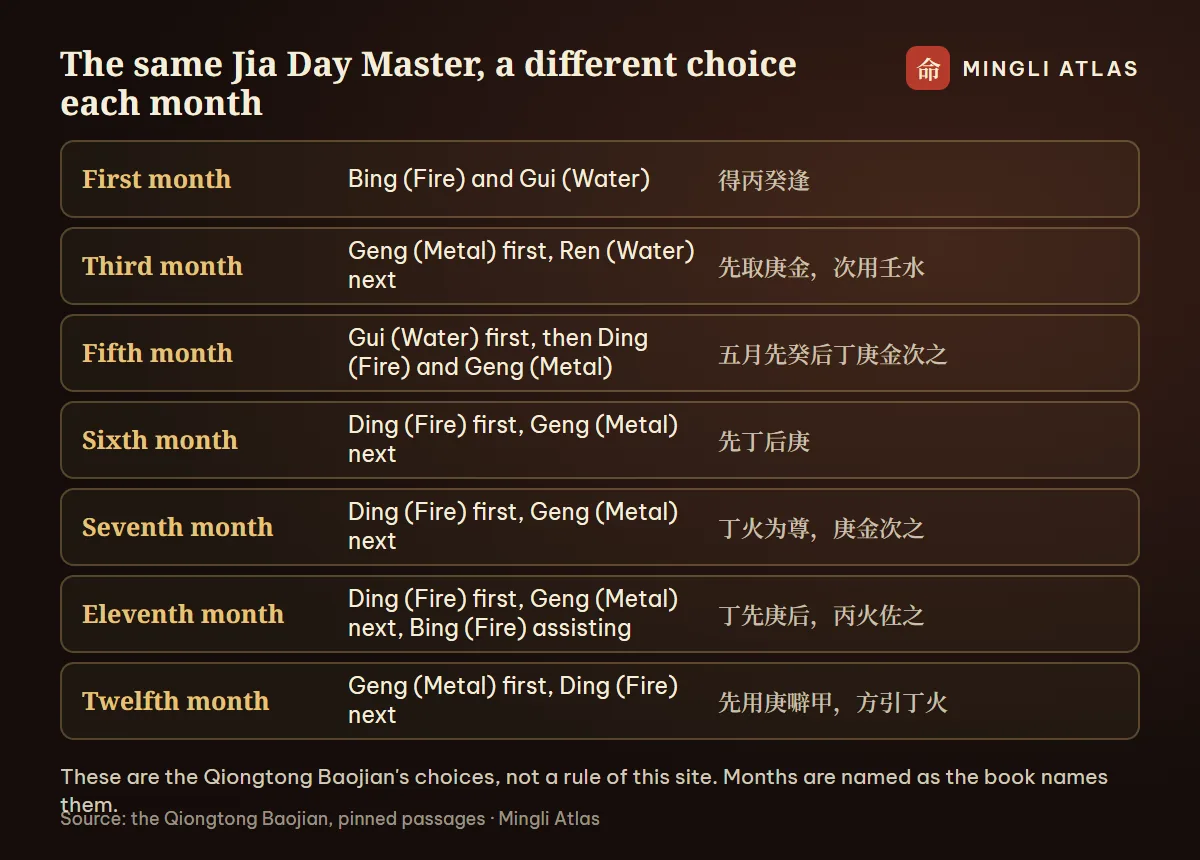
The table shows two things. A fixed Day Master still gets a different choice month by month, because this approach looks at the season and not at one line for the whole stem. And it is one book’s approach; a reading by Day Master strength or by disease and medicine would lean on other facts of the same chart.
The sample chart: why there is no Useful God
The synthetic chart used across these guides was born at 08:00 on 25 March 2003 in Hanoi, male, Day Master Ding (丁), Yin Fire, born in the Mao month. By a reading of the Day Master’s strength, the chart cannot be settled by a rule, because the evidence runs both ways and a clash sits on two decisive points, as the guide to a strong or weak Day Master says. By a reading of the season, the site has not pinned a passage of the book for the stem Ding, so there is no word to give.
Because both are open, the site gives no Useful God for the sample chart, and no tool of the site does. What the site has are the facts for a reader to weigh: the stems, the hidden stems and Ten Gods, the season of birth, the combinations and clashes, and the luck pillars. This is a chart for learning, not anyone’s real chart.
When two sources give two different Useful Gods
- Ask which basis each uses. Day Master strength, season, disease and medicine or something else, because each basis leads to its own answer.
- Check the birth data. A wrong birth hour or a birth near a solar term can change the chart, and so the answer. See solar terms and the month pillar and the birth time checklist.
- Treat the answer as one way of reading, not a conclusion. A Useful God is a hypothesis for reflecting on yourself; use it as a question to think with, not as a verdict.
To see the facts of your own chart, calculate your BaZi chart. See how to read a BaZi chart in seven steps for the steps that come before a Useful God. A chart is a frame for reflecting on yourself, not a certain prediction. For how this site calculates and reads a chart, see the methodology.
From reading to your chart
See your own chart
Free BaZi and Zi Wei charts, read against the classical texts, with no email needed.