How to Find the Ten Gods in a BaZi Chart
To find the Ten Gods in a BaZi chart, take the Day Master as the reference point and compare every other stem with it using two questions: which element is this stem relative to the Day Master, and does it share the Day Master’s Yin or Yang? The two answers give exactly one of ten names. This guide turns the rule into a table of five relationships by two polarities, works a sample chart through completely, hidden stems included, and then uses a ten-by-ten table calculated by the Mingli Atlas calculator to show two things few guides count: every name appears exactly ten times, and the Ten Gods always come in reciprocal pairs between two stems. It only covers how to name a stem; what each Ten God stands for is in the Ten Gods guide.
What rule decides the Ten Gods?
A Ten God is the name a stem takes when it stands next to the Day Master, not a fixed property of the stem. For each stem you ask two things. The first is its element relationship to the Day Master: same element, produced by the Day Master, controlled by the Day Master, controlling the Day Master, or producing the Day Master. The second is polarity: the same as the Day Master or the opposite. Five relationships times two polarities make ten cells.
| Relationship of the stem to the Day Master | Same polarity | Opposite polarity |
|---|---|---|
| Same element | Friend | Rob Wealth |
| Produced by the Day Master | Eating God | Hurting Officer |
| Controlled by the Day Master | Indirect Wealth | Direct Wealth |
| Controls the Day Master | Seven Killings | Direct Officer |
| Produces the Day Master | Indirect Resource | Direct Resource |
In every row the same-polarity cell is on the left and the opposite-polarity cell on the right. The Wealth, Officer and Resource rows say Indirect or Seven Killings when the polarity is the same and Direct when it is opposite; the same-element row and the row the Day Master produces have names of their own. For the element and polarity of each stem see the heavenly stems guide and the five elements guide; the Day Master is the stem of the Day pillar, as explained in what a Day Master is.
Example: what does a Ding Day Master call the ten stems?
Ding is Yin Fire. Earth is the element Ding produces, Metal is the element Ding controls, Water controls Ding, and Wood produces Ding. Apply the table to each stem and you get one full row of ten. The values come from the Mingli Atlas calculator, not from hand counting.
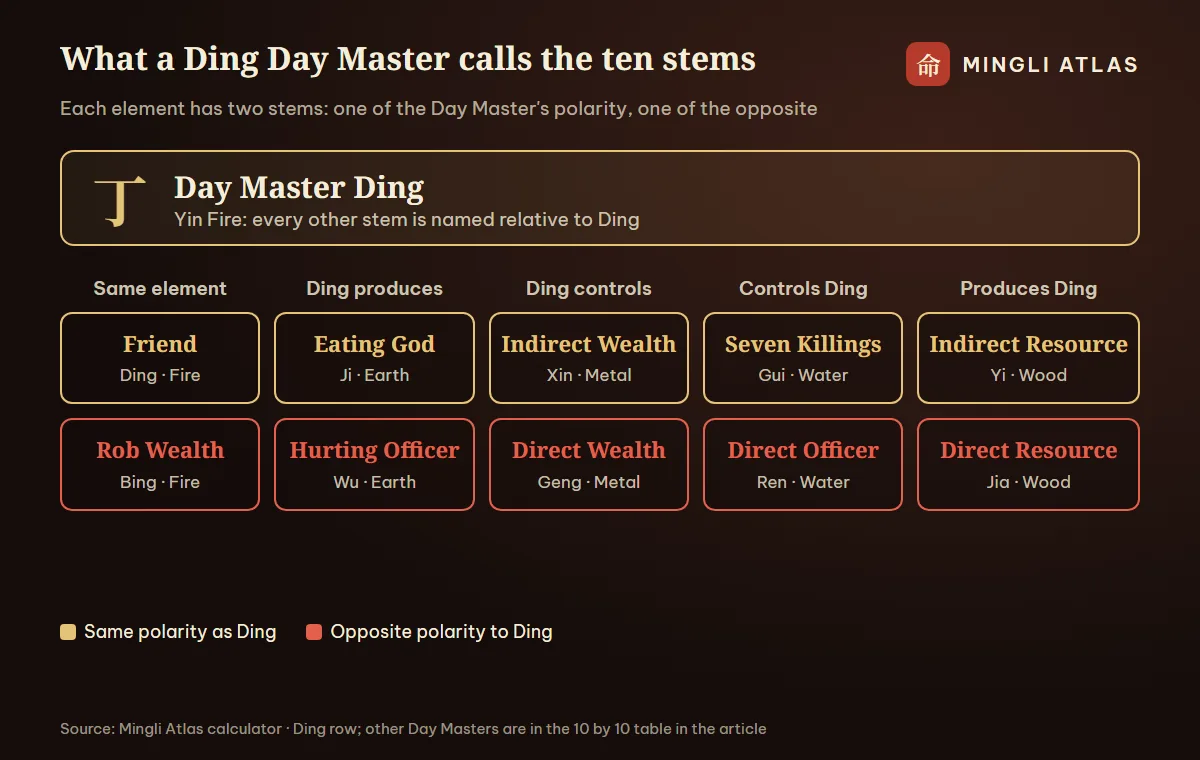
| Stem | Element, polarity | Relationship to Ding | Ten God |
|---|---|---|---|
| Ding | Yin Fire | Same element, same polarity | Friend |
| Bing | Yang Fire | Same element, opposite polarity | Rob Wealth |
| Ji | Yin Earth | Produced by Ding, same polarity | Eating God |
| Wu | Yang Earth | Produced by Ding, opposite polarity | Hurting Officer |
| Xin | Yin Metal | Controlled by Ding, same polarity | Indirect Wealth |
| Geng | Yang Metal | Controlled by Ding, opposite polarity | Direct Wealth |
| Gui | Yin Water | Controls Ding, same polarity | Seven Killings |
| Ren | Yang Water | Controls Ding, opposite polarity | Direct Officer |
| Yi | Yin Wood | Produces Ding, same polarity | Indirect Resource |
| Jia | Yang Wood | Produces Ding, opposite polarity | Direct Resource |
How to work through a whole chart, hidden stems included
Take the sample chart born at 08:00 on 25 March 2003 in Hanoi, with the four pillars Gui Wei, Yi Mao, Ding You and Jia Chen. The Day Master is Ding. Only the Day pillar’s own stem is left unnamed; the other visible stems and every hidden stem in the four branches get a Ten God. The hidden stems are listed in the order the calculator gives them; see the hidden stems guide for more.
| Pillar | Stem on the pillar | Branch and hidden stems |
|---|---|---|
| Year Gui Wei | Gui: Seven Killings | Wei hides Ji (Eating God), Ding (Friend), Yi (Indirect Resource) |
| Month Yi Mao | Yi: Indirect Resource | Mao hides Yi (Indirect Resource) |
| Day Ding You | Ding: Day Master | You hides Xin (Indirect Wealth) |
| Hour Jia Chen | Jia: Direct Resource | Chen hides Wu (Hurting Officer), Yi (Indirect Resource), Gui (Seven Killings) |
That is 3 visible stems other than the Day Master and 8 hidden stems, 11 positions in all. Counted by name:
| Ten God | Positions in the sample chart |
|---|---|
| Indirect Resource | 4 |
| Seven Killings | 2 |
| Direct Resource | 1 |
| Eating God | 1 |
| Friend | 1 |
| Indirect Wealth | 1 |
| Hurting Officer | 1 |
| Rob Wealth, Direct Wealth, Direct Officer | 0 each |
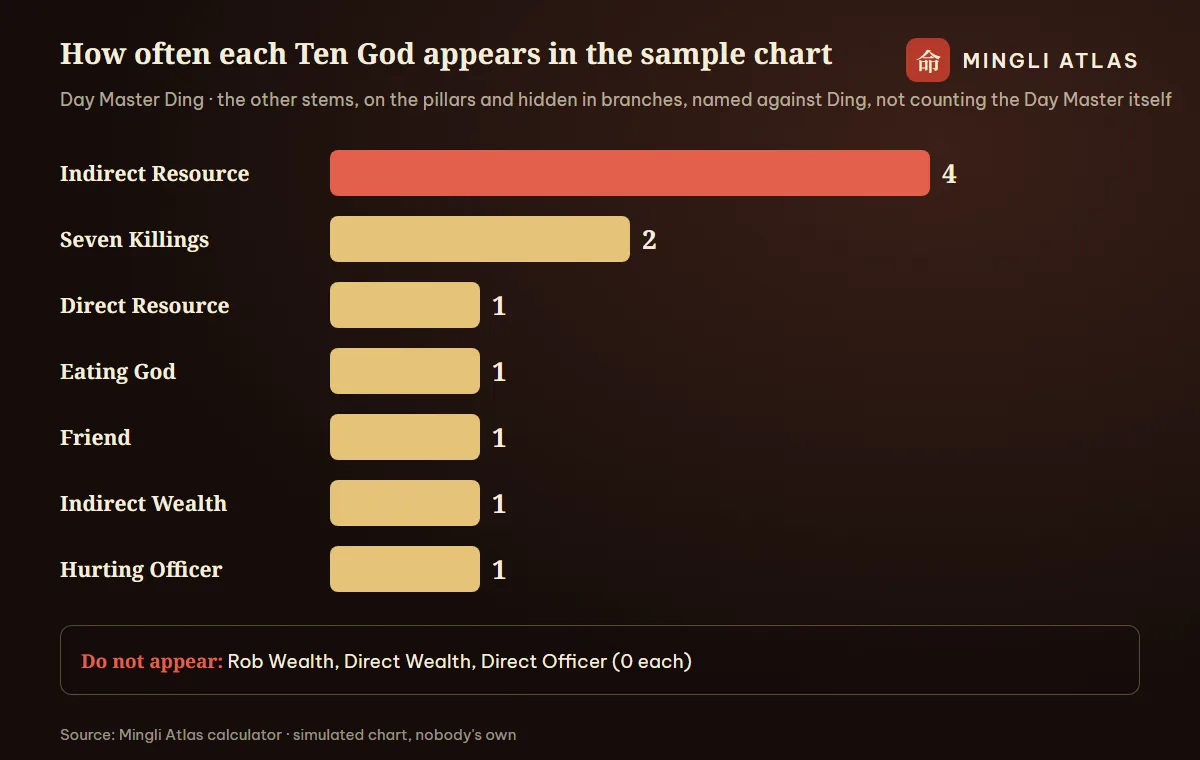
Indirect Resource appears four times because the stem Yi repeats in the Month pillar and in the three branches Wei, Mao and Chen. The Resource group (Indirect and Direct) takes 5 of the 11 positions. This is a position count to make the chart easier to see, not a verdict on whether the Day Master is strong or weak: that also needs the birth month and the roots, as in the strong or weak Day Master guide. A missing Ten God is not a flaw either; it only means no stem in the chart carries that name.
The full table: ten Day Masters by ten stems
Here are all 100 cells, calculated by the Mingli Atlas calculator. Each row is a Day Master and each column is a stem to be named. The Ding row matches the table above.
| Day Master | Jia | Yi | Bing | Ding | Wu | Ji | Geng | Xin | Ren | Gui |
|---|---|---|---|---|---|---|---|---|---|---|
| Jia | Friend | Rob Wealth | Eating God | Hurting Officer | Indirect Wealth | Direct Wealth | Seven Killings | Direct Officer | Indirect Resource | Direct Resource |
| Yi | Rob Wealth | Friend | Hurting Officer | Eating God | Direct Wealth | Indirect Wealth | Direct Officer | Seven Killings | Direct Resource | Indirect Resource |
| Bing | Indirect Resource | Direct Resource | Friend | Rob Wealth | Eating God | Hurting Officer | Indirect Wealth | Direct Wealth | Seven Killings | Direct Officer |
| Ding | Direct Resource | Indirect Resource | Rob Wealth | Friend | Hurting Officer | Eating God | Direct Wealth | Indirect Wealth | Direct Officer | Seven Killings |
| Wu | Seven Killings | Direct Officer | Indirect Resource | Direct Resource | Friend | Rob Wealth | Eating God | Hurting Officer | Indirect Wealth | Direct Wealth |
| Ji | Direct Officer | Seven Killings | Direct Resource | Indirect Resource | Rob Wealth | Friend | Hurting Officer | Eating God | Direct Wealth | Indirect Wealth |
| Geng | Indirect Wealth | Direct Wealth | Seven Killings | Direct Officer | Indirect Resource | Direct Resource | Friend | Rob Wealth | Eating God | Hurting Officer |
| Xin | Direct Wealth | Indirect Wealth | Direct Officer | Seven Killings | Direct Resource | Indirect Resource | Rob Wealth | Friend | Hurting Officer | Eating God |
| Ren | Eating God | Hurting Officer | Indirect Wealth | Direct Wealth | Seven Killings | Direct Officer | Indirect Resource | Direct Resource | Friend | Rob Wealth |
| Gui | Hurting Officer | Eating God | Direct Wealth | Indirect Wealth | Direct Officer | Seven Killings | Direct Resource | Indirect Resource | Rob Wealth | Friend |
Two regularities show up in the table. First, every row has all ten names exactly once, and over all 100 cells each name appears exactly 10 times. Second, the same stem gets different names under different Day Masters: Jia is Direct Resource to a Ding Day Master but Seven Killings to a Wu Day Master. So there is no “Jia is always a Resource” or “Geng is always an Officer”; you must know the Day Master first.
Do the Ten Gods come in reciprocal pairs?
Yes. If stem B is the Eating God of Day Master A, then A is the Indirect Resource of B, because the Eating God is the child and the Indirect Resource is the parent, the same link read from its two ends. The 100-cell table gives exactly six pairs, with no exception:
| A calls B | B calls A |
|---|---|
| Friend | Friend |
| Rob Wealth | Rob Wealth |
| Eating God | Indirect Resource |
| Hurting Officer | Direct Resource |
| Indirect Wealth | Seven Killings |
| Direct Wealth | Direct Officer |
A quick check: once you have named a stem, swap the two stems and name again. If the result is not the matching pair above, you have mixed up an element or a polarity somewhere.
How to read the Ten Gods once they are named
- Find the Day Master from the Day pillar, not from the Year pillar.
- For each visible stem, note its element and polarity and look it up in the table of five relationships.
- Open each branch for its hidden stems and name each one, in the order the chart lists them.
- Count the positions for every name and write down the names that are absent too, not just the loudest one.
- Read the meaning following how to read a BaZi chart, phrase it with “tends to”, and pick one concrete thing to try this week.
Common mistakes
- Naming stems from someone else’s Day Master or from one fixed stem instead of the chart’s own Day Master.
- Forgetting the hidden stems and naming only the four visible ones.
- Reading “Direct” as good and “Indirect” as bad, when they only mean opposite or same polarity as the Day Master.
- Swapping the same-polarity and opposite-polarity columns in the four rows of production and control.
- Drawing a conclusion from a Ten God appearing often or rarely before looking at the birth month.
A chart is a frame for reflecting on yourself, not a certain prediction. For how this site calculates and reads a chart, see the methodology, and for the Ten Gods of your own chart, calculate your BaZi chart.
Keep reading
From reading to your chart
See your own chart
Free BaZi and Zi Wei charts, read against the classical texts, with no email needed.